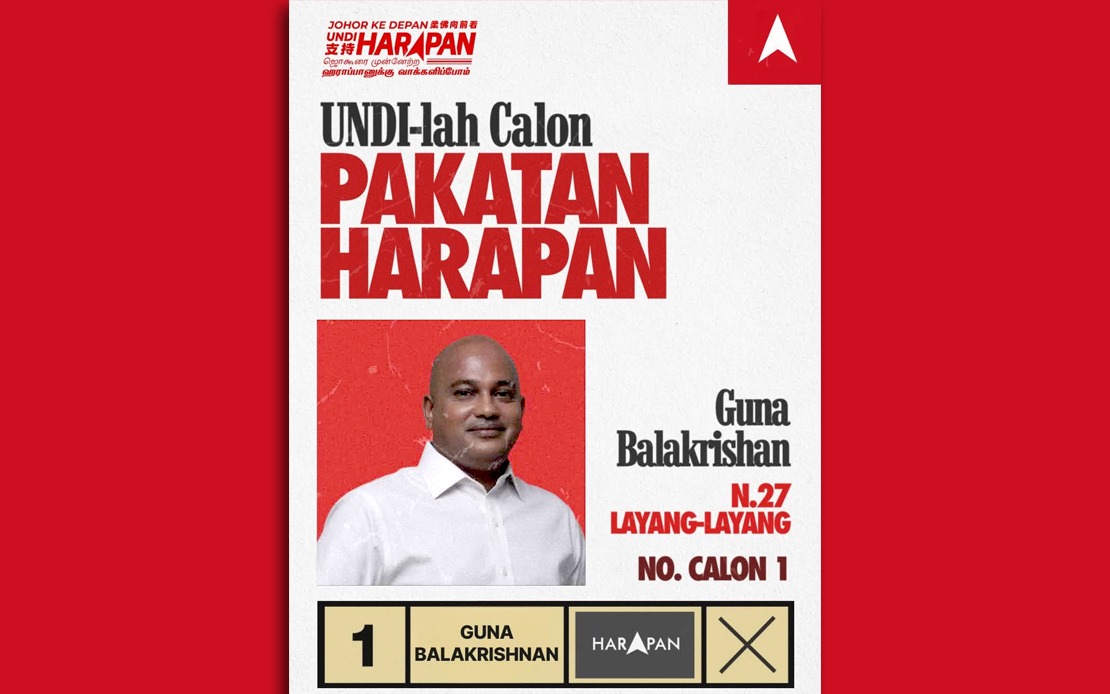
Guna Balakrishnan, the Pakatan Harapan candidate contesting the Layang-Layang state seat in the upcoming Johor election, has announced an ambitious development agenda centred on addressing longstanding community concerns and fostering inclusive growth across the constituency. Speaking in Kluang, the candidate presented six key policy pledges that he said represent genuine commitments rather than fleeting campaign rhetoric, directly responding to issues residents have raised over repeated rounds of state elections.
At the heart of Guna's platform lies a commitment to tackle chronic flooding that has devastated communities throughout the Layang-Layang area, with particular attention to vulnerable settlements including Kampung Senda, Sungai Sayong, Kampung Tengah Renggam, Ulu Benut, Simpang Renggam, and Kampung Chokro. Beyond temporary relief measures, his manifesto proposes systematic upgrades to drainage infrastructure and accelerated implementation of long-planned mitigation schemes, alongside dedicated maintenance regimes for roads and public facilities that have deteriorated through years of deferred upkeep. This focus reflects the reality that Johor constituencies, particularly in rural divisions, face recurring inundation during monsoon seasons, with insufficient state and local resources traditionally allocated to preventive infrastructure.
Complementing the flood agenda, Guna has identified deficits in basic public utilities as a second major pillar. He intends to expand street lighting coverage in underserved areas—a seemingly modest intervention that carries genuine implications for personal security, especially affecting evening commerce and social activities in villages. Simultaneously, he has flagged rural internet connectivity as a priority, recognising that digital access has become essential infrastructure for education, business, and market access. This acknowledgment positions him alongside other emerging voices in Malaysian politics who understand that rural development cannot proceed without closing the digital divide that has widened during the pandemic.
Economic empowerment constitutes the third dimension of his platform. Rather than pursuing large-scale industrial investment that rarely benefits constituencies of Layang-Layang's scale, Guna has opted to target small traders and micro-enterprises, sectors that traditionally employ a plurality of working-age residents. He has additionally proposed leveraging Renggam's tourism potential—a relatively underdeveloped asset in Johor's tourism hierarchy—as a pathway to sustainable income generation. This approach suggests recognition that development must work with existing community assets and human capital rather than imposing external models.
Youth engagement represents a fourth focus area, with Guna proposing substantial expansion of Technical and Vocational Education and Training opportunities. Beyond conventional TVET pathway promotion, he has committed to establishing a dedicated motorsports facility that provides structured outlet for youth energy whilst creating talent development pathways. This pledge speaks to a frustration evident across Malaysian constituencies where young people perceive limited pathways between secondary schooling and stable employment, with skills training often perceived as residual to academic progression. A motorsports track represents both recreational infrastructure and potential employment generation through facility management and competitive organisation.
Women's economic participation features as the fifth manifesto component, with explicit promises to strengthen entrepreneurship support mechanisms. Given that women constitute disproportionate percentages of informal traders and home-based businesses across rural Malaysia, targeted support could unlock significant economic activity. Similarly, Guna has proposed establishing a Senior Citizens Activity Centre—a PAWE facility—reflecting demographic realities in rural constituencies where ageing populations require structured engagement to maintain social connection and productive contribution to community life. These provisions indicate understanding that inclusive development encompasses age and gender dimensions often overlooked in conventional infrastructure planning.
Operationally, Guna has framed his entire approach around bridge-building between constituents and state government apparatus. He has committed to working alongside the Johor state administration, local authorities, and relevant agencies to translate manifesto promises into actionable policy. This positioning suggests awareness that a single state assemblyman, whilst politically significant, operates within constraints imposed by state budgets, federal transfers, and bureaucratic capacity. By emphasising collaborative governance, he implicitly acknowledges that delivery depends on bureaucratic execution and inter-agency coordination rather than individual political will alone.
The Layang-Layang contest presents a three-way competition that will shape Johor's state assembly composition. Guna faces Barisan Nasional candidate Chua Jian Boon and incumbent Abd Mutalip Abd Rahim, who represents Perikatan Nasional. With 25,181 registered voters, the constituency remains winnable for multiple political configurations, particularly if turnout patterns diverge from national tendencies. The July 11 election, with early voting scheduled for July 7, will determine whether voters prioritise continuity under PN, return to BN, or embrace PH's alternative platform.
Guna's manifesto reflects broader evolution in Malaysian opposition politics beyond Kuala Lumpur, where rural constituencies increasingly demand specific policy responses rather than abstract ideological positioning. His emphasis on flood management, rural infrastructure, youth skills training, and demographic-specific support suggests campaign research into genuine resident concerns rather than generic promises. Whether this translates into electoral advantage remains uncertain, particularly in constituencies where incumbency and machinery often outweigh individual candidate positioning. Yet the specificity and local grounding of his platform distinguishes it from earlier rounds of Johor electoral contests, indicating that state-level politics have shifted toward more granular development discourse.

