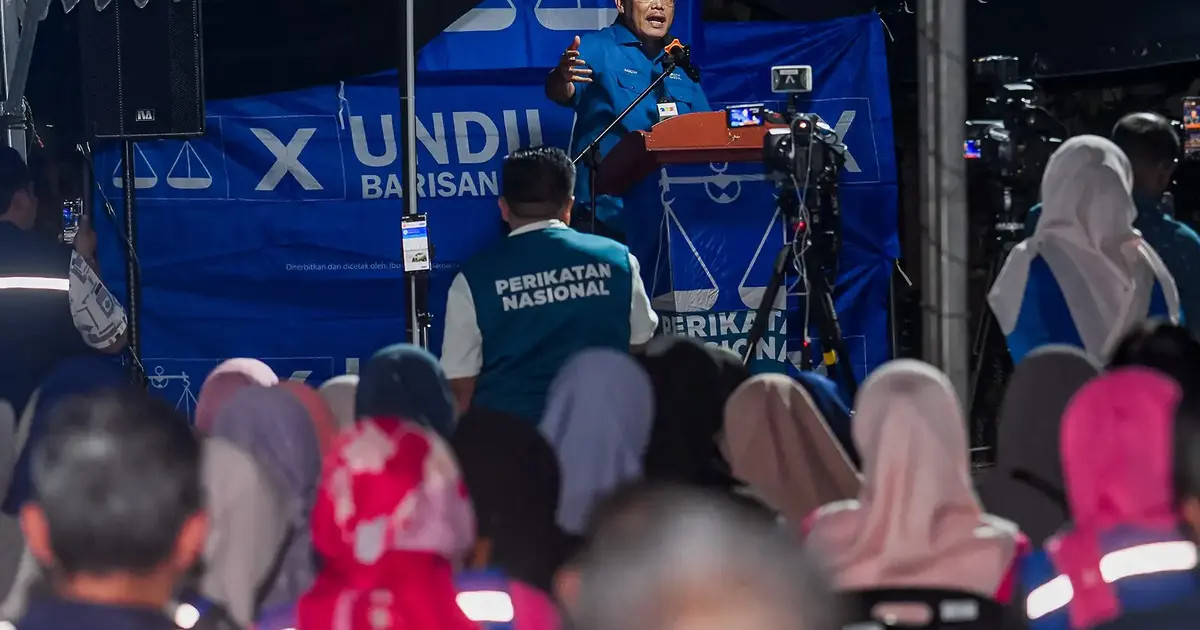
Perikatan Nasional president Hamzah Zain has proposed that the electoral coalition forged between PN and Barisan Nasional adopt the unified name 'Perikatan Barisan Nasional', marking a significant development in the two major political blocs' collaborative strategy ahead of the Negeri Sembilan state election scheduled for August 1. This nomenclature signals an attempt to present a cohesive political front to voters while maintaining the distinct identities of both coalitions within a broader alliance framework.
The naming proposal carries substantial implications for how the combined alliance will be marketed to the electorate and how governance responsibilities will be distributed following a potential electoral victory. Rather than presenting themselves as competing forces that have merely agreed not to contest against each other, the two coalitions are positioning themselves as a unified political entity. This branding approach reflects a shift toward emphasizing cooperation and consensus rather than the traditional adversarial dynamics that have characterised Malaysian political contests.
Crucially, the agreement reached between PN and BN includes a power-sharing arrangement whereby Barisan Nasional would assume the lead role in forming and managing the Negeri Sembilan state government should their combined slate secure victory at the ballot box. This settlement addresses one of the most contentious aspects of such electoral pacts—the division of spoils and the question of which coalition partner receives the chief minister's post and its attendant administrative authority. By ceding the primary executive role to BN, PN has made a calculated concession that apparently carries sufficient compensation or strategic advantage to justify accepting a secondary position in state administration.
The Negeri Sembilan election represents a critical test case for PN-BN collaboration in Malaysia's increasingly fractious political environment. The state has traditionally been a BN stronghold, though recent electoral patterns across the country have shown no political dominance is guaranteed. PN's willingness to accept a subordinate governmental role while securing the joint alliance nomenclature suggests the coalition values the symbolic and practical benefits of partnership over singular control of the state apparatus. For BN, securing PN's cooperation locks in a powerful electoral advantage that could prove decisive in a closely contested state race.
The creation of 'Perikatan Barisan Nasional' as a unified brand represents a departure from Malaysia's customary coalition politics, where alliances typically function as loose arrangements between distinct political entities rather than genuinely integrated movements. Historical precedent shows that such formal naming conventions help establish shared identity among coalition partners and can facilitate voter cohesion around a common platform. The label itself, combining the Malay words for 'alliance' and 'national', attempts to invoke both stability and broad-based legitimacy.
For Southeast Asian observers monitoring Malaysian political developments, this coalition arrangement illustrates the region's shifting dynamics as traditional political divisions become increasingly fluid. The collaboration between PN and BN, two coalitions that have frequently positioned themselves as alternatives to each other, underscores how electoral mathematics and the desire to achieve governing majorities can override ideological and historical rivalries. This pragmatism reflects the competitive pressures facing Malaysian politicians in a context where no single coalition commands overwhelming voter loyalty.
The power-sharing agreement also suggests a hierarchy within the coalition structure, with BN accorded the prestige and practical authority of state leadership while PN maintains influence through governmental participation. This arrangement differs from perfectly balanced coalitions where partners share executive responsibilities equally. BN's assumption of the chief minister position signals recognition of the coalition's comparative electoral strength or strategic bargaining power in negotiations. Whether this hierarchical arrangement satisfies PN's political ambitions or generates internal dissatisfaction among its members remains to be observed as the campaign progresses.
Negeri Sembilan holds particular symbolic weight in Malaysian politics, serving as a test case for innovative governance arrangements and coalition strategies. The state's compact size and relatively manageable voter population make it an ideal laboratory for experimenting with new political combinations before potentially scaling them to larger, more complex electoral contests. Success in Negeri Sembilan could encourage PN and BN to pursue similar arrangements in other states, fundamentally reshaping Malaysia's political landscape.
The August 1 election will determine whether voters embrace the 'Perikatan Barisan Nasional' concept as a viable governing alternative. Should the coalition win decisively, the arrangement would validate this collaborative approach and potentially encourage replication elsewhere. Conversely, an electoral setback might indicate voter scepticism toward what could be perceived as an artificial political construct lacking authentic grassroots support. The campaign period will reveal whether the unified branding can translate into tangible electoral advantages by consolidating coalition voters behind a common platform.
As the election approaches, the implications of this PN-BN pact extend beyond Negeri Sembilan's borders. The arrangement demonstrates that Malaysia's two primary political coalitions, despite fundamental differences, recognise mutual benefit in strategic cooperation against other political competitors. The 'Perikatan Barisan Nasional' brand represents more than nomenclature—it embodies a new chapter in Malaysian coalition politics where pragmatism supersedes traditional antagonism, establishing precedents that could reshape how political partnerships function throughout the nation's democratic system.

