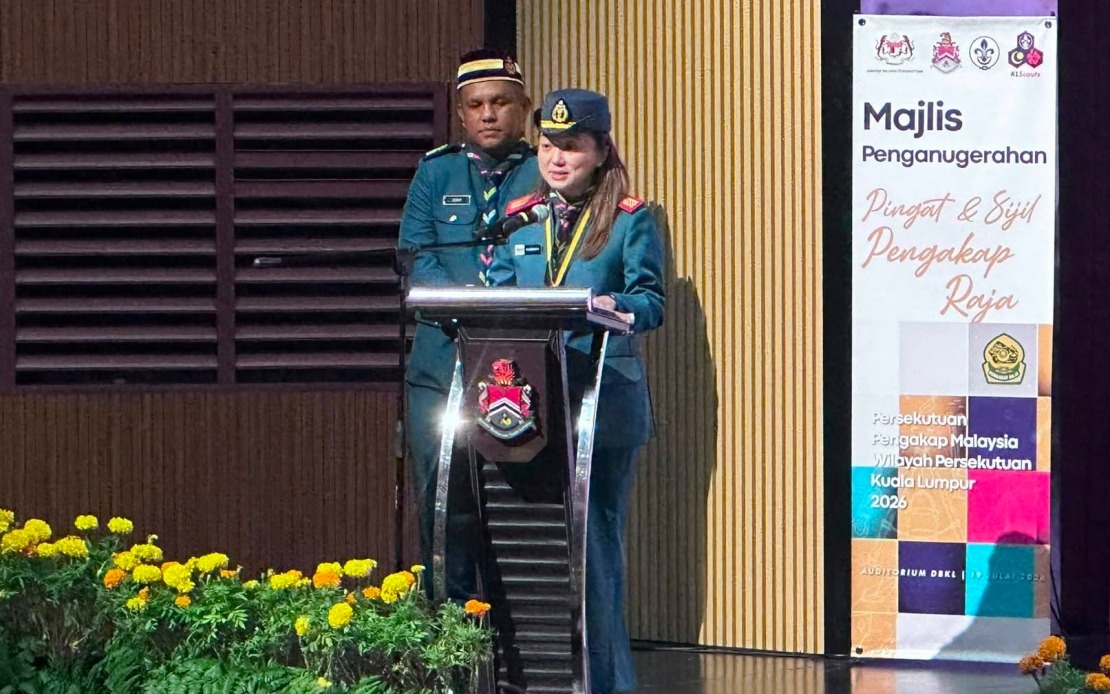
Hannah Yeoh, the Minister in the Prime Minister's Department responsible for the Federal Territories, has been appointed president of the Federal Territories State Scouts Council following a proclamation ceremony held at City Hall Auditorium in Kuala Lumpur on July 19. The elevation marks a significant institutional recognition of her commitment to youth development and community engagement across the nation's capital region. Running parallel to the ceremony was the 2026 Kuala Lumpur Federal Territory King's Scout Medal and Certificate Presentation Ceremony, which celebrated the achievements of scouts who have demonstrated exceptional dedication to the movement's core principles.
In a demonstration of her administration's backing for scouting initiatives, Yeoh announced an immediate ministerial allocation of RM20,000 to strengthen youth engagement throughout the Federal Territories. The funding allocation reflects a strategic investment in developing young leaders during their formative years, addressing both structured school holiday programmes and inclusive opportunities for youth who face barriers to participation. This financial commitment signals political acknowledgment that scouting organisations play a vital role in character development and national building efforts, particularly in an urban context where such structured youth engagement has proven increasingly valuable.
Duringher remarks at the ceremony, Yeoh outlined the dual-track approach to the funding distribution. An initial RM10,000 grant would support the Kuala Lumpur Federal Territory branch of the Scouts Association of Malaysia in designing and implementing enriched programmes specifically during school holidays when young people have extended availability. Recognising that access to scouting activities varies significantly among different socioeconomic groups, she subsequently enhanced the allocation by an additional RM10,000 directed specifically toward training programmes targeting youth who might otherwise lack opportunities to participate in mainstream scouting activities. This two-pronged strategy acknowledges systemic participation gaps and attempts to democratise access to youth development programmes across the Federal Territories.
The ceremony also saw Rosli Nordin, the Executive Director of Kuala Lumpur City Hall, proclaimed as chairman of the Kuala Lumpur Federal Territory State Scouts Council. This dual-leadership structure—combining ministerial and municipal administrative perspectives—positions the council to address both strategic policy direction and on-ground implementation of scouting programmes. The collaboration between Yeoh's ministry and DBKL reflects the institutional coordination necessary for scaling youth initiatives across an increasingly complex urban environment, where youth programming competes for limited civic space and resources.
Among the ceremony's highlights was the presentation of King's Scout Certificates, the pinnacle achievement within Malaysia's scouting hierarchy, to 58 deserving recipients. These individuals have navigated rigorous evaluation criteria spanning leadership capacity, technical skills acquisition, personal resilience, meaningful community contribution, and demonstrated commitment to the foundational Scout Promise and Scout Law. The King's Scout designation serves as official recognition of the recipients' transformation into principled young leaders equipped with both practical competencies and ethical frameworks necessary for constructive societal participation.
Beyond the prestige awards, Yeoh presented Chief Scout's Commendation Certificates to 75 scout leaders, acknowledging the mentorship and guidance these individuals provide to younger scouts. She additionally distributed Federal Territories Scouts Wangsa Certificates to 108 scout leaders, recognising their specialised contributions to institutional capacity. This tiered recognition system reinforces the hierarchical structure of achievement within scouting while celebrating the mentorship pipeline that sustains the movement across generations. The substantial number of adult recipients underscores the significant volunteer infrastructure supporting youth development in the Federal Territories.
The gathering attracted high-ranking figures within Malaysia's scouting and political establishment. Major General Datuk Prof Dr Mohd Zin Bidin, serving as Chief Scout of Malaysia, brought national-level perspective to the proceedings, while Tan Sri Johari Abdul, both a National Scout Council member and Speaker of Dewan Rakyat, represented the intersection of parliamentary leadership and scouting values. Such institutional convergence at the ceremony demonstrates that scouting maintains elevated status within Malaysia's national leadership circles, functioning not merely as a recreational organisation but as a recognised institution for cultivating national cohesion and ethical citizenship.
For Malaysian readers and Southeast Asian observers, this appointment and funding commitment carry broader implications regarding how urban societies integrate character development into youth policy. In Malaysia's context, where rapid urbanisation has occasionally strained traditional community bonding mechanisms, formalised scouting programmes operated through structured councils provide organised channels for civic participation and values formation. The Federal Territories, encompassing Kuala Lumpur, Labuan, and Putrajaya, represent the nation's administrative and political centre, making the health of youth development initiatives there symbolically significant for national governance narratives.
Yeoh's appointment as council president places her in direct advocacy for scouting within ministerial circles, potentially influencing federal-level youth policy beyond the territories. Her explicit financial commitment signals that contemporary government leadership recognises scouting's continued relevance despite the digital age and changing leisure patterns among Malaysian youth. The RM20,000 allocation, while modest in absolute terms, carries disproportionate significance as tangible evidence of political will—a signal that sustained institutional support exists for traditional youth development mechanisms that emphasise character, service, and community responsibility over passive consumption of entertainment.
The timing of this leadership transition and funding announcement occurs within Malaysia's broader context of youth development policy refinement. National frameworks addressing digital citizenship, mental health awareness, and inclusive participation have gained prominence in recent policy discourse, and scouting's structured emphasis on outdoor engagement, peer mentorship, and character-building activities positions the movement as a complementary mechanism within this evolving ecosystem. By elevating Yeoh's profile within the scouting hierarchy while simultaneously committing resources to inclusive programming, the Federal Territories administration articulates a vision of youth development that balances celebration of high achievement with deliberate expansion of opportunity to underrepresented populations.
Looking forward, the implications of this leadership change extend to considerations about how Malaysia's urban centres maintain civic vitality and institutional resilience. Scouting movements in developed democracies have historically served as incubators for democratic values and cross-communal solidarity, functions increasingly valued in plural societies navigating complex social cohesion challenges. The Federal Territories' enhanced investment in scouting, symbolised through ministerial patronage and budgetary commitment, suggests policy recognition that structured youth engagement remains strategically important for national stability and social integration objectives, even as Malaysian society experiences rapid technological and demographic transformation.

