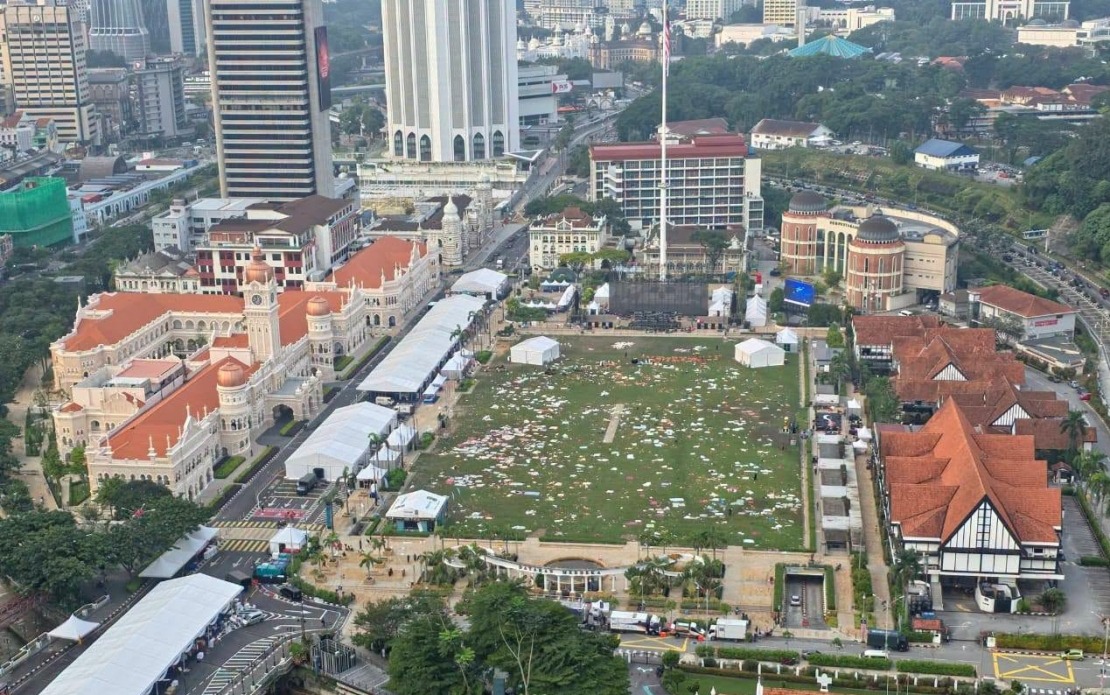
Federal Territories Minister Hannah Yeoh has acknowledged the substantial efforts made by Kuala Lumpur City Hall workers who undertook extensive cleaning operations at Dataran Merdeka after the venue became strewn with refuse during a public screening event for the 2026 FIFA World Cup final. The cleanup operation highlighted a broader national conversation about civic responsibility and the relationship between citizens and public institutions in maintaining shared spaces.
While commending DBKL's swift response and worker dedication, Yeoh seized the opportunity to articulate a more fundamental message about individual accountability within Malaysian society. She emphasised that although taxpayers rightly expect quality public services and government agencies must meet their obligations, the basic act of disposing rubbish properly should remain a personal responsibility rather than an additional burden placed upon already stretched municipal workers.
The minister's comments reflect growing concern among policymakers about the gap between public expectations and civic behaviour. Yeoh articulated this tension directly, noting that the right to access public services does not automatically translate into the right to shift all maintenance responsibilities onto government employees. Her statement underscores a distinction between government duty and individual behaviour—acknowledging that DBKL has fulfilled its obligations while challenging citizens to fulfil theirs.
Dataran Merdeka holds profound symbolic significance within Malaysia's national narrative. Beyond its function as an event venue, the space represents the nation's historical consciousness and embodies the dignity of Kuala Lumpur as the federal capital. Yeoh framed cleanliness and proper maintenance not merely as aesthetic concerns but as expressions of collective national pride and respect for shared heritage. This positioning elevates the litter issue from a simple sanitation matter to one touching upon how Malaysians regard their common spaces and cultural landmarks.
The minister connected her message to the Malaysia MADANI agenda, the government's development framework. She interpreted MADANI as extending beyond physical infrastructure and economic metrics to encompass the quality of civic engagement and how citizens conduct themselves within public life. This framing suggests that national progress cannot be measured solely through construction projects or GDP figures, but must include intangible elements such as public behaviour, environmental consciousness, and communal respect for shared assets.
Yeoh's intervention aligns with recent statements from Prime Minister Datuk Seri Anwar Ibrahim, who has similarly contended that a nation's true advancement reflects not only in its buildings and development projects but in the character and conduct of its people. This philosophical alignment within government leadership indicates a coordinated push to reframe what national development means, particularly among younger generations and urban populations accustomed to viewing progress primarily through economic lenses.
The practical implications of this messaging carry particular weight in Kuala Lumpur, where increasingly large public gatherings and events place considerable strain on municipal infrastructure and sanitation systems. The Dataran Merdeka incident represents one visible manifestation of a pattern seen across Southeast Asian capitals, where rapid urbanisation and mass public engagement with shared spaces sometimes outpace the development of corresponding civic consciousness. The challenge facing Malaysia is whether messaging alone can reshape behaviour, or whether structural interventions—such as enhanced waste management infrastructure or modified event management protocols—become necessary.
From a Malaysian perspective, Yeoh's comments resonate against the backdrop of ongoing discussions about the quality of public services and government accountability. Opposition voices have frequently critiqued municipal performance, particularly regarding cleanliness and maintenance standards in urban areas. By directly praising DBKL's efforts while simultaneously calling for public responsibility, Yeoh attempts to position government as responsive and efficient while redirecting some accountability toward citizens themselves. This rhetorical strategy aims to deflect criticism while building a narrative of shared investment in urban quality.
The Dataran Merdeka cleanup also serves as a microcosm for broader Southeast Asian urban challenges. As the region's cities host increasingly large-scale international events and sporting spectacles, the question of how public spaces are maintained during and after such occasions becomes strategically important. For Malaysia, which aspires to position itself as a regional hub for international events and gatherings, the image of responsible public behaviour and well-maintained venues carries diplomatic and economic implications that extend beyond local civic virtue.
Yeoh's invitation for Malaysians to treat public spaces as shared responsibility draws on an implicit social contract model of governance. Rather than viewing relationship between state and citizen as primarily transactional—citizens pay taxes, government provides services—she proposes a reciprocal framework where both parties maintain obligations. Citizens should pay taxes and maintain public spaces responsibly, while government should ensure efficient service delivery. This articulation suggests a philosophical shift in how the administration wishes to frame governmental legitimacy.
The effectiveness of such messaging depends heavily on cultural receptivity and institutional reinforcement. In Malaysia's multicultural context, appeals to shared national pride and collective stewardship of public spaces can transcend communal boundaries, potentially building consensus around civic behaviours. However, sustained behavioural change typically requires not only moral persuasion but also consistent institutional practices, enforcement mechanisms, and visible consequences for non-compliance. Cleaning campaigns alone, without complementary approaches, often produce temporary improvements rather than lasting transformation.
Looking forward, the incident provides an opportunity for Malaysian authorities to examine whether current public education campaigns adequately cultivate civic consciousness among residents and visitors. The success of Yeoh's appeal will ultimately be measured not through statements but through observable changes in public conduct at Dataran Merdeka and other shared spaces. Whether this represents a turning point in Malaysian urban civic behaviour or remains a momentary intervention remains to be seen, but the conversation itself signals that government leadership recognises cleanliness and public responsibility as issues worthy of ministerial attention.

