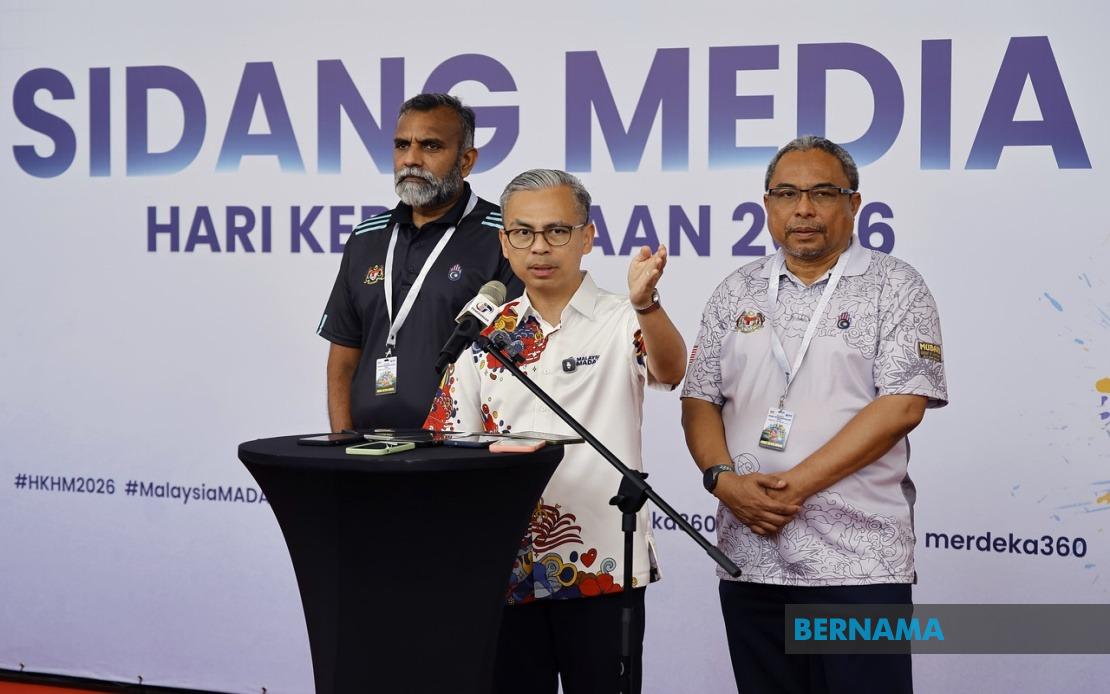
Celebrations marking Malaysia's 2026 National Day at Dataran Putrajaya this week will unfold under cloud-management protocols, with authorities urging visitors to adopt respiratory protection against the persistent haze blanketing the region. Communications Minister Datuk Seri Fahmi Fadzil, steering the main organising committee for the National and Malaysia Day festivities, has advised attendees—particularly vulnerable populations—to consider wearing N95 masks as a precaution aligned with directives from the Health Ministry.
The scale of preparation underscores organisers' determination to sustain public confidence in the event despite environmental headwinds. Beyond advisory notices, the committee has moved to distribute more than 10,000 N95 masks directly to scheduled participants, framing the measure as a protective initiative rather than a mandatory requirement. Fahmi emphasised during a press briefing following the full-scale dress rehearsal that mask-wearing remains voluntary, reflecting Malaysia's approach of balancing caution with individual choice—a stance that sidesteps the kind of restrictions that triggered public friction during earlier pandemic phases. Parents accompanying young children and individuals with pre-existing respiratory conditions such as asthma have been specifically encouraged to carry their own masks, signalling that organisers recognise differentiated risk profiles among the crowd.
The Health Ministry's stationing of medical personnel across multiple sites throughout the venue represents a parallel layer of contingency planning. These clinical teams, positioned strategically to respond to emergencies and health complications, will handle cases ranging from haze-related respiratory distress to other acute medical incidents. Early reports suggest this infrastructure is functioning as designed, with no significant incidents reported from the preparatory phase. The redundancy built into medical coverage demonstrates organisers' anxiety about potential system failures during a high-profile national event where crowds may swell into tens of thousands and media scrutiny will intensify.
The National Day rehearsal itself proceeded without notable complications, validating much of the logistical architecture put in place. The apparent smoothness of the dry run carries particular weight given the scale of coordination required to choreograph ceremonial elements whilst managing environmental and health variables. Such rehearsals serve Malaysia's tradition of public ceremonialism as both dress-test and confidence-building exercise, signalling to international observers and domestic audiences alike that proceedings will unfold with competence and order.
Media infrastructure for the event has expanded substantially, with 823 journalists accredited compared to roughly 600 a year prior. This 37 per cent surge reflects either intensifying international or domestic journalistic interest in Malaysia's founding celebrations or deliberate efforts by authorities to expand media participation. Fahmi's confidence that internet connectivity will prove sufficient this year—a direct contrast to presumed difficulties in previous iterations—suggests telecommunications planners have addressed technical bottlenecks that previously hamstrung real-time coverage. The Malaysian Communications and Multimedia Commission, working through its Network Monitoring Centre and coordinating with telecom service providers, has installed additional communications hardware across 102 celebration venues to ensure streaming and transmission capabilities meet demand.
From a security posture, the Royal Malaysia Police have reported no incidents of concern as of the briefing date, with public order being maintained across preparation phases. This absence of flagged threats reflects either successful preventive policing or straightforward absence of credible concerns—both outcomes satisfactory to event planners. The communications ministry's willingness to highlight security stability suggests authorities view the threat environment as manageable, likely underpinned by intelligence assessments and conventional security measures rather than extraordinary restrictions.
The haze advisory, whilst seemingly routine, carries deeper significance for Southeast Asia's seasonal air quality challenges. Malaysia has long contended with transboundary pollution, particularly during dry seasons when agricultural burning in Indonesia drifts across the Strait of Malacca. The decision to proceed with celebrations whilst issuing health guidance represents pragmatic acceptance that environmental conditions may be suboptimal but not prohibitive. This stance contrasts with scenarios in which air quality indices have triggered event postponements or venue relocations in previous years.
For Malaysian residents and international visitors planning attendance, the parallel messaging—proceed but protect—frames the event as occurring within normal parameters, albeit ones that necessitate modest precautionary steps. The voluntary masking approach aligns with contemporary public health communication preferences that avoid perceived heavyhandedness whilst signalling institutional awareness of environmental stressors. Parents and individuals with health vulnerabilities now possess sufficient information to make informed decisions about attendance or protective measures.
The expanded media accreditation signals confidence in the event's profile and likely reflects government interest in amplifying coverage of national identity narratives and ceremonial pageantry. In Malaysia's media landscape, where certain outlets receive preferential access and others labour under implicit constraints, the overall number of journalists admitted provides a rough gauge of authorities' appetite for scrutiny and narrative diversity. The emphasis on improved internet access suggests organisers view digital distribution as critical to reaching audiences beyond the immediate venue and across Southeast Asia.
Operationally, this year's celebration appears to incorporate lessons from previous iterations, with redundancy built into medical response, communications infrastructure scaled upward, and media participation expanded. The haze management protocol—advisory rather than prohibitive—reflects evolving public health frameworks that acknowledge environmental realities without surrendering to them. For Malaysia, hosting major ceremonial events whilst navigating air quality challenges has become a recurring fixture of seasonal planning, embedding resilience into national calendars even as the underlying environmental drivers remain unresolved across the region.

