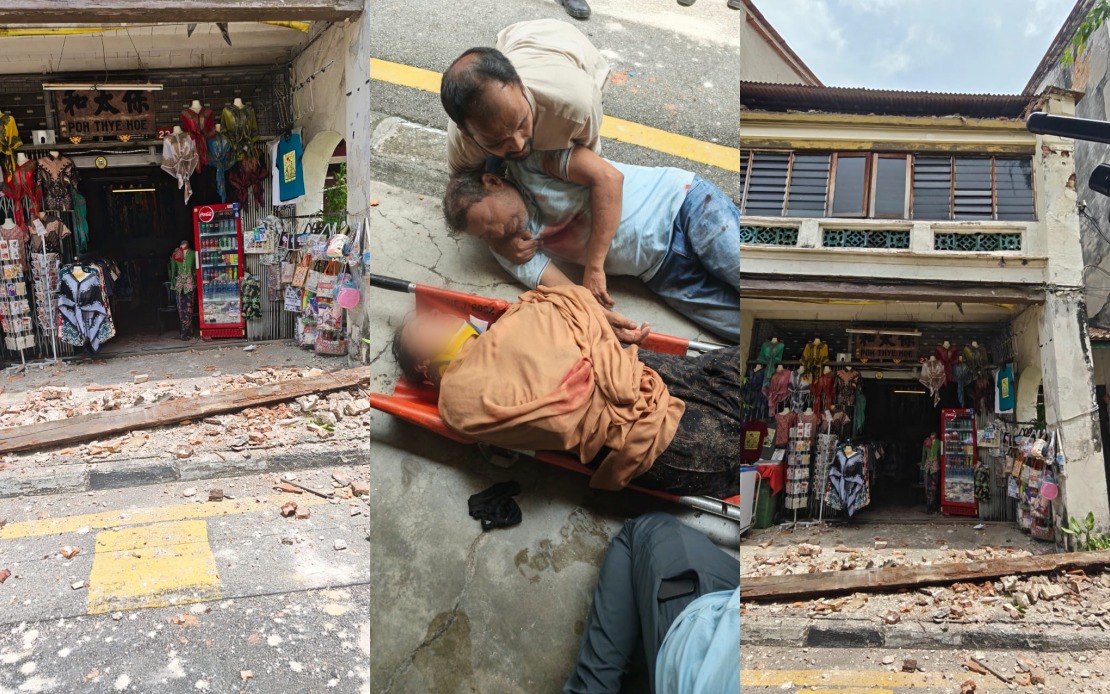
A sudden structural incident at one of George Town's heritage buildings has raised serious questions about the condition of the historic district's ageing properties. Two Sri Lankan tourists, identified as Mohamad Ammtar, aged 66, and Fatimah, aged 55, sustained injuries after debris from an upper-floor beam collapsed onto them along Armenian Street, a major drawcard for visitors to the Penang World Heritage site. Emergency services received the distress call at 1.11 pm, and firefighters from Lebuh Pantai Fire and Rescue Station swiftly attended the scene, with both casualties receiving initial medical attention before being transported to Penang Hospital for further assessment and treatment.
The debris that caused the incident consisted of sizeable stones and timber fragments from a first-floor structural beam, demonstrating the hazard posed by deteriorating building fabric in high-traffic areas. The unfortunate timing for the pair added another layer of concern—the two tourists had been scheduled to return to Sri Lanka the following day, meaning their holiday plans were severely disrupted. The building itself had mixed usage, with a grocery business operating from the ground floor while the upper floor stood vacant, suggesting that ongoing maintenance or oversight may have been limited.
The incident has triggered an immediate policy response from Penang's state government. Wong Hon Wai, chairman of the State Tourism and Creative Economy Committee, visited the scene and subsequently announced that both the George Town World Heritage Incorporated entity and the Penang City Council would be tasked with communicating mandatory safety advisory notices to all heritage building proprietors throughout the state. His remarks underscored a critical vulnerability in the carefully preserved district: the structural integrity of buildings, some dating back centuries, cannot be taken for granted despite their cultural and historical significance.
Wong emphasised that the scope of concern extends far beyond the single building involved in today's mishap. Heritage and older structures across George Town must now undergo thorough inspections to verify their safety standards, he stressed. The underlying anxiety is understandable—pedestrians and international visitors constantly move through these narrow streets and colonial-era premises, and any structural failure poses substantial risks to public welfare. The committee chairman's pointed remarks reflected the government's recognition that heritage preservation must be balanced with immediate structural safety obligations to living people.
For Malaysia's tourism sector, particularly in Penang, the incident carries uncomfortable implications. George Town attracts significant numbers of international visitors annually, and heritage tourism represents a cornerstone of the state's economic strategy. Events like this can inadvertently damage the destination's reputation if perceptions develop that heritage areas are unsafe or poorly maintained. The swift official response—including the commitment to coordinate support with the Sri Lankan High Commission in Kuala Lumpur—suggests authorities are acutely aware of the diplomatic and commercial sensitivities at stake.
The state government has committed to investigating the root causes of the structural failure while simultaneously extending assistance to the injured tourists. This dual approach reflects an understanding that both immediate crisis management and longer-term prevention mechanisms must be addressed. A comprehensive investigative report from relevant authorities will determine whether the collapse resulted from natural deterioration, poor maintenance practices, inadequate renovation work, or some combination thereof.
George Town's World Heritage status, conferred in 2008, places special responsibility on stakeholders to maintain standards befitting the designation. The historic district comprises hundreds of buildings spanning multiple centuries, many constructed using traditional methods and materials that, while architecturally distinctive, may require specialised maintenance and monitoring. The financial resources and technical expertise required to systematically assess and remedy structural deficiencies across such a large inventory present genuine challenges for property owners, municipal authorities, and heritage preservation bodies.
This incident will likely catalyse broader discussion about funding mechanisms for heritage building maintenance and the appropriate division of responsibility between private owners, municipal governments, and tourism authorities. Southeast Asian heritage destinations frequently grapple with this tension: balancing conservation aspirations with the practical realities of maintaining aging structures that continue to serve commercial, residential, and public functions. Malaysia's experience in George Town may provide valuable lessons for other regional heritage sites facing similar pressures.
The immediate consequence will be heightened scrutiny of building safety across the heritage zone, potentially affecting business operations if proprietors are required to undertake significant remedial work. However, the longer-term benefit—preventing further injuries and ensuring the sustainable use of these culturally important buildings—clearly justifies the temporary inconvenience. Property owners who have deferred maintenance obligations may now find themselves under regulatory pressure to act, making this an inflection point for how comprehensively George Town's architectural heritage is preserved and safeguarded.

