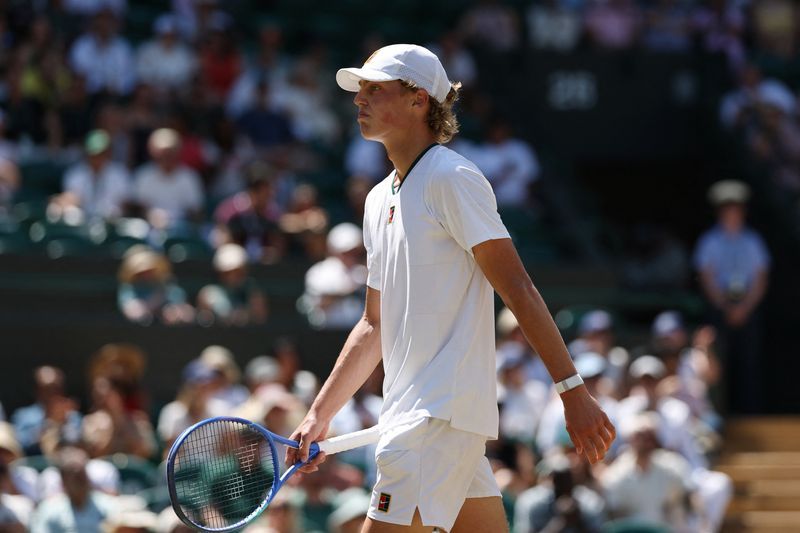
Seventeen-year-old Cruz Hewitt, the son of Australian tennis legend Lleyton Hewitt, has announced his arrival on the professional tennis circuit with a commanding first-round victory at the Washington Open. Playing as a qualifier in the ATP 500 event, the young Aussie dispatched American Marcos Giron 6-3 6-4 in a dominant performance that signals his rapid ascent through the rankings. The win represents a watershed moment for the teenager, who entered the tournament ranked 612 in the world and now stands on the brink of securing matches against some of the sport's elite players.
The timing of Cruz's breakthrough carries particular significance given his family's deep connection to the Washington tournament. His father, a former world number one, captured the event's title in 2004, and the younger Hewitt grew up attending matches at the venue. In his post-match comments, Cruz acknowledged the emotional resonance of achieving this milestone at a venue so intertwined with his family's sporting history, describing the experience as "surreal." This convergence of personal legacy and individual achievement speaks to the unique pressures and privileges that come with being the child of a tennis icon.
Cruz's exceptional summer has already generated considerable buzz within tennis circles well before this Washington triumph. Just weeks earlier, the teenager reached the Wimbledon boys' final, where he finished as runner-up to American Jordan Lee. That performance at the Championships came nearly twenty-five years after his father claimed the men's singles title at the same venue, establishing a poignant bookend to the family's illustrious association with the tournament. The juxtaposition underscores both the continuity of Hewitt family excellence and the distinct path that Cruz is carving for himself.
By securing victory at Washington, Cruz joined an increasingly exclusive cohort of exceptionally young competitors breaking through at tour level. He became the fourth male player born in 2008 or later to record an ATP-level win, following Diego Dedura, Thijs Boogaard, and Moise Kouame. More impressively, his victory made him the youngest player to triumph at the Washington event since Japan's Kei Nishikori achieved the feat in 2007, a distinction that underscores the rarity of teenage success at this level of professional tennis. The achievement carries weight not merely as a statistical accomplishment but as evidence of genuine competitive capability against seasoned professionals.
Cruz's composed demeanour throughout the match and his measured approach to managing the psychological demands of professional tennis suggest maturity beyond his years. In his own analysis of the contest, he reflected on the advice his father imparted, which centred on perspective and process rather than outcome. Lleyton counselled his son to savour the experience, to concentrate on executing points individually, and to harness the energy of the crowd rather than viewing it as an additional burden. This emphasis on enjoyment and minute-by-minute focus represents a philosophy distinct from the outcome-obsessed mentality that sometimes characterises young competitive athletes.
The teenager's ability to acknowledge pressure whilst simultaneously channelling it constructively reveals psychological sophistication that bodes well for his future development. Rather than denying nervousness or attempting to suppress it entirely, Cruz framed tension as a manageable element of the competitive environment, one that he could transform into positive motivation. This nuanced understanding of mental resilience suggests that his father's mentorship extends well beyond technical tennis instruction into the equally crucial domain of psychological preparedness.
Cruz now advances to a second-round encounter against either Greek star Stefanos Tsitsipas or fellow Australian Alex de Minaur, a prospect that generates distinctly different implications for the young player. A potential clash with de Minaur carries particular resonance in Cruz's mind, as the two have maintained a close personal relationship since childhood. De Minaur, who has achieved substantial success on the professional circuit, has functioned almost as an older brother to Cruz and has visited the Hewitt family home during holiday periods. The prospect of competing against someone for whom he harbours genuine affection and admiration introduces an intriguing layer of emotional complexity to what would otherwise be a straightforward professional tennis match.
For Malaysian and broader Southeast Asian tennis enthusiasts, Cruz's emergence represents the continued vitality of Australian tennis and the enduring competitive advantages that the nation's depth of coaching infrastructure and talent development systems provide. While Southeast Asia has produced accomplished players, the consistent ability of Australian teenagers to compete at elite levels reflects systematic investment in junior development programmes and a tennis culture that prioritises both competitive excellence and player welfare.
The narrative arc of the Hewitt family also carries broader implications for succession and legacy in professional sports. Rather than viewing his father's achievements as an insurmountable standard or a burden from which to escape, Cruz appears to have integrated his father's experience as a resource and inspiration. This balanced relationship between familial legacy and individual ambition represents a model that might resonate with other second-generation athletes navigating the complex psychology of following in the footsteps of sporting icons. As Cruz progresses through the tournament and beyond, his trajectory will offer valuable insights into whether teenage promise can evolve into sustained professional success in an increasingly competitive landscape.

