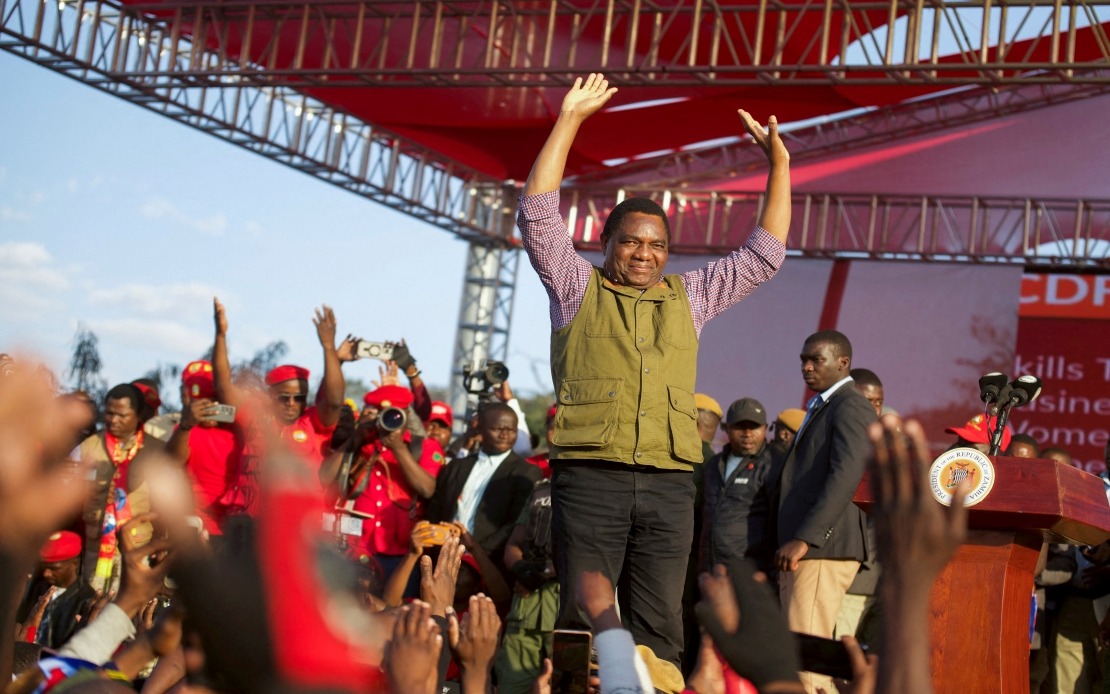
Zambian President Hakainde Hichilema is moving decisively towards a second term in office after securing a commanding advantage in the country's presidential election held over the weekend. With results announced at the National Election Results Centre in Lusaka, the 64-year-old economist and rancher has amassed 1,544,140 votes from 135 of 226 constituencies that have been counted and reported by the Electoral Commission of Zambia. This substantial tally, representing roughly one-third of the nation's voting constituencies, suggests a trajectory toward victory in what would cement his hold on power following his initial landslide success three years ago.
Hichilema's performance in this election reflects the continued backing of voters under the United Party for National Development banner, the party through which he first captured the presidency in 2021. His current front-runner position stands in marked contrast to the challenge mounted by his closest rival, Brian Mundubile, who represents the National Reconciliation Party for Unity and Prosperity. The 55-year-old lawyer has accumulated 1,030,662 votes from the same set of constituencies, placing him significantly behind the incumbent by a margin exceeding 500,000 votes. This gap proves substantial enough that barring an unprecedented reversal in the remaining constituencies yet to report, Mundubile appears unlikely to overtake Hichilema even as final tallies emerge.
The electoral contest featured 13 candidates vying for the presidency, yet the competition has effectively centered on these two frontrunners. Mundubile's opposition alliance has nonetheless demonstrated electoral strength in specific regions, particularly in Zambia's urbanized territories stretching through Lusaka and the Copperbelt mining region, which are economically vital zones. Such geographic concentration of opposition support suggests that while Hichilema commands broader national appeal, significant pockets of the electorate remain skeptical of his administration's direction, particularly in areas where mining interests and urban employment patterns shape voter priorities.
For Hichilema, validation through a second-term victory carries particular significance given the economic challenges he inherited and the reform agenda he has pursued since 2021. The president has emphasized his administration's success in restructuring what he characterizes as excessive national debt, a pressing concern for a nation whose fiscal stability directly affects its ability to invest in public services and infrastructure. His government has also pointed to revival efforts in the mining sector, which remains the backbone of Zambia's economy and export earnings. These economic initiatives have been complemented by expanded social programs, most notably the introduction of free education spanning primary and secondary levels in public institutions, a benefit affecting millions of Zambian families.
The constitutional framework governing Zambian elections establishes that a winning candidate must secure more than 50 percent of valid votes cast to claim the presidency outright. Should no candidate achieve this threshold in the initial count, a runoff election between the top contenders would be triggered. Given Hichilema's substantial current lead and the still-incomplete nature of the count, the possibility of a second ballot remains technically open, though the margins suggest he is likely tracking toward the required majority threshold even accounting for variations in turnout and vote distribution across remaining constituencies.
Zambia's electoral architecture and the conduct of this contest carry implications that extend beyond the country's borders, particularly for the Southern African Development Community region and for democratic governance across the continent more broadly. Elections in major African economies often serve as barometers for institutional strength and the durability of democratic competition, especially when incumbents seek renewal of their mandates. The relative smoothness of the voting process and the transparent reporting of results through the Electoral Commission of Zambia demonstrate institutional capacity that supports confidence in the outcome, contrasting with electoral crises witnessed in some neighboring states.
Hichilema's trajectory from his 2021 victory to this apparent second-term triumph reflects both personal political acumen and the effectiveness of his party's organizational machinery. His background as an entrepreneur and agricultural investor has informed his economic messaging, positioning him as a figure invested in private sector dynamism alongside state-led development. This combined appeal has resonated across diverse constituencies, enabling him to maintain momentum despite the inevitable criticisms that accompany any administration overseeing significant economic restructuring and adjustment programs.
The opposition's performance, while trailing substantially, merits examination within Zambia's broader political context. Mundubile's showing in urban centers suggests that discontent with specific policies or concerns about the pace of economic improvement remain real grievances for portions of the electorate. Urban voters, particularly younger citizens seeking employment opportunities, may harbor doubts about whether the government's mining sector revival and educational investments translate into tangible job creation and upward mobility. These constituencies will likely remain sources of political contestation in Zambia's post-election landscape regardless of the final presidential outcome.
The consolidation of results by Electoral Commission of Zambia Chairperson Mwangala Zaloumis continued through Sunday evening, with the announcement coming at 2130 GMT. The methodical, public reporting of tallies from constituencies as they are counted and verified reflects institutional procedures designed to build confidence and transparency in the process. This approach contrasts sharply with approaches adopted in some regional contexts where results are announced in batches or where transparency concerns have generated disputes over electoral legitimacy.
For regional observers, particularly those in Southeast Asia monitoring electoral trends, Zambia's experience offers instructive lessons about managing incumbent re-election campaigns in resource-dependent economies facing debt pressures and fiscal constraints. The intersection of economic reform, social spending expansion, and political durability presents a familiar challenge in developing democracies. How Hichilema navigates a second term while maintaining the reform momentum he has established will provide crucial data on whether the electoral coalition supporting him can be sustained through subsequent cycles of economic adjustment and social demand.

