The Lebanese militant organization Hizbollah has moved to block any prospect of an Israeli security zone in southern Lebanon, with party chief Naim Qassem publicly opposing the arrangement in response to Israeli Prime Minister Benjamin Netanyahu's recent insistence that his country's forces would maintain their position for an extended period. This declaration represents a significant hardening of rhetoric from Hizbollah at a moment when the region faces mounting instability from cross-border hostilities that have intensified over recent months.
Netanyahu's commitment to maintain an Israeli military foothold in Lebanese territory reflects Jerusalem's stated security concerns regarding militant activities emanating from the south. The Israeli government has framed such a presence as essential to preventing attacks launched against Israeli communities near the border. However, the assertion that troops would remain indefinitely contradicts earlier diplomatic messaging suggesting any occupation would be temporary in nature, complicating efforts by international mediators to broker a sustainable resolution.
Qassem's unequivocal rejection carries particular weight given Hizbollah's military capability and the organization's historical role in shaping outcomes along the Israel-Lebanon border. The group's refusal to countenance a permanent or semi-permanent Israeli military zone signals that any attempt to formalize such an arrangement would likely provoke armed confrontation. This stance reflects broader Lebanese national sentiment opposing foreign military occupation, a principle enshrined in the country's constitution and international agreements governing Lebanese sovereignty.
The disagreement over a security zone touches on fundamental questions about territorial integrity and regional power balance. A formalized Israeli military zone in southern Lebanon would constitute a de facto partition of Lebanese sovereignty in that region, setting precedent for other external powers to demand similar territorial accommodations. For a country already struggling with state fragmentation and the presence of multiple armed groups, such an arrangement would further undermine central government authority and complicate reconstruction efforts.
Historical context illuminates why this particular issue generates such visceral opposition within Lebanon. Previous Israeli military interventions in Lebanese territory, most notably the 1982 invasion and subsequent occupations lasting into the 2000s, left deep scars on Lebanese society and contributed to the rise of Hizbollah itself. Lebanese citizens across sectarian lines view renewed Israeli military presence with considerable apprehension, viewing it as a potential revival of past conflicts that devastated civilian infrastructure and displaced hundreds of thousands.
The timing of Netanyahu's statement appears strategically designed to signal resolve to Israeli voters and international allies regarding border security. However, the declaration risks undermining any ongoing diplomatic channels between Israel and Lebanon. Regional and international mediators have attempted to negotiate ceasefires and agreements that would establish buffer zones and reduce cross-border incidents without requiring permanent foreign military occupation. Netanyahu's language suggests Israel may be moving away from such negotiated frameworks toward unilateral security arrangements.
Southeast Asian observers should note the broader implications of this dispute for regional stability and international law. The rejection of Israeli security zones in Lebanon reinforces the principle that unilateral military occupation, however framed in security terminology, faces resistance from affected populations and neighboring states. This principle carries relevance across Asia, where maritime disputes and border tensions occasionally generate pressure for similar arrangements.
Hizbollah's position also reflects complex domestic Lebanese politics, where the organization commands significant parliamentary representation and military resources. The group's categorical rejection serves multiple audiences: reassuring its Shia constituency that it will not compromise on sovereignty, maintaining credibility as a resistance movement, and signaling to other Lebanese political factions that national interests should supersede sectarian considerations regarding Israeli encroachment.
The standoff illustrates how military occupation, regardless of stated defensive purposes, generates long-term strategic competition rather than stability. Israeli security concerns regarding border attacks are legitimate, yet the proposed solution of indefinite military presence likely guarantees continued confrontation rather than reducing it. Lebanese military capacity remains limited compared to Israel, creating asymmetry that has historically encouraged Israeli military initiatives, though not necessarily producing lasting security improvements.
International diplomatic efforts face mounting pressure to produce alternatives to this trajectory. The United Nations, regional states including Saudi Arabia and Egypt, and Western powers including France and the United States have varying interests in preventing full-scale conflict between Israel and Hizbollah. Yet without addressing underlying security dilemmas and offering Israelis credible alternatives to unilateral occupation, negotiations appear destined to stall.
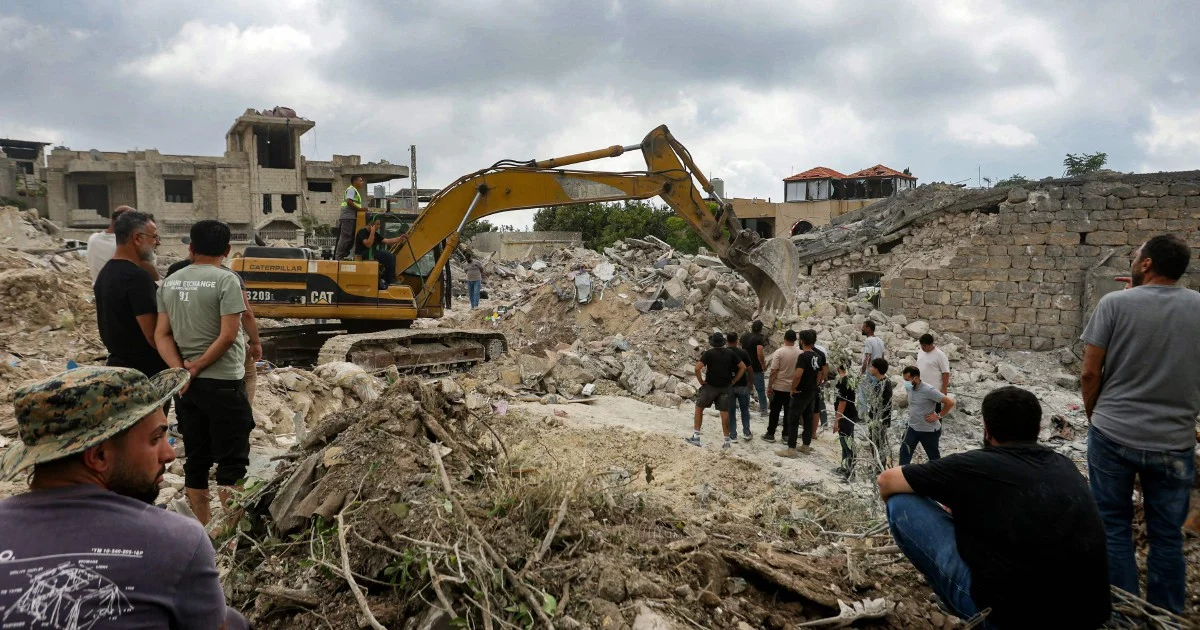
Qassem's statement signals that Hizbollah will mobilize its military capacity if Israel attempts to formalize or expand any security zone arrangement. This creates genuine risk of escalation spiraling beyond current cross-border skirmishes into broader regional conflict. Lebanese civilian populations in border areas already face displacement and infrastructure destruction from ongoing hostilities, with humanitarian impacts extending across the country.
%22%2F%3E%3C%2Fpattern%3E%3C%2Fdefs%3E%3Crect%20width%3D%22100%25%22%20height%3D%22100%25%22%20fill%3D%22url(%23phaa1dg)%22%2F%3E%3Crect%20width%3D%22100%25%22%20height%3D%22100%25%22%20fill%3D%22url(%23phaa1dp)%22%2F%3E%3Ctext%20x%3D%2250%25%22%20y%3D%2250%25%22%20text-anchor%3D%22middle%22%20dominant-baseline%3D%22central%22%20fill%3D%22rgba(255%2C255%2C255%2C0.95)%22%20font-family%3D%22Georgia%2C%20'Times%20New%20Roman'%2C%20serif%22%20font-weight%3D%22700%22%20font-size%3D%22272%22%20letter-spacing%3D%22-0.02em%22%3EAnwar%3C%2Ftext%3E%3C%2Fsvg%3E)