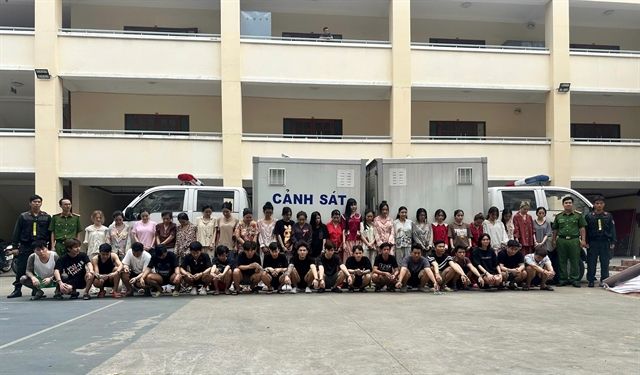
Vietnamese authorities in Ho Chi Minh City have successfully broken up an extensive network smuggling and distributing etomidate-laced electronic cigarettes, with police announcing the arrest of 49 people including four foreign nationals this week. The operation, which unfolded across multiple supply chains feeding the city's nightlife venues, resulted in the confiscation of 1,670 vape pods alongside significant quantities of ketamine and methamphetamine. The case represents a troubling shift in how narcotics are being packaged and marketed to consumers, particularly younger demographics who may not recognise the health dangers lurking within products designed to appear trendy and innocuous.
Etomidate, the primary substance at the centre of this investigation, is a short-acting surgical anaesthetic that carries serious legal consequences following its addition to Vietnam's controlled substances list in January. The chemical became strategically valuable to traffickers precisely because of the challenge it poses to conventional detection methods. Dealers ingeniously masked the drug within sweetener compounds for vaping devices, then distributed them under deceptively appealing brand names such as "chill pod", "relaxation pod", "sleep-well pod" and "fly pod". These marketing tactics deliberately obscured the presence of a dangerous medical substance, making the vapes virtually indistinguishable from legitimate nicotine products on casual inspection.
The investigation's origins trace back to intelligence gathered on a street-level dealer using the moniker Ba Giá, later identified as Nguyen Huu Huan, 28, from Dong Thap province. Police discovered that Huan and his wife, Ngo Thi Kim Chi, 30, had been systematically selling contaminated vapes to customers including a Ho Chi Minh City resident named Tran Phuc, 31. Once Huan became the focus of investigation, authorities uncovered the expansive nature of the supply operation, revealing at least two distinct trafficking networks that fed product into the city's distribution ecosystem. The complexity of the organisation suggests this was far from an isolated operation but rather a coordinated commercial enterprise with established supply chains and customer bases.
One major supply network allegedly operated under the direction of Huynh Ngoc Thuy Nhu, 26, with assistance from Hua Tuong Vy, 20, both Ho Chi Minh City residents. A second, potentially more organised operation was led by Le Quoc Duy, 40, from An Giang province, who managed the critical function of cross-border smuggling. Duy's significance lay in his ability to move contraband from Cambodia through remote border crossings in An Giang before routing supplies onward to Ho Chi Minh City distribution points. Police recovered thirty-seven vape pods from Duy's location alongside 200 grams each of ketamine and methamphetamine, indicating this particular trafficker diversified across multiple drug categories. The involvement of cross-border smuggling networks underscores how Southeast Asian drug trafficking exploits regional border vulnerabilities and the difficulty faced by individual nations in controlling transnational flows.
A third supplier network introduced a foreign dimension to the scheme, allegedly organised by Han Kiat, a Cambodian national, working alongside three other foreign nationals whose identities reflect the internationalised nature of drug distribution networks. This group specifically targeted foreign nationals residing in Ho Chi Minh City, suggesting sophisticated market segmentation wherein traffickers deliberately stratified their customer base by nationality and language. The presence of two South Korean nationals, one Chinese national, and one Cambodian national among the arrested foreign suspects indicates the operation drew participants from across the region, transforming Ho Chi Minh City into a nexus for international drug commerce.
The pharmacological profile of etomidate explains why traffickers view it as an attractive product despite the legal risks. When inhaled through vaping, etomidate bypasses the gastrointestinal system entirely, passing through lung tissue directly into the bloodstream and crossing the blood-brain barrier within seconds. Initial consumption produces disorientation and mild hallucinations that appeal to recreational users seeking novel psychoactive experiences. However, the substance carries grave dangers including neurotoxicity, severe drowsiness, uncontrolled muscle spasms and complete loss of consciousness. Most alarmingly, high doses or combinations with alcohol and other central nervous system depressants can trigger sudden respiratory arrest, presenting an acute overdose risk that users cannot anticipate or control.
A critical vulnerability that traffickers deliberately exploit is the mismatch between consumer drug testing capacity and the chemical properties of etomidate. Conventional rapid test kits available in retail markets reliably detect traditional narcotics including heroin, cannabis and methamphetamine, but prove entirely ineffective against etomidate's distinct molecular structure. Traffickers explicitly leverage this gap, marketing their products as "undetectable" or guaranteed to produce "100 per cent negative" results on standard testing equipment. Only sophisticated laboratory analysis systems operated by law enforcement and certified forensic agencies possess the capability to accurately identify etomidate, creating a technological asymmetry that criminals exploit deliberately. This knowledge gap transforms young consumers into unwitting risk-takers who may believe themselves to be engaged in relatively low-risk consumption.
Young people represent the deliberately targeted demographic for these products, a reality that motivated police to issue specific public health warnings. The visual design and marketing language surrounding these vapes employ contemporary aesthetics and aspirational messaging that resonates with youth culture. The very nature of vaping technology carries less social stigma than traditional drug consumption methods, and the products physically resemble legitimate commercial nicotine devices sold openly in convenience stores. This camouflage effect, combined with sophisticated branding that emphasises relaxation and mood enhancement rather than intoxication, creates multiple layers of deception that young consumers lack the experience to penetrate.
The implications of this case extend beyond Ho Chi Minh City's borders and into wider Southeast Asian drug policy and enforcement frameworks. The operation demonstrates how organised trafficking networks rapidly innovate in response to legal prohibitions and enforcement pressure, finding novel delivery mechanisms and novel chemical compounds that circumvent existing control regimes. The Cambodian connection reveals how porous borders and varying national drug laws create trafficking corridors that established procedures struggle to contain. For Malaysia and other regional partners, the case serves as an early warning signal that etomidate-laced vapes may eventually migrate across borders, as supply networks typically seek to maximise market reach and geographic diversification once successful operations establish themselves.
The effectiveness of this particular investigation ultimately depended on human intelligence rather than technical detection capabilities, with initial information about a street-level dealer triggering the unravelling of larger supply networks through systematic follow-up work. This underscores the continued importance of community awareness and willingness to report suspicious activity to authorities. Police in Ho Chi Minh City have urged citizens, particularly young people, to exercise extreme caution regarding electronic cigarettes from unknown sources, to dismiss advertising claims at face value, and to understand that possession, sale, transport or use of illegal drugs carries serious criminal liability. As the vaping landscape continues to evolve globally, the convergence of drug trafficking innovation and youth-oriented marketing represents an escalating public health challenge requiring sustained vigilance and cross-border coordination among Southeast Asian enforcement agencies.

