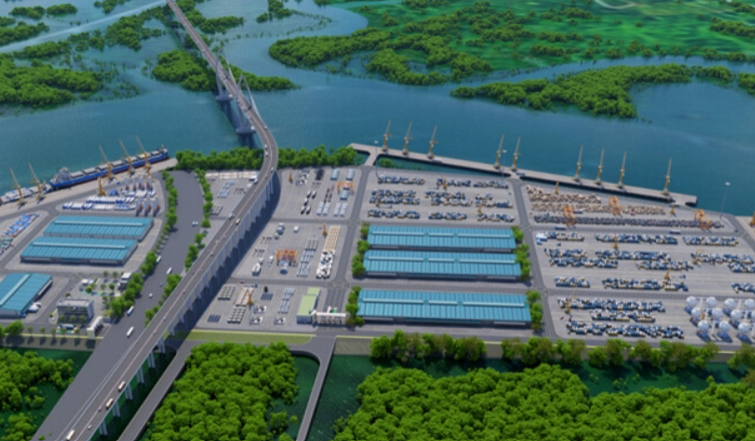
Ho Chi Minh City officially inaugurated construction of the QTM International Port on Sunday, July 5, marking a strategic investment of nearly VNĐ6.9 trillion (US$261 million) aimed at fortifying Vietnam's largest economic centre as a regional logistics powerhouse. The facility represents the city's response to surging cargo demand and its ambition to position itself as a critical node connecting Southeast Asian and global trade networks. Located within the Phu My Ward of the Cai Mep-Thi Vai deep-water port complex, the project signals Ho Chi Minh City's determination to maintain momentum despite intensifying regional competition from other major ports across Southeast Asia.
The port will be constructed across two phases spanning from 2026 to 2034, with planners targeting an ultimate annual throughput capacity of 16 million tonnes across more than 80 hectares of developed land. The infrastructure development includes an expansive integrated warehousing and logistics facility occupying approximately 200,000 square metres, designed to provide comprehensive storage and distribution services for containerised and breakbulk cargo. This integrated approach reflects contemporary best practices in port management, allowing for seamless transfer of goods between maritime and land-based transport modes without extended dwell times.
When fully operational, the QTM International Port will accommodate eight deep-water berths initially designed to receive container vessels and general cargo ships displacing up to 60,000 deadweight tonnes (DWT). The design incorporates future expandability to handle larger vessels reaching 100,000 DWT, positioning the facility to accommodate the evolving megaship trend dominating global container shipping. This scalability ensures the port remains competitive as maritime operators continue deploying increasingly large vessels on major trunk routes, particularly those connecting Asia with Europe and North America.
The timing of this investment reflects transformative changes within Ho Chi Minh City's administrative boundaries. Recent administrative consolidation of three nearby localities has substantially altered the city's spatial footprint and economic composition, generating unprecedented demand for freight movement and raw material distribution. Hoang Nguyen Dinh, vice chairman of the Ho Chi Minh City People's Committee, emphasised during the groundbreaking ceremony that cargo transport requirements have intensified markedly following this merger, necessitating expedited development of integrated logistics networks with robust connections to regional and international supply chains. The city's transport infrastructure must evolve rapidly to manage this enlarged economic hinterland.
Economic indicators underscore the urgency of port expansion. Sea and inland waterway cargo volumes handled by Ho Chi Minh City surged 7.3 percent during the first six months of this year alone, according to municipal authorities, reflecting sustained demand from manufacturing sectors and international trade flows. This growth trajectory outpaces many Southeast Asian peers and demonstrates the port's strategic importance to Vietnam's export-oriented economy. The expansion project directly addresses capacity constraints that could otherwise throttle economic expansion across the southern region.
Deputy Prime Minister Pham Gia Tuc highlighted a critical economic inefficiency driving the investment imperative. Currently, logistics expenses consume between 14 and 16 percent of Vietnam's gross domestic product—a burden substantially exceeding benchmarks in developed economies and more efficient regional competitors. Modern port infrastructure capable of minimising cargo dwell times and reducing transshipment costs could recapture billions of dollars annually in productivity gains. By facilitating faster cargo clearance and more efficient distribution networks, the QTM International Port addresses a structural weakness in Vietnam's competitive positioning within global trade.
The Deputy Prime Minister specifically urged project developers to accelerate the construction timeline, requesting operational launch of the initial phase within approximately 11 months. This compressed schedule reflects government priorities around supporting Ho Chi Minh City's ambitious economic growth targets, which contemplate double-digit expansion rates over the medium term. Compressed timelines invariably present logistical and engineering challenges, yet the political emphasis on rapid delivery suggests government willingness to mobilise resources and streamline permitting processes.
Ho Chi Minh City's geographic advantages position it as a natural regional logistics centre. The municipality commands approximately 110 kilometres of coastline, providing natural deepwater anchorages and protected harbours suitable for large-scale maritime operations. The existing Cai Mep-Thi Vai deep-water port complex already ranks among globally significant container hub facilities, offering direct scheduled service to major international trade lanes spanning the trans-Pacific region and European markets. These established connections provide immediate demand visibility and shipping line partnerships that new facilities can leverage.
The Cai Mep-Thi Vai complex functions as a critical infrastructure asset for Vietnamese exporters and importing enterprises across the entire Mekong Delta and central highlands regions. Direct access to major international shipping routes eliminates transshipment delays that characterise smaller regional ports, reducing transit times and associated financing costs for time-sensitive goods. The QTM International Port's integration within this established complex creates synergistic efficiencies, as operators can consolidate cargo across multiple facilities and optimise vessel utilisation across diverse service offerings.
From a Southeast Asian perspective, Ho Chi Minh City's port expansion reflects Vietnam's intensifying competition with neighbouring economic centres, particularly Singapore and Thailand, for positioning within regional and global supply chain networks. As manufacturing increasingly relocates from China due to geopolitical considerations and rising labour costs, Vietnamese ports compete aggressively to capture resulting cargo flows. Efficient port infrastructure represents a critical competitive factor influencing corporate location decisions by multinational manufacturers and logistics operators evaluating Vietnam against alternative Southeast Asian jurisdictions.
The project also reflects Vietnam's strategic objective of reducing economic dependence on Chinese transshipment hubs, particularly as trade tensions between Beijing and the West reshape global logistics patterns. By expanding capacity at southern Vietnamese ports, the government enables local exporters and multinational manufacturers to access alternative routing options that diminish reliance on Chinese intermediaries. This infrastructure investment therefore carries geopolitical dimensions beyond purely economic calculus, supporting Vietnam's balancing act between maintaining beneficial economic relationships with China while diversifying logistics dependencies.
The QTM International Port investment demonstrates Ho Chi Minh City's sustained commitment to infrastructure modernisation despite macroeconomic headwinds and fiscal constraints facing the Vietnamese government. The decision to commit substantial capital resources to port expansion reflects confidence in sustained demand for Vietnamese export products and continued attractiveness of Vietnam as a manufacturing destination within global supply chains. Success in executing this complex project within stipulated timelines will significantly strengthen Ho Chi Minh City's position as Southeast Asia's premier logistics gateway and reinforce Vietnam's economic trajectory.

