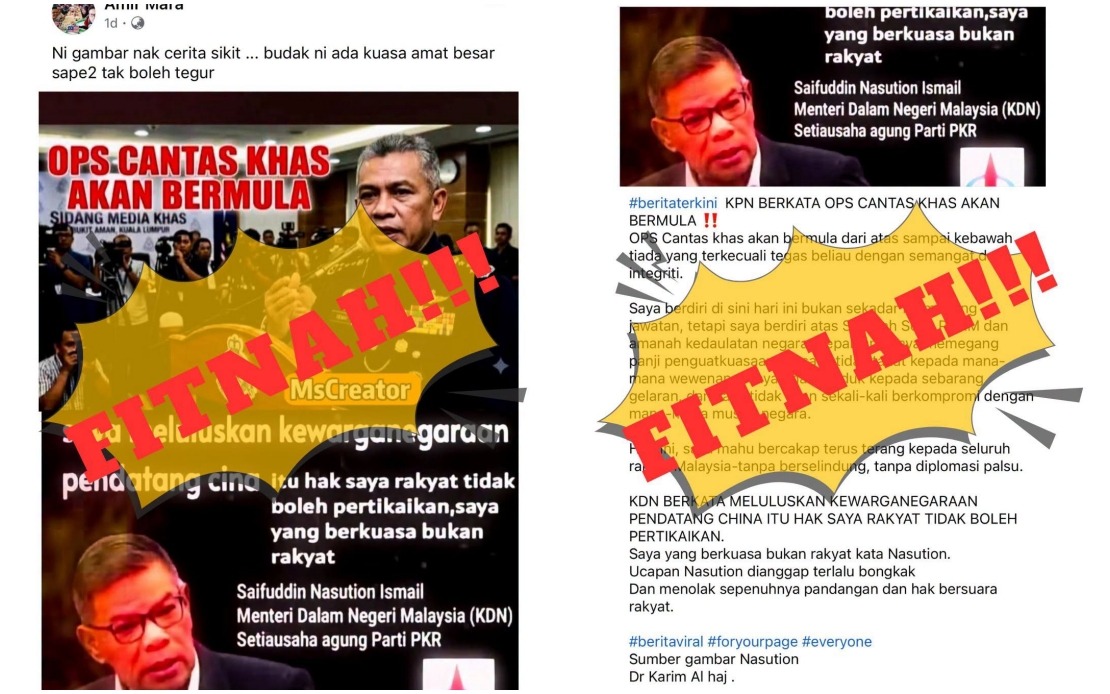
Home Minister Datuk Seri Saifuddin Nasution Ismail has categorically rejected allegations that his ministry engaged in mass citizenship grants to foreign nationals, describing the claims as part of a coordinated effort to mislead the public and inflame communal sensitivities. Speaking in Putrajaya on August 19, the minister addressed widespread social media narratives alleging irregular naturalisation practices, insisting that he has previously provided comprehensive explanations supported by official documentation and verified data.
The minister's statement comes as misleading posters and video clips continue circulating across digital platforms, reviving discredited narratives about alleged grants of Malaysian citizenship to non-citizens. Saifuddin Nasution emphasised that these materials, though repeatedly debunked through official channels and media reporting, remain in active circulation—suggesting a deliberate campaign rather than isolated instances of genuine confusion. The persistence of such claims despite prior ministerial clarifications underscores the challenge Malaysian authorities face in combating coordinated misinformation strategies that exploit internet infrastructure and social media algorithms to reach millions of users.
The allegations touch on deeply sensitive issues within Malaysia's multicultural context, particularly regarding citizenship criteria and national demographic composition. Specific claims have alleged that approximately 1.2 million Chinese nationals remain in Malaysia following purported mass naturalisation, a figure that carries significant implications for public discourse on immigration policy and national identity. These narratives, whether originating from genuine misunderstanding or deliberate fabrication, carry potential to destabilise social cohesion by activating latent anxieties about citizenship integrity and foreign presence within Malaysian borders.
Saifuddin Nasution warned that the dissemination of demonstrably false citizenship claims carries consequences extending far beyond reputational damage to individuals or institutions. Such misinformation, he argued, actively corrodes public confidence in state machinery responsible for immigration administration and citizenship verification. When citizens lose faith in governmental institutions' ability to maintain accurate records and enforce regulatory standards, the legitimacy of broader administrative processes comes under question, creating cascading effects throughout the bureaucratic apparatus that citizens depend upon for essential services and governance.
The minister identified racial tension incitement as a secondary but equally serious consequence of the citizenship misinformation narrative. In Malaysia's context, where communal relations remain fragile despite decades of relative stability, claims suggesting preferential or irregular citizenship treatment based on ethnicity strike at foundational social compacts. Such narratives can activate zero-sum thinking among different ethnic communities, fostering perceptions of unfair advantage or institutional bias that may persist long after the underlying factual claims are disproven, thereby contributing to gradual erosion of interethnic trust.
Beyond communal implications, Saifuddin Nasution identified national security dimensions to the citizenship misinformation phenomenon. Deliberately false claims about irregular naturalisation processes can generate public alarm about border control efficacy and immigration management, potentially prompting uncoordinated vigilantism or panic reactions. Additionally, such narratives may serve as cover for actual irregular activities or may be weaponised by hostile actors seeking to amplify internal divisions and undermine institutional credibility at critical moments.
The minister explicitly called upon all segments of Malaysian society to exercise greater responsibility in information consumption and dissemination, particularly through social media platforms where verification mechanisms remain underdeveloped. He urged citizens to verify controversial claims through official government sources rather than accepting information circulated through peer networks or anonymous accounts, recognising that modern information ecology privileges speed and emotional resonance over accuracy. This plea reflected broader global concerns about digital literacy and the institutional capacity of democratic societies to maintain shared factual foundations necessary for coherent policymaking and social consensus.
Saifuddin Nasution's intervention also served implicitly as a warning against political actors who might exploit citizenship narratives for electoral advantage or partisan mobilisation. His reference to avoiding exploitation of sensitive issues for political interests suggested awareness that some political actors may deliberately amplify or sustain misinformation campaigns to activate particular voter constituencies or undermine governmental legitimacy. This dimension of the problem proves particularly vexing in electoral democracies where political competition incentivises the maximisation of voter anxiety and mobilisation, even when such activities compromise factual accuracy and social stability.
The home minister's statement reflects escalating international challenges with combating coordinated misinformation across Southeast Asia, where rapid internet penetration, diverse language ecosystems, and uneven media literacy create fertile ground for false narratives to spread rapidly. Malaysia's experience with citizenship misinformation parallels similar patterns observed in neighbouring countries where immigration-related claims become vehicles for broader expressions of identity anxiety and nationalist sentiment. The persistence of such narratives despite official refutation suggests that misinformation prevention requires strategies extending beyond mere factual correction to encompassing understanding of the psychological and social foundations that make certain false claims emotionally resonant regardless of evidential support.
Moving forward, Saifuddin Nasution's intervention signals that Malaysian authorities intend to maintain consistent messaging refuting citizenship irregularities while simultaneously calling upon institutional, civil society, and individual actors to combat misinformation through more sophisticated means than simple denials. The effectiveness of such efforts will likely depend on whether alternative narratives can be established that address underlying anxieties about immigration, demographic change, and institutional capacity while grounding public discourse in verifiable facts and transparent processes. Without such comprehensive approach, future iterations of citizenship-related misinformation will likely continue exploiting the gap between official explanations and public perception, particularly among communities with limited access to credible information sources or deep-rooted scepticism toward government communications.

