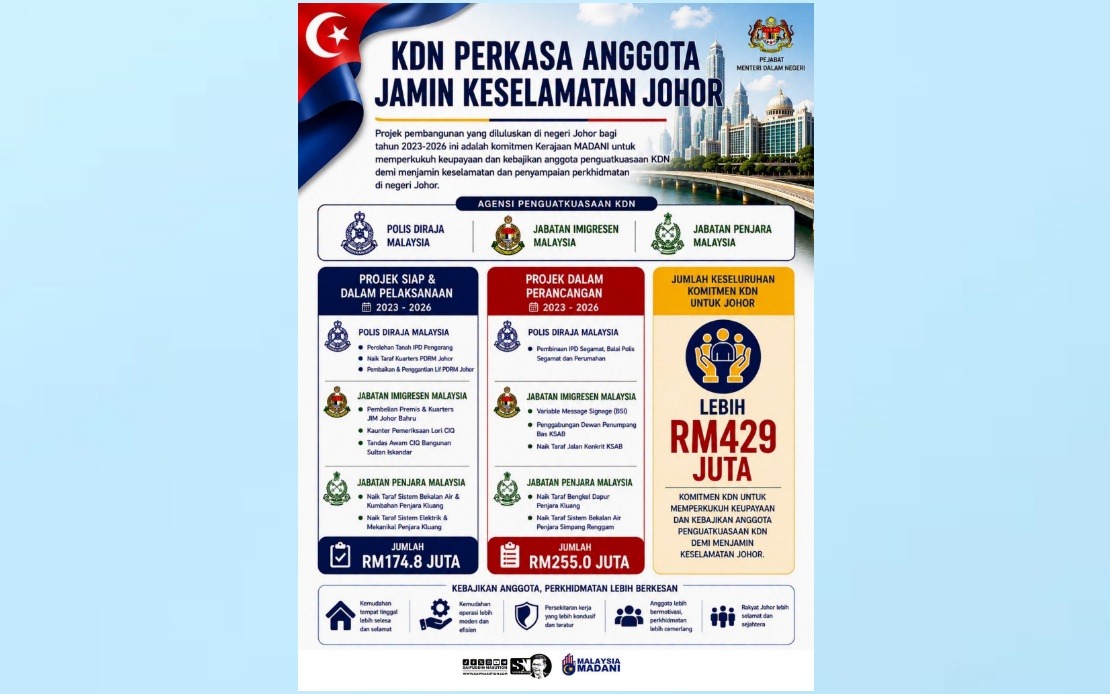
The Malaysian Home Ministry has committed more than RM429 million since 2023 towards bolstering the welfare standards and operational effectiveness of three key enforcement agencies operating across Johor. Home Minister Datuk Seri Saifuddin Nasution Ismail disclosed this substantial investment encompasses the Royal Malaysia Police (PDRM), the Malaysian Immigration Department (JIM), and the Malaysian Prisons Department, signalling a comprehensive approach to strengthening law enforcement infrastructure in the state.
The financial commitment reflects a strategic recognition that personnel welfare extends far beyond providing basic amenities. According to Saifuddin Nasution, investing in officer comfort and modern working environments directly translates into enhanced operational performance and greater public safety outcomes. This philosophy positions personnel wellbeing not merely as a humanitarian concern but as a foundational element of effective law enforcement, where better facilities and conducive workplaces enable officers to discharge their duties with greater efficiency and confidence.
The allocation has been structured into two implementation phases. The first comprises RM174.8 million for projects either completed or actively under construction, while the remaining RM255 million funds initiatives currently in advanced planning stages. This phased approach allows the ministry to balance immediate operational needs with longer-term strategic infrastructure development, ensuring resource deployment follows evidence-based priorities across the state's enforcement sector.
Currently executing projects demonstrate tangible commitment to infrastructure modernisation. These include acquisition of land for the Pengerang District Police Headquarters, procurement of office and residential premises for the Johor Bahru Immigration Department, and facility upgrades at Kluang Prison. Such initiatives address pressing operational requirements that directly impact officer morale and service capacity, particularly in districts where accommodation shortages or aging infrastructure have hindered workforce retention and productivity.
The pipeline of planned projects reveals the ministry's vision for comprehensive modernisation across Johor's enforcement landscape. Plans include constructing the Segamat District Police Headquarters featuring both operational stations and residential quarters, reorganising bus passenger terminal facilities at the Sultan Abu Bakar Complex, and implementing kitchen and water supply infrastructure improvements at correctional facilities including Kluang and Simpang Renggam prisons. These projects collectively address systemic gaps that have accumulated over years of deferred maintenance and demographic expansion.
Saifuddin Nasution contextualised this Johor-specific investment within the broader MADANI Government framework, emphasising that development allocations to the state have experienced significant growth. Prime Minister Datuk Seri Anwar Ibrahim recently highlighted in Parliament that Johor's total development and management allocation has increased substantially to approximately RM14.6 billion, representing a substantial elevation from the previous RM10.2 billion baseline. This trajectory suggests sustained commitment to addressing infrastructure deficits across the state.
For Malaysian readers, particularly those residing in Johor, this investment carries implications extending beyond enforcement agencies themselves. Improved police facilities and trained personnel directly correlate with faster crime response times, enhanced investigation quality, and greater community policing effectiveness. Similarly, modernised immigration infrastructure facilitates smoother processing of legitimate travellers while strengthening border security, whilst prison improvements support rehabilitation objectives and reduce institutional overcrowding pressures that can compromise safety and reintegration outcomes.
Regionally, the investment reflects Malaysia's ongoing efforts to strengthen law enforcement capacity in its most economically significant state outside the Federal Territories. Johor, as a major commercial hub with significant cross-border activity with Singapore and substantial international trade flows, requires enforcement infrastructure matching its strategic importance. Enhanced police headquarters in districts like Segamat and Pengerang addresses geographical service gaps that previously constrained emergency response and investigative reach across the state's diverse terrain and population distribution.
The emphasis on personnel welfare as a strategic objective also signals evolving understanding within Malaysian governance circles regarding public sector motivation and performance. Traditional approaches often prioritised equipment acquisition over working conditions, yet Saifuddin Nasution's framing suggests recognition that retention of experienced officers, attraction of quality recruits, and maintenance of institutional morale depend significantly on tangible improvements to daily working environments. This perspective aligns with international best practices in law enforcement management where personnel satisfaction correlates directly with operational outcomes and public trust metrics.
Looking forward, the success of these initiatives will largely depend on execution timeliness and quality of implementation. Malaysian government infrastructure projects historically experience scheduling variations and cost variations, necessitating robust project management oversight. The two-phase structure does provide flexibility for course corrections and phased learning, though residents and enforcement stakeholders will monitor whether projected completion dates materialise and whether allocated funding translates into genuinely improved working conditions rather than accumulating in budget schedules.
The announcement also reflects broader political messaging regarding development equity and state-level responsiveness. By publicly detailing Johor-specific investments and quantifying their extent, the government aims to demonstrate tangible commitment to this economically important state, potentially addressing perceptions of development concentration in other regions. For stakeholders in Johor's enforcement agencies—police officers working from overcrowded stations, immigration officers processing high passenger volumes, and correctional staff managing facility pressures—such announcements signal recognition that their operational challenges warrant priority resource allocation.

