Home Minister Datuk Seri Saifuddin Nasution Ismail has announced a comprehensive suite of development initiatives that will reshape security and administrative infrastructure across Johor, reflecting the federal government's determination to position the state as a secure and efficiently functioning region. The multi-faceted programme involves coordination across six major agencies falling under the Home Ministry's purview, each contributing targeted improvements to their respective operational footprint throughout the state.
Johor occupies a uniquely strategic position within Malaysia's security architecture. As the nation's southern gateway and home to critical international border crossings, the state serves as a frontline for managing transnational security challenges, immigration flows and law enforcement priorities. This geographic and administrative significance justifies the elevated focus on modernising facilities and upgrading systems that have become strained under increasing operational demands. The Home Ministry's renewed commitment to infrastructure investment in Johor therefore carries implications extending well beyond state boundaries, affecting how Malaysia manages security along one of its most travelled and sensitive frontiers.
Within the Royal Malaysia Police portfolio, the ministry is channelling resources toward establishing new district-level command centres that will decentralise policing operations and improve response capabilities in outlying areas. The construction of the Segamat district police headquarters represents a concrete step toward closing geographical service gaps, while concurrent land acquisition for Pengerang headquarters signals preparedness for future growth in that industrial corridor. Complementing these structural projects are maintenance initiatives targeting police accommodation and essential building systems, addressing long-standing backlog issues that affect personnel welfare and operational readiness.
The immigration and border management dimension reflects heightened attention to processing efficiency and service quality at key checkpoints. Sultan Iskandar Building and Sultan Abu Bakar Complex, both critical throughpoints for international travellers and commercial traffic, are slated for comprehensive facility upgrades. These improvements address both the mechanical aspects of border operations—streamlined queuing systems, modernised scanning technology, improved documentation processing—and the institutional standards that govern how officers discharge their duties. Enhanced facilities and better-designed workflows are expected to reduce congestion, accelerate legitimate travel and commerce, and create more professional environments for both personnel and the public.
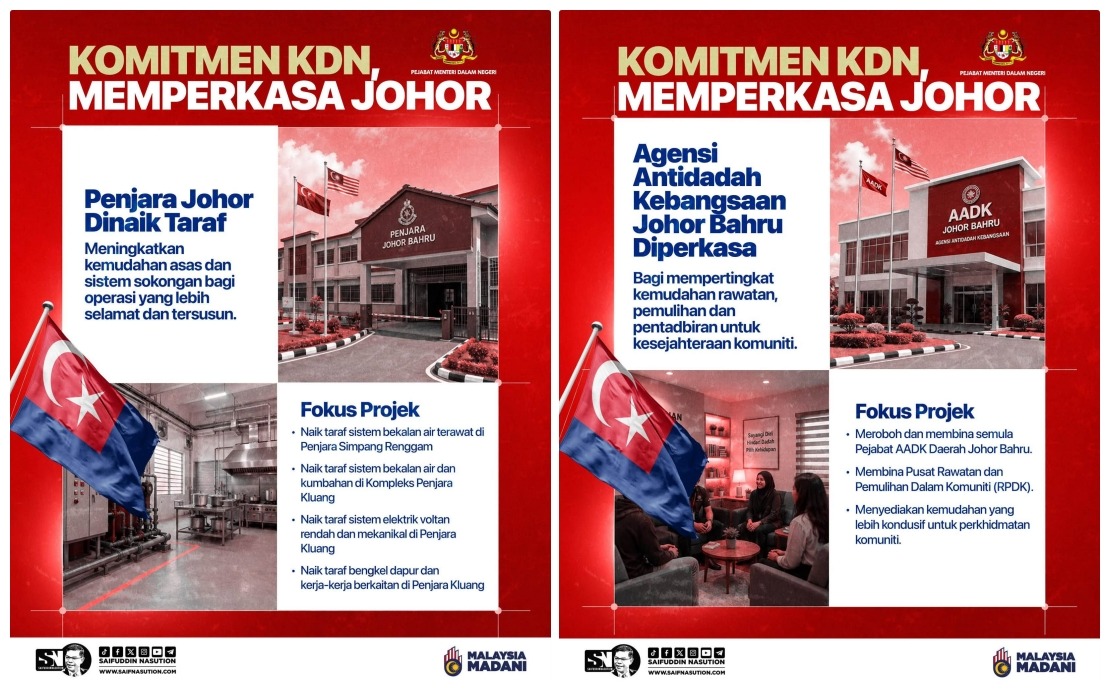
The National Registration Department's planned construction of a new Batu Pahat district office signals expansion of civil registration services in an area experiencing population growth. Such facilities form the backbone of citizenship administration, identity verification and official documentation, functions that increasingly require modern infrastructure as digital systems integrate with physical service points. Similarly, the Prisons Department's system upgrades at Kluang and Simpang Renggam facilities address custodial care standards and institutional modernisation, reflecting evolving approaches to correctional management.
The National Anti-Drugs Agency component of this programme carries particular resonance for Malaysia's ongoing public health and law enforcement priorities. Redeveloping AADK offices and treatment centres across Johor acknowledges both the anti-narcotics enforcement mission and the therapeutic rehabilitation dimensions increasingly central to drug policy. Modern facilities with appropriate treatment infrastructure support the government's pivot toward addressing substance abuse as a public health challenge alongside traditional interdiction efforts.
Maritime security represents another critical strand within this initiative. The upgrading of Abu Bakar Maritime Base's jetties and supporting infrastructure underscores Malaysia's continued investment in coastal and territorial waters monitoring. The Malaysian Maritime Enforcement Agency requires contemporary facilities to effectively police Johor's extensive maritime jurisdiction, combat smuggling and piracy, and coordinate with regional maritime security partners. Enhanced physical infrastructure translates directly into operational capability and personnel safety in a demanding operational environment.
The timing of these announcements, coinciding with the 16th Johor state election scheduled for polling on July 11, merits examination. While developmental infrastructure programmes naturally attract political attention during election cycles, the breadth of agencies involved and the interconnected nature of the improvements suggest a genuine strategic vision for Johor's administrative modernisation. The projects span multiple electoral cycles and budget years, indicating commitments extending beyond immediate political calculations. However, the concentrated public emphasis during an election period does raise legitimate questions about resource prioritisation and whether Johor's demonstrated security and administrative needs have historically received commensurate investment or whether this represents an acceleration of long-deferred improvements.
For Malaysian readers, particularly those in Johor, these developments carry tangible implications. Improved police infrastructure should translate into faster emergency response times and enhanced community policing capacity. Border infrastructure upgrades promise reduced travel delays for the hundreds of thousands who cross into or through Johor regularly. Enhanced civil registration facilities improve access to essential government services. More broadly, these investments signal sustained federal commitment to the state's development, though their ultimate success depends on execution quality, ongoing maintenance funding and whether agencies can evolve their service models to match improved facilities.
The Home Ministry's framing of these initiatives around the themes of security preparedness, service efficiency and support for personnel reflects standard institutional messaging. Yet the substance of the investments—distributed across multiple agencies, geographically dispersed within the state, and spanning both enforcement and service delivery functions—suggests a more holistic conception of state administration than security concerns alone would typically generate. This integrated approach acknowledges that modern governance requires simultaneous attention to law enforcement, civil administration, immigration management and public service delivery.
From a Southeast Asian perspective, Malaysia's continued investment in border infrastructure and security capabilities has broader regional implications. As transnational challenges ranging from human trafficking to illicit commodity flows intensify across the region, countries maintaining robust administrative and security infrastructure at key thoroughfares contribute to regional stability. Johor's upgraded capacity therefore carries significance extending to neighbouring countries and regional security cooperation frameworks.
The Home Ministry's commitment ultimately rests on execution. Infrastructure projects require sustained funding beyond initial construction, skilled personnel to operate modernised systems, and institutional adaptability to leverage new capabilities effectively. The announcement of intentions must be followed by transparent implementation, measurable performance standards and accountability mechanisms. For Johor's residents and the broader Malaysian public, monitoring how rapidly these projects transition from announcement to tangible completion will indicate whether this represents genuine developmental momentum or familiar political cycle rhetoric.

