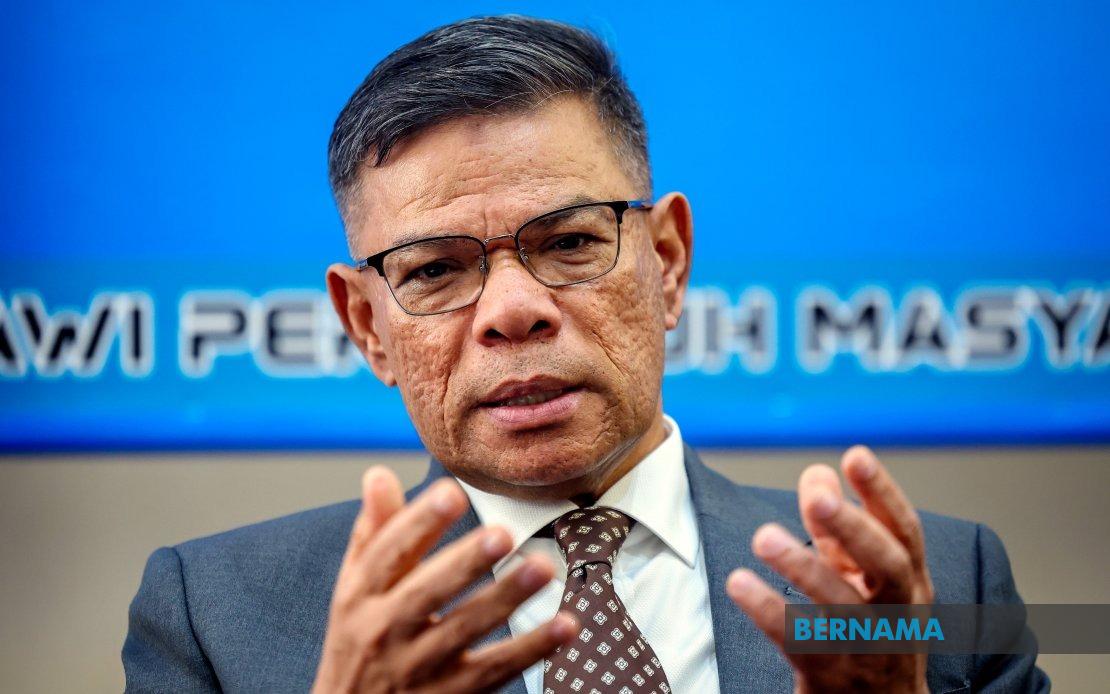
The Home Ministry has pledged to maintain consultative engagement with key constituencies before bringing forward revised Prisons Act amendments that would establish legal safeguards for prison officers performing their functions in good faith. Home Minister Datuk Seri Saifuddin Nasution Ismail made the commitment during a press briefing in Putrajaya on July 27, seeking to address widespread misunderstandings about the legislative package's intent and scope among civil society, lawmakers, and the general public.
Saifuddin acknowledged that elements of the proposed reform have been reinterpreted by certain stakeholders, particularly non-governmental organisations and parliamentary members, as a covert mechanism to confer blanket immunity on prison personnel. He emphasised that this characterisation fundamentally misrepresents the amendment's actual purpose, which centres on establishing a protective framework specifically for officers acting in accordance with the law rather than providing unconditional legal cover. The distinction, he contended, remains critical to understanding the proposal's true operational scope.
The Home Ministry had previously deferred tabling the Prisons (Amendment) Bill 2026, enabling the Parliamentary Special Select Committee to undertake deeper examination of the proposed measures. This postponement reflected recognition of the sensitivity surrounding the legislation and the need for thorough parliamentary scrutiny before formal reintroduction. The delay underscores the government's awareness that proper institutional review and stakeholder input could substantially strengthen the policy's credibility and public acceptance.
The proposed amendments encompass several distinct components extending beyond officer protection. Among these are provisions permitting electronic monitoring systems to observe the movements of designated inmates, establishment of a volunteer corps to bolster prisoner rehabilitation programming, and the contested legal protections for officers executing their duties within statutory parameters. Each element warrants separate consideration, though public discourse has concentrated predominantly on the liability question.
Saifuddin articulated his position that comparable protective provisions exist across Malaysia's legislative framework, establishing both procedural consistency and contextual precedent. He stressed that legislative coherence across different Acts strengthens the amendment's legitimacy, preventing the Prisons Act from standing as an outlier while maintaining uniform standards of officer protection. This alignment with existing statutory models, he suggested, demonstrates the proposal's conformity with established constitutional practice rather than representing unprecedented delegation of immunity.
To illustrate the necessity for such protection, the minister referenced a case involving a prison director subjected to legal proceedings following execution of a court-authorised corporal punishment sentence, with the inmate subsequently dying despite medical protocols. He also cited instances where deceased prisoners undergoing overnight custody generated lawsuits against officers, notwithstanding conclusive medical evidence eliminating any wrongdoing. These scenarios, Saifuddin contended, demonstrate the vulnerability of prison personnel to litigation even when performing lawfully-mandated duties, justifying protective amendments.
The minister sought to allay concerns regarding accountability by clarifying that proposed protections would not extend to scenarios involving negligence, breach of statutory obligations, or deliberate misconduct. Prison officers would remain entirely subject to prosecution, civil suits, and disciplinary action where evidence substantiated such dereliction. This carve-out principle, he asserted, preserves the fundamental accountability architecture while merely insulating officers performing duties competently and lawfully.
Saifuddin referenced the Human Rights Commission of Malaysia's investigation into disturbances at Taiping Prison as a concrete illustration of sustained accountability mechanisms. Following SUHAKAM's inquiry, police initiated formal investigations, internal disciplinary measures proceeded, and legal actions advanced through judicial channels simultaneously. This multi-layered response, he underscored, demonstrates institutional commitment to accountability even in complex circumstances, refuting suggestions that the proposed amendments represent immunity expansion.
The necessity for public clarification arises partly because terminology within legislative frameworks often generates misinterpretation, particularly when statutory language encompasses qualified protections. The distinction between protection for good-faith action and absolute immunity remains intellectually straightforward but frequently gets obscured in political discourse. The ministry's commitment to continuous stakeholder engagement reflects recognition that legislative legitimacy ultimately depends upon public understanding and acceptance, requiring sustained effort to explain technical distinctions.
For Malaysian stakeholders, this legislative episode illuminates broader tensions between occupational liability exposure and operational effectiveness within security institutions. Prisons constitute high-risk environments where split-second decisions carry substantial consequences, and officers require sufficient confidence in institutional backing to perform duties effectively. Conversely, ensuring genuine accountability through accessible legal remedies protects detainee rights and prevents systemic abuse. The amendment seeks equilibrium rather than tilting entirely toward either extreme.
Regional context matters as well, since prison management standards across Southeast Asia increasingly emphasise rehabilitation alongside security. Nations throughout the region grapple with similar questions concerning officer accountability and protection, making Malaysia's legislative approach instructive. The Home Ministry's commitment to transparent dialogue may provide a workable model for jurisdictions seeking to balance occupational security with transparent accountability.
The planned consultations will likely involve Parliamentary committees, civil rights advocates, correctional authorities, legal scholars, and affected communities. Through such engagement, the ministry hopes to refine legislative language ensuring that protection terminology becomes unambiguous, creating statutory provisions that secure officer confidence while preserving genuine accountability. The effort, though administratively demanding, reflects understanding that durable policy requires genuine consensus rather than partisan advancement.
Ultimately, the amendment's success hinges upon the government's capacity to explain technical distinctions persuasively and upon stakeholders' willingness to distinguish legitimate protection from objectionable immunity. This legislative struggle mirrors broader governance challenges in democracies balancing institutional effectiveness against transparent accountability—a tension admitting no perfect resolution but requiring perpetual negotiation among competing legitimate interests.

