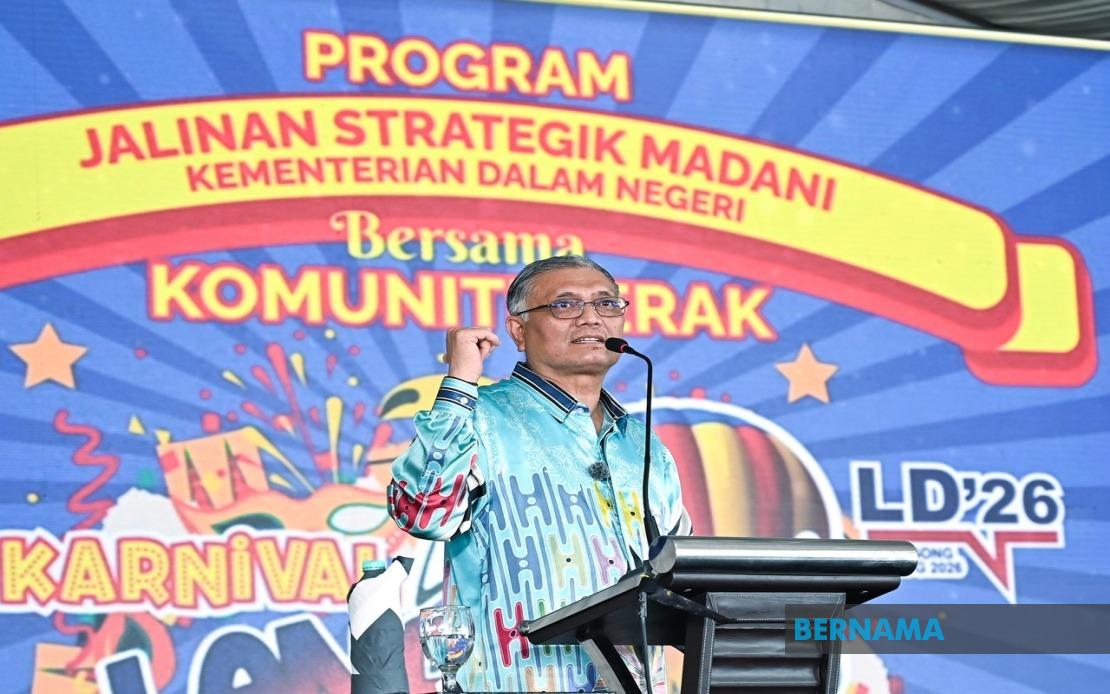
The Home Ministry unveiled an ambitious community outreach initiative in Lenggong this week, bringing multiple government agencies and their services to residents in a novel attempt to bridge the gap between bureaucracy and local populations. The two-day MADANI Strategic Partnership Programme, which commenced at Dataran Lenggong, represents a shift toward decentralised service delivery and represents the ministry's commitment to making administrative processes less daunting for ordinary Malaysians unfamiliar with navigating complex government structures.
What distinguishes this initiative from conventional town halls is its multifaceted approach to engagement. Rather than confining interactions to formal presentations, organisers incorporated recreational activities alongside substantive service opportunities, recognising that sustained community participation requires both enjoyment and practical value. Colouring competitions and children's performances created an atmosphere conducive to families, while religious talks addressed spiritual dimensions often absent from governance conversations. This holistic framework acknowledges that public trust emerges not solely through transactional exchanges but through genuine, multifaceted community interaction.
The operational component proved equally significant. Staffed service counters representing KDN agencies proved surprisingly popular, indicating latent demand among residents for direct access to government officials. Visitors seized the opportunity to update personal records, obtain legal advice, and lodge formal complaints without navigating intimidating office environments or navigating bureaucratic waiting periods. This accessibility model suggests potential scalability across other government ministries, provided adequate resourcing and staff training materialise.
Deputy Home Minister Datuk Seri Dr Shamsul Anuar Nasarah articulated the programme's underlying philosophy during the opening ceremony, emphasising that contemporary governance requires constant dialogue between security institutions and grassroots communities. His comments underscore recognition that policing and national security cannot depend solely on top-down enforcement; instead, sustainable security outcomes emerge through collaborative problem-solving with residents who possess intimate knowledge of localised crime patterns, substance abuse networks, and informal dispute resolution mechanisms.
The integration of exhibitions featuring the Royal Malaysia Police, Immigration Department, and National Anti-Drugs Agency provided tangible demonstrations of each institution's functions and operational capacities. Rather than abstract descriptions, residents encountered actual personnel, equipment, and procedural explanations, demystifying organisations often perceived as distant or intimidating. This transparency potentially cultivates institutional credibility while enabling citizens to understand precisely which agency addresses specific concerns.
The sporting component, which attracted approximately 1,190 participants in a combined Fun Ride and Fun Run coordinated by the People's Volunteer Corps and the National Anti-Drugs Agency, demonstrates shrewd programming logic. Exercise-focused activities generate enthusiasm while promoting wellness messaging without resorting to didactic health lectures. Routing participants through Lenggong's villages provided dual benefits: participants experienced the region's natural beauty and cultural attractions whilst residents in surrounding areas witnessed concerted government attention and resource deployment.
Lenggong Valley's UNESCO World Heritage Site designation lends particular significance to this initiative. The location embeds the MADANI programme within narratives of heritage preservation and sustainable tourism development, connecting security institutions to broader regional development objectives. This contextual framing positions the Home Ministry not primarily as a law-enforcement entity but as a stakeholder in comprehensive regional progress encompassing cultural preservation, economic opportunity, and community wellbeing.
The involvement of Datuk Seri Dr Shamsul Anuar as both Deputy Home Minister and Lenggong Member of Parliament illustrates the political dimensions underlying this initiative. Elected representatives increasingly recognise that service delivery effectiveness constitutes an electoral asset; constituents remember tangible government presence and responsiveness more readily than abstract policy commitments. This convergence of administrative objectives and political interests, whilst potentially cynical in observation, generates practical benefits for residents who gain genuine service access regardless of underlying motivations.
For Malaysian governance more broadly, the MADANI programme offers instructive lessons about reimagining public sector engagement. Digitisation and centralised bureaucracies, whilst efficient at scale, risk alienating populations lacking technological literacy or confidence navigating online systems. Mobile, community-based service delivery models acknowledge these limitations whilst capitalising on government agencies' existing resources and expertise. Replication across other ministries—particularly health, education, and local governance—could substantially amplify public access to essential services, particularly benefiting rural and economically marginalised communities.
The emphasis on two-way engagement deserves particular scrutiny, as it represents genuine departure from conventional top-down governance communication. When security agencies position themselves as listeners rather than merely enforcers, residents gain legitimate channels for articulating concerns about policing practices, resource allocation, or policy implementation. This dialogue architecture potentially enhances institutional legitimacy and responsiveness whilst identifying implementation gaps that centralised decision-making might overlook. However, translating such engagement into tangible policy adjustments requires institutional commitment extending beyond individual initiatives; otherwise, programmes risk generating cynicism when communities perceive their input as performative rather than consequential.
Moving forward, the programme's sustainability and scalability warrant monitoring. One-off events generate goodwill but create limited lasting impact without systematic follow-up mechanisms. Establishing permanent community liaison frameworks, feedback response protocols, and regular service delivery schedules would transform MADANI from discrete initiative into institutionalised practice. For Southeast Asian nations grappling with public trust deficits and service delivery challenges, the Lenggong model merits adaptation and refinement, provided policymakers commit resources and organisational energy necessary for genuine, sustained community engagement.

