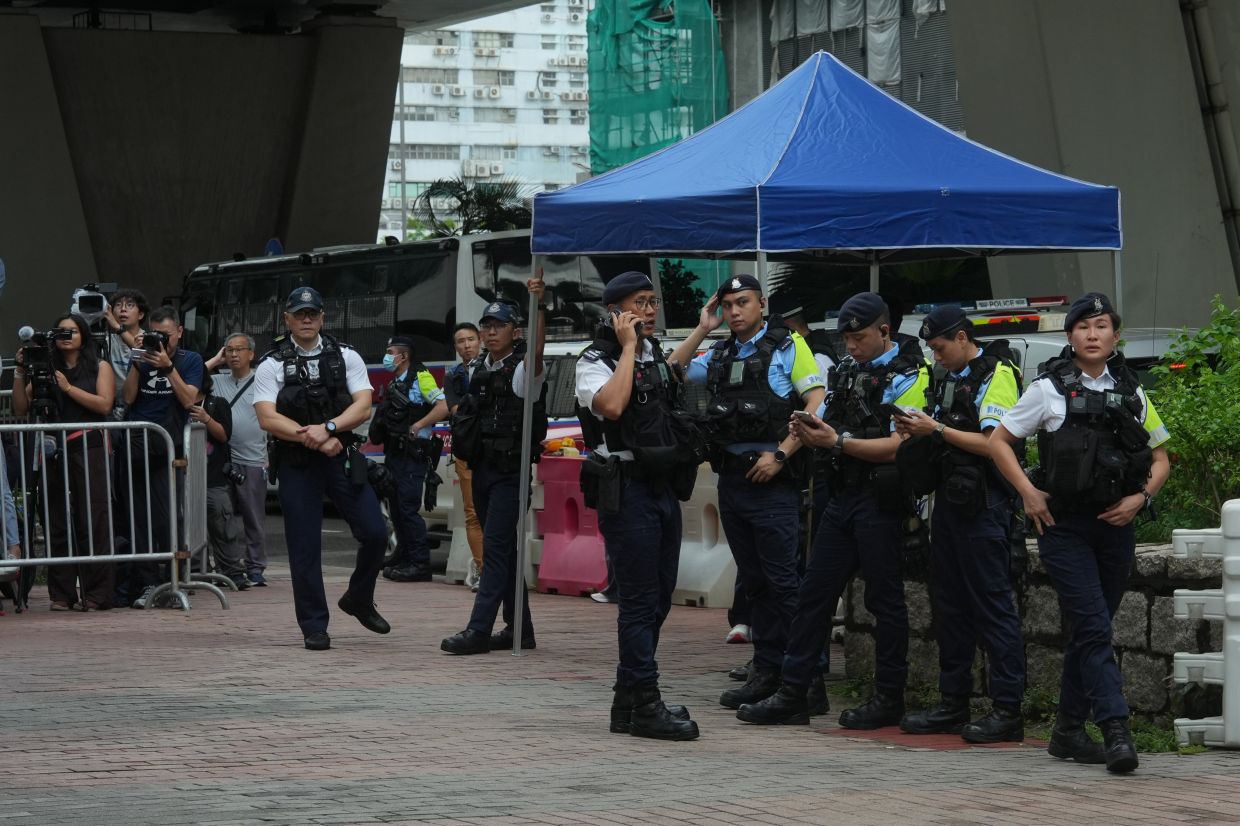
Hong Kong police have detained a woman on suspicion of public disorder, obstruction, and seditious intent after she allegedly wore a T-shirt bearing a message authorities deemed seditious outside West Kowloon Court. The force disclosed details of the arrest on Monday evening, though officials declined to release specifics about the operation itself, citing public safety concerns. The detention occurred in the early hours before a significant court judgment unfolded, drawing attention to escalating enforcement of Hong Kong's national security framework and the government's approach to controlling dissent and public expression near sensitive venues.
The arrested woman was apprehended shortly after 5am on Friday as more than 50 people gathered outside the courthouse awaiting a verdict in a landmark subversion case. According to witness accounts relayed to media outlets, she wore a black T-shirt printed with Japanese characters, though the precise message and its alleged seditious content remain undisclosed. A plainclothes officer reportedly identified her and escorted her into a police vehicle while journalists and onlookers observed and filmed the incident. Officers then directed media representatives to vacate the area as the woman was taken away, suggesting the security operation was designed to limit public documentation of the arrest.
The timing of the detention immediately preceded judges' delivery of guilty verdicts against Lee Cheuk‑yan, former chairman of the Hong Kong Alliance in Support of Patriotic Democratic Movements of China, and Chow Hang‑tung, the alliance's former vice-chairwoman. Both faced charges of inciting subversion under Hong Kong's national security law, specifically for calling for an end to "one-party dictatorship" in mainland China. The alliance, which organised Hong Kong's annual Tiananmen Square vigil commemorating the 1989 crackdown, has since been disbanded following mounting legal and political pressure.
In a comprehensive 216-page ruling, three High Court judges found Lee and Chow guilty and established a significant legal precedent. The judges determined that any attempt to overthrow or undermine the leadership of the Communist Party of China could constitute subversion, effectively interpreting the national security law to protect not merely China's governmental structure but the specific political system and the ruling party itself. The ruling reflected judges' assessment that Hong Kong's constitutional framework, as enshrined in the Basic Law, does not accommodate Western-style democratic systems that fundamentally challenge or replace single-party rule.
The case represents one of the most high-profile prosecutions under the national security law introduced in June 2020, a framework that has transformed Hong Kong's legal and political landscape. Lee, a veteran pro-democracy lawmaker with decades of activism behind him, and Chow, a respected barrister known for civil society advocacy, have remained in custody for nearly five years awaiting resolution. Their prolonged detention and subsequent conviction underscore the severity with which authorities treat national security offences, reshaping the boundaries of permissible political speech and activism within the territory.
A fourth defendant, Albert Ho Chun‑yan, who served as the alliance's vice-chairman, has been held for more than four years. Ho pleaded guilty to charges in January and awaits sentencing, potentially facing significant prison time. The staggered outcomes in this case—with some defendants convicted after trial and others entering guilty pleas—reflect the mounting pressure on activists and civil society figures to accept legal consequences rather than pursue protracted court battles.
For Malaysian observers and Southeast Asian analysts, the Hong Kong case illuminates broader regional trends regarding how governments are defining and prosecuting sedition, national security, and the boundaries of political dissent. The expansion of sedition laws to encompass T-shirt messages and symbolic expression raises questions about the future scope of such legislation across the region, where several nations have similarly expanded national security frameworks. The arrest of the woman in the T-shirt demonstrates that authorities are extending enforcement beyond formal political activities to target everyday expressions of dissent, establishing a chilling effect on public assembly and demonstration near sensitive venues.
The conduct of police during the arrest—directing media away from the scene and conducting plainclothes enforcement—also reflects patterns seen in other jurisdictions, where authorities attempt to minimise documentation of controversial enforcement actions. The gathering of 50 people outside the courthouse itself became subject to security operations, suggesting that even passive assembly near courts handling national security cases may trigger police intervention. This development has implications for freedom of assembly across the region, as it signals a willingness to police the physical spaces around justice institutions.
The judges' ruling that any challenge to Communist Party leadership constitutes subversion represents a particularly significant interpretation, as it effectively criminalises a entire category of political speech and ideology rather than specific incitement to violence or direct overthrow. This approach differs from traditional sedition frameworks in several Commonwealth jurisdictions, including Malaysia, where sedition typically requires demonstration of intent to excite opposition to lawful authority or create public disorder. The Hong Kong model suggests a more expansive interpretation aligned with mainland Chinese national security concepts.
For political observers in Malaysia and the region, the Hong Kong developments warrant close attention regarding how sedition and national security laws evolve. Malaysia's own Sedition Act, while controversial, has historically maintained certain doctrinal limits that the Hong Kong national security law appears to transcend. Understanding how Hong Kong courts interpret security offences provides cautionary examples for jurisdictions considering similar legislative frameworks or expanded enforcement approaches. The case also demonstrates the vulnerability of civil society institutions, as the Hong Kong Alliance's dissolution was effectively forced through legal pressure rather than formal government prohibition.
The broader implications extend to regional concerns about the interplay between national security imperatives and democratic governance. As governments across Southeast Asia strengthen security frameworks ostensibly to protect national integrity, the Hong Kong experience shows how such laws can transform fundamental rights including freedom of expression, freedom of assembly, and freedom of association. The arrest for wearing a T-shirt encapsulates this tension—the government's security concerns versus citizens' ability to express political views through everyday symbols and messages.
Looking ahead, the sentencing of Lee, Chow, Ho, and any others convicted in related cases will provide further indication of sentencing norms for national security offences in Hong Kong. Whether custodial sentences will span years or decades, and how the courts justify such terms, will influence perceptions across Asia regarding the severity of enforcement and the practical implications of national security laws for activists and ordinary citizens. The case will likely remain a reference point for international observers tracking democratic backsliding and the application of security laws to suppress legitimate political expression.

