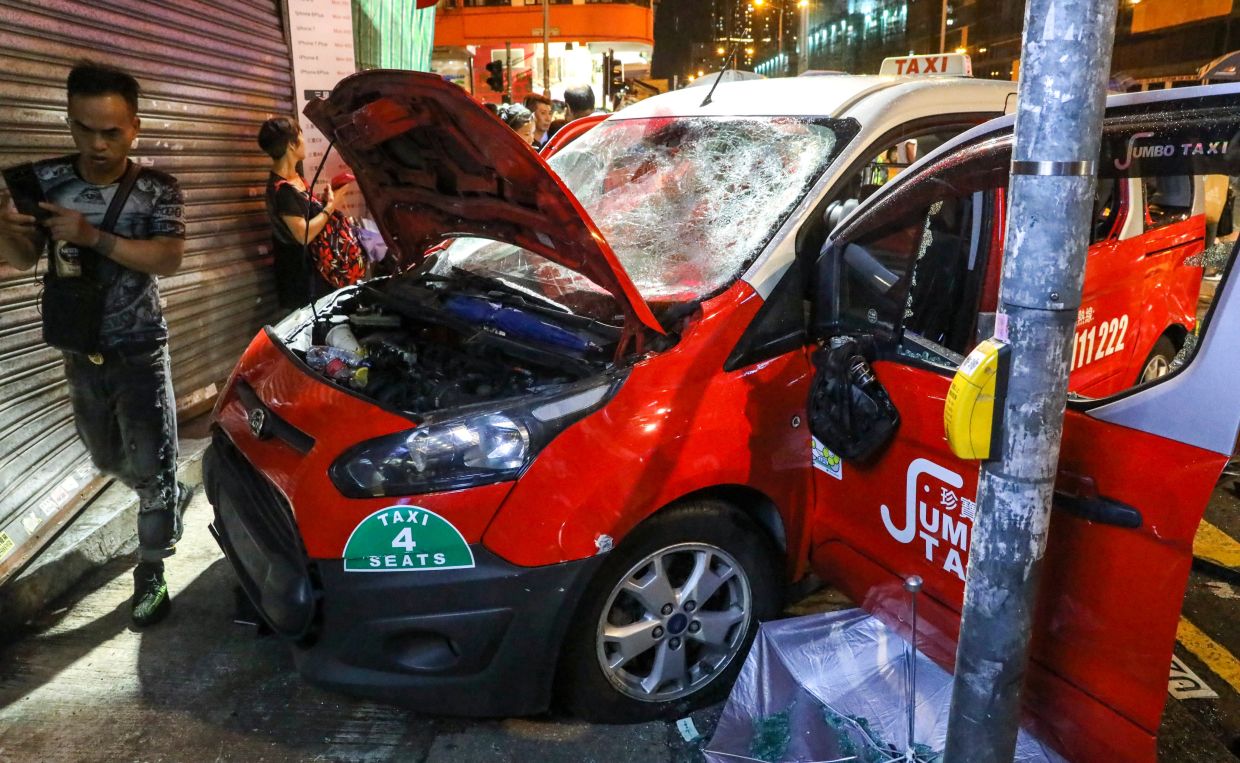
Park Hoi-lam's legal team has asked the Hong Kong courts to hold taxi driver Henry Cheng Kwok-chuen accountable for damages totalling at least HK$8.4 million following a collision that has fundamentally altered the trajectory of her life. The incident occurred on October 6, 2019, when Cheng's vehicle jumped the kerb on Yen Chow Street in Sham Shui Po and struck Park and another pedestrian during the height of Hong Kong's pro-democracy demonstrations. The case, heard before Mr Justice Simon Leung Chun-man, represents one of several personal injury claims emerging from the turbulent period of civil unrest that gripped the city four years ago, raising broader questions about liability when public disorder creates circumstances leading to individual harm.
Parking argued through her counsel Susanna Leong that the mechanics of the accident themselves demonstrate the driver's culpable negligence. The plaintiff's legal team contends that Cheng failed to execute any of the basic safety measures expected of a responsible operator—he neither sounded his horn to warn pedestrians of danger nor applied brakes before the collision transpired. This failure to take elementary precautions, they assert, represents a fundamental breach of the duty of care that every driver owes to those sharing the roadway and pavement. The subsequent violence directed at the taxi, they maintain, is entirely separate from the question of how and why the original impact occurred, and therefore cannot serve as legal justification for the initial collision.
The defence has constructed a fundamentally different narrative around the incident, one that positions the cabby himself as an unfortunate casualty of the day's violence. Lawyers representing Cheng acknowledged the serious nature of Park's injuries but argued that seeking compensation from someone they characterise as "another victim of the violence" represents an unjust outcome. The defence contends that while the driver was navigating Sham Shui Po, he faced a hostile environment and became the target of what they describe as a vicious assault involving metal rods and hard objects wielded by protesters. From this perspective, the collision represents not deliberate negligence but rather the driver's desperate attempt to escape a dangerous situation where his own safety was under direct threat.
Parking's testimony painted a picture of an ordinary afternoon that deteriorated into chaos without warning. She had been travelling toward Tsim Sha Tsui by public bus when congested roads forced her group to disembark in Sham Shui Po. When word reached them that railway services had also been suspended, they decided to proceed on foot toward Mong Kok. Walking ahead of her companions, Park found herself alone when she suddenly became aware of a disturbance near the taxi. In her account to the court, she described turning to flee just as the vehicle accelerated toward her at considerable speed, giving her no opportunity to escape the impact.
The physical consequences of that moment have proven far more enduring than any transient disruption from the protest itself. Park sustained severe injuries to her lower limbs requiring seven surgical interventions within a three-month period following the collision. Even after her discharge on January 18, 2020, her recovery remained incomplete, necessitating months of outpatient physiotherapy. Although physicians confirmed that further surgical improvement was unlikely, Park was informed that she may eventually require knee replacement surgery as she ages, a prospect that casts a long shadow over her future quality of life. The lingering pain in her knee restricts her mobility to the point where she cannot walk for more than an hour without requiring substantial rest.
The impact on Park's capacity to function in her current employment as a kindergarten clerk illustrates the manner in which invisible disabilities reshape everyday existence. She cannot lift heavy objects, a significant limitation in an environment where childcare frequently requires physical assistance. More poignantly, she is unable to comfort distressed toddlers through the simple act of picking them up and holding them—a fundamental aspect of early childhood care that she can no longer perform. Her cosmetic surgeon has recommended reconstructive surgery to address visible scarring on her legs, but Park lacks the financial resources to pursue this treatment, meaning she will carry visible reminders of the collision indefinitely.
The defence strategy shifted toward challenging Park's narrative of ongoing disability by introducing covert surveillance footage obtained through a private detective agency. The video appeared to show Park engaging in ordinary activities—shopping and dining—seemingly without difficulty. This material formed the basis of the defence's argument that she had returned to a normal life and therefore had not suffered the severe functional impairment she claimed. Park's response revealed the subtle but profound distinction between performing discrete activities and maintaining a genuinely meaningful existence. She pointed out that the surveillance captured only moments of her daily routine and asked whether shopping and dining, activities that any person might accomplish despite significant pain and limitation, truly constituted evidence of a normal life.
The procedural history of the case also became relevant to the defence strategy. When Park provided a police statement in March 2020, she brought along both a barrister and solicitor, a choice that defence counsel Ashok Sakhrani attempted to characterise as evidence of consciousness of guilt or concern about legal culpability. Park's explanation that she was simply protecting her own interests appears straightforward, and she categorically denied any participation in the protest itself. Her account suggests that she was an incidental victim caught in the wrong place at the wrong time, rather than a participant in the demonstrations whose presence invited the risk of confrontation with hostile forces.
This case emerges from a distinctive moment in Hong Kong's recent history when the collision of protest activity with ordinary urban life created circumstances where civilians could sustain serious injuries with contested lines of responsibility. The 2019 demonstrations represented a pivotal period that reshaped the city's political trajectory and left individual victims whose recovery processes continue years later. For Malaysian observers, the case illustrates how civil unrest, regardless of its political justifications, invariably produces human casualties whose suffering persists long after public attention shifts elsewhere. The trial's expected duration of six days reflects the complexity of establishing liability in circumstances where multiple parties claim victim status and where the broader political context threatens to obscure fundamental questions of personal accountability and duty of care.

