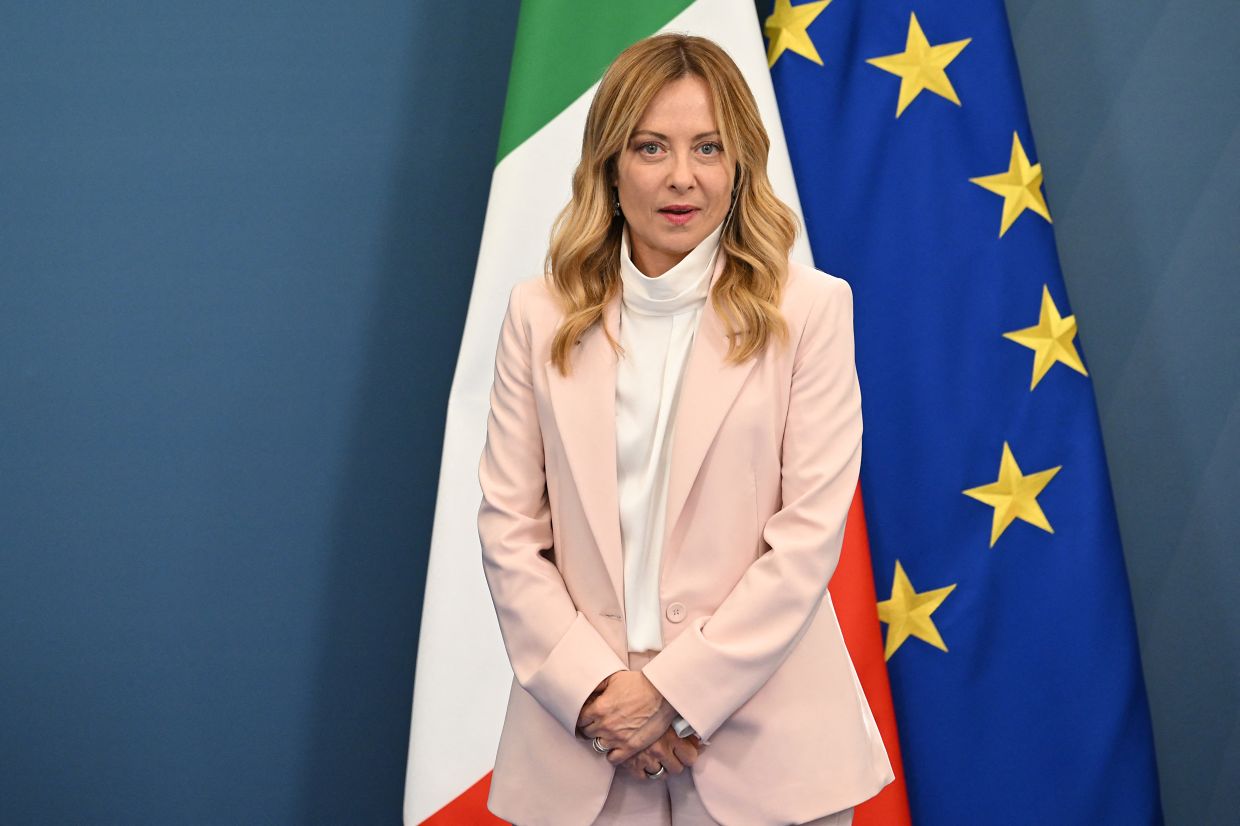
Italy's Prime Minister Giorgia Meloni has undergone a striking transformation since taking office in October 2022, and nowhere is this evolution more visible than in her carefully curated wardrobe. What began as a deliberately provocative aesthetic—dark suits and clunky black boots signalling her emergence from the fringes of right-wing Italian politics—has gradually shifted toward a more refined and approachable style. Today, Meloni frequently appears in pastel-coloured suits with wide-legged trousers that obscure her high heels, a calculated presentation that fashion and political analysts say conveys authority without aggression. The progression is remarkable not merely as a fashion statement but as a window into how she has repositioned herself on the European and global stage, moving from a combative outsider to a pragmatic leader of Europe's third-largest economy.
Fashion experts argue that Meloni's sartorial choices carry deliberate political weight. Antonio Mancinelli, who teaches at Rome's Costume and Fashion Academy, notes that she demonstrates sophisticated understanding of nonverbal communication through clothing. The shift toward lighter tones and softer silhouettes serves a purpose beyond aesthetics. In Italy's political context, where the nation's fashion industry remains a cornerstone of its international prestige and economic output, the image presented by a female leader carries particular significance. Stella Jean, an Italian-Haitian designer, emphasises that when a woman leads a country synonymous with fashion excellence, her wardrobe choices become matters of national importance, not mere personal preference. Every outfit makes a statement about how Meloni wishes to be perceived—and by extension, how she wants Italy itself to appear to the world.
Meloni's early political career presented a starkly different image. In 1996, when she was only nineteen years old, she appeared in a French television interview dressed almost entirely in black, organising members of a right-wing youth movement. During that segment, she made controversial comments defending Benito Mussolini, remarks that have periodically resurfaced to complicate her political narrative. This uncomfortable history meant that when she rose to prominence, every wardrobe choice carried the weight of those associations. In Italy, black holds multiple meanings—while fashionable globally and traditional in mourning contexts, it remains historically linked to fascist aesthetics in the Italian consciousness. As she ascended through political ranks, Meloni gradually distanced herself from this visual vocabulary.
Her appointment as youth minister under Silvio Berlusconi in 2008 marked a transition point. Entering mainstream government, Meloni shifted toward more conventional professional attire: dark suits paired with white shirts, a change that signalled her growing integration into establishment politics. The evolution continued over the following decade and a half. By the time she mounted her successful campaign for prime minister in 2022, Meloni had already begun broadening her public appeal beyond her party's core supporters. Her now-famous campaign speech, in which she emotionally described herself as "a woman, a mother, a Christian," became a viral moment that helped her attract conservative centrists concerned about her radical past. The speech's resonance suggested a leader who understood identity beyond ideology.
When Meloni took office as Europe's only female leader of a major power at that time, observers widely predicted she would govern as a radical outsider intent on challenging European Union authority and pursuing extreme positions. Many expected confrontation with Brussels on migration, spending, and geopolitical alignment. These predictions have largely proven incorrect. While maintaining conservative, restrictive policies toward immigration domestically, Meloni has demonstrated remarkable pragmatism toward EU governance structures. She has become one of Ukraine's strongest European advocates, willing to provide military support and stand firm against Russian aggression. Significantly, she has also shown independence from American pressure, famously pushback against Donald Trump, earning respect from fellow European leaders. This political moderation required a corresponding visual presentation.
Experts in fashion communication suggest that Meloni's wardrobe adjustments directly correlate with her expanded political responsibilities. Michela Bonafoni, a fashion instructor at Unicollege in Florence, explains that lighter colours communicate loyalty, tenderness, and openness. By adopting pastels and neutral tones, Meloni signals a welcoming demeanor without sacrificing authority or credibility. The wide-legged trouser cuts, while fashionable, serve the practical function of concealing high heels—eliminating a visual signifier that could be reductively interpreted through gendered lenses. These choices reflect strategic awareness that international diplomacy and governance require an image of seriousness balanced with approachability. Riccardo Alcaro, a political analyst at Italy's Institute for International Affairs, contextualises this shift: when leading a small opposition party, Meloni addressed a narrow ideological base; as premier of a major European democracy, she must present herself as a credible, debate-worthy leader whose ideas warrant serious consideration.
The contrast between Meloni's current aesthetic and her younger self extends beyond mere clothing swaps. In the mid-1990s, she cultivated an image explicitly tied to her party's radical positioning. The monochromatic black outfit, the youth activism, the inflammatory historical references—all functioned as deliberate signals to a specific constituency. Decades later, having navigated the complexities of actual governance, Meloni's fashion sense reflects someone no longer seeking confrontation for its own sake. The absence of all-black ensembles is particularly significant; they have largely vanished from her public appearances. Even her accessories have been modulated, with high heels now consistently hidden beneath tailored trousers rather than prominently displayed. These are not accidental choices but rather manifestations of deliberate brand management.
Interestingly, Meloni's office has declined to comment on her wardrobe choices or the advisors who guide them, a discretion that underscores the political sensitivity surrounding her image. Whether her styling reflects formal consultation with fashion professionals or emerges from her own intuition remains undisclosed. Regardless, her evolution provides a fascinating case study in how political leaders communicate identity through appearance. Her transformation mirrors broader patterns among world leaders who increasingly understand fashion as political language. Ukrainian President Volodymyr Zelenskyy's military-style dress signals wartime resilience, Mexican President Claudia Sheinbaum's Indigenous-embroidered garments honour cultural traditions, and UK political figures use casual clothing to project accessibility. Yet Meloni's situation contains unique dimensions tied to her nation's contested twentieth-century history and her party's ideological roots.
As Meloni enters the final year of her mandate, she faces intensifying challenges from within her own political coalition, including competition from younger right-wing figures. Regardless of her wardrobe, these political pressures will likely dominate headlines. However, her fashion trajectory tells an important supplementary story: that of a political operator sophisticated enough to understand how appearance shapes perception, and willing to align her visual presentation with her evolving political philosophy. Whether viewed cynically as strategic image management or more charitably as genuine evolution, Meloni's shift from all-black combativeness to soft pastels represents a calculated effort to present herself as a capable, moderate democratic leader rather than a radical outsider. In an era where political communication happens increasingly through visual channels, her wardrobe choices matter—not because of superficiality, but because image and substance have become inseparably intertwined in contemporary politics.

