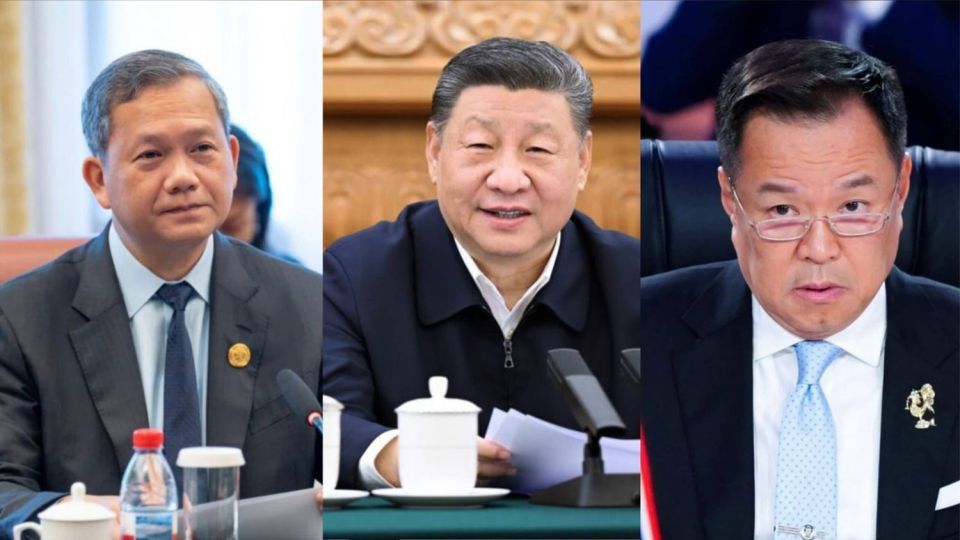
Prime Ministers Hun Manet of Cambodia and Anutin Chanvirakul of Thailand are set to converge in Shanghai this month for the World AI Conference 2026, an event being championed by Chinese President Xi Jinping. The dual appearance at the high-profile technology forum presents an opportunity for Beijing to leverage its considerable economic and diplomatic influence in pushing the two Southeast Asian neighbours toward resolving a longstanding territorial conflict that has festered since December, when the pair last engaged in formal negotiations. Both leaders have indicated they will use their Shanghai visit for bilateral discussions with Xi and Chinese Premier Li Qiang, setting the stage for potential mediation efforts by the world's second-largest economy.
Hun Manet's delegation reflects the seriousness with which Phnom Penh views the engagement, extending from July 15 to 17 and including Foreign Minister Prak Sokhonn, Defence Minister Tea Seiha, and Sun Chanthol, the first vice-chairman of the Council for the Development of Cambodia. Thailand's contingent will be similarly high-level, with Foreign Minister Sihasak Phuangketkeow accompanying Anutin. The composition of these delegations underscores that discussions will touch on substantive matters of state rather than ceremonial niceties. Cambodia's foreign ministry has framed the visit as an opportunity to deepen the "Comprehensive Strategic Partnership of Cooperation" with China, while simultaneously advancing what it terms the "Diamond Cooperation Framework" and building an "all-weather Cambodia-China Community with a Shared Future."
The diplomatic choreography leading up to Shanghai reveals the complexity of the border impasse. The two leaders previously crossed paths at the ASEAN Future Forum held in Hanoi in early June, where they exchanged handshakes for assembled cameras but conspicuously avoided substantive discussions regarding their territorial tensions. That carefully staged encounter hinted at mutual reluctance to engage directly, even as both leaders maintain strategic relationships with China. The Shanghai conference now presents a structurally different environment—one where the host nation's interests in regional stability and continued investment opportunities may translate into active diplomatic pressure.
Cambodia's border grievances are rooted in concrete territorial occupation. Approximately 20,000 Cambodian civilians remain displaced from their homes in areas currently under Thai military control, a humanitarian dimension that complicates straightforward negotiation. The situation reflects not merely a disagreement about lines on maps but the physical displacement of populations and the breakdown of normal civilian life in contested zones. This human element adds urgency to any mediation effort, as protracted displacement breeds resentment and hardens political positions on both sides of the border.
Analysts and Cambodia's own policy establishment believe Beijing possesses both the motivation and leverage to catalyse meaningful progress. China's substantial trade relationships with both countries give it significant economic leverage, while its position as a major development partner provides additional diplomatic currency. The expectation that China will intervene stems partly from a December 2025 agreement known as the Fuxian Consensus, a Chinese-brokered framework explicitly intended to address such conflicts through peaceful means and adherence to international law. Should China choose to activate this mechanism aggressively in Shanghai, it could reframe the entire trajectory of negotiations.
Yet structural obstacles persist that may resist even Beijing's considerable influence. Kin Phea, director of the International Relations Institute at Cambodia's Royal Academy, identifies Thailand's military establishment as the critical impediment to resolution. Rather than viewing the Thai civilian government as the ultimate decision-maker, Phea argues that those actually wielding power—the military hierarchy—have systematically ignored commitments made by their civilian counterparts to Cambodia. This civil-military divide within Thailand complicates external mediation, as agreements forged at the prime ministerial level may lack enforcement mechanisms when military institutional interests diverge from civilian diplomatic objectives.
Phea's analysis points to a pattern of Thai military actions on the ground that effectively nullify diplomatic progress achieved at higher levels. Troops continue to occupy Cambodian territory, and encroachment on sovereign Cambodian land persists despite civilian government pledges to cease such activities. This enforcement gap suggests that any Shanghai breakthrough would require not merely agreement between Hun Manet and Anutin but also concrete measures to subordinate Thai military operations to civilian diplomatic direction. Without mechanisms ensuring military compliance, even well-intentioned accords risk remaining merely ink on paper.
Cambodia's policy establishment has articulated specific expectations for how China should exercise its mediating role. Rather than brokering vague goodwill statements, Cambodia's analysts contend that Beijing should condition its continued support and investment on concrete Thai actions: withdrawal of military personnel from occupied territories, return to formal negotiations through the Joint Boundary Commission, and explicit acknowledgment of the Fuxian Consensus framework. This approach would essentially embed Cambodia's territorial claims into the conditions for maintaining China's backing, transforming Beijing's role from neutral mediator into an enforcer of defined boundaries and commitments.
The geopolitical context amplifies both the potential and limitations of a Chinese initiative. For Beijing, regional stability along Southeast Asian borders directly affects its Belt and Road Initiative investments and broader strategic positioning in the region. A destabilized Cambodia-Thailand border undermines the commercial corridors that China has invested heavily in developing. Conversely, Thailand's military leadership may harbour reservations about appearing subordinate to Chinese pressure, particularly given Thailand's complex security relationships with the United States and other regional powers. The balance between Thailand's desire to maintain investment and development cooperation with China against its resistance to external pressure on military prerogatives will ultimately determine whether Shanghai produces tangible movement.
The timing of the Shanghai conference adds another layer of complexity. The World AI Conference provides diplomatic cover for discussions that might otherwise appear reactive to external mediation. Both leaders can present their attendance as participation in a signature technology forum while quietly engaging in border negotiations in bilateral sessions. This staging allows national pride considerations to be managed, as neither leader need frame discussions as capitulating to international pressure but rather as part of routine strategic engagement with a major partner during a prestigious international event.
For Malaysia and the broader Southeast Asian region, the outcome carries implications beyond Cambodia and Thailand. Should China successfully broker a border resolution, it would demonstrate Beijing's capacity to intervene decisively in regional disputes, potentially raising expectations for its involvement in other territorial matters across Southeast Asia. Conversely, if the Shanghai meetings yield only rhetorical commitments without substantive progress, it may signal limits to Beijing's mediation capacity when military establishments resist diplomatic solutions. Malaysia, navigating its own strategic relationships and territorial considerations, will be watching closely to assess both China's effectiveness as a regional mediator and the durability of agreements forged under its auspices.

