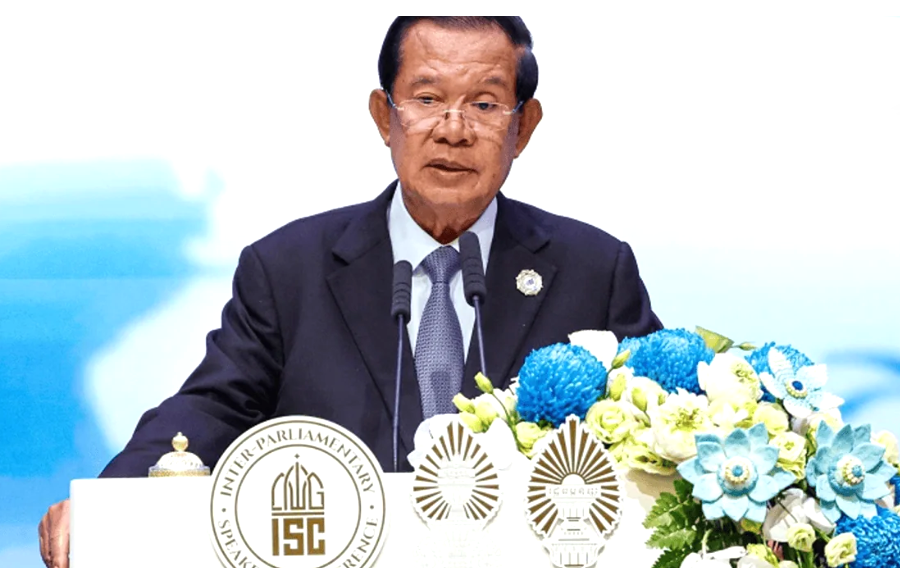
At the 2nd Inter-Parliamentary Speakers' Conference in Phnom Penh this week, Hun Sen delivered a pointed critique of what he characterised as Thailand's exploitation of international concern over cross-border cybercrime to mask what Cambodia views as territorial aggression. The Senate president's remarks, delivered to an assembly of parliamentary leaders from nations including Pakistan, Malaysia, Myanmar, Australia and Russia, framed the Cambodia-Thailand border dispute within a broader pattern of how state actors are weaponising global challenges to pursue nationalist objectives outside the bounds of recognised international law.
Hun Sen's central argument rested on the notion that contemporary conflicts have fundamentally transformed in nature and justification. Rather than explicit military invasion, he suggested that modern powers now cloak territorial ambitions in the language of combating transnational crimes. The application of extraterritorial jurisdiction over online scam operations, he contended, has become a convenient facade behind which Thailand has occupied portions of Cambodia's sovereignty. This rhetorical manoeuvre, Hun Sen implied, allows aggressive states to act with what they perceive as international legitimacy whilst circumventing formal declarations of war or straightforward territorial conquest.
The Cambodian leader's accusation that Thailand has violated ceasefire agreements by treating them as merely ceremonial documents carries substantial weight in Southeast Asian diplomatic circles. For Malaysia and other ASEAN members navigating complex border arrangements and maritime disputes, Hun Sen's observations about the fragility of negotiated agreements present uncomfortable reminders that written commitments can be reinterpreted or disregarded by more powerful neighbours. His suggestion that agreements function only symbolically, lacking enforcement mechanisms that can constrain determined state actors, strikes at the heart of how smaller nations rely on international frameworks to protect their territorial integrity.
Beyond the specific Cambodia-Thailand disagreement, Hun Sen articulated a sweeping critique of how dominant global powers are systematically dismantling the post-World War II international order. He identified multiple dimensions of this erosion: trade wars that weaponise customs regimes and rescind previously negotiated commercial advantages; technology conflicts centred on semiconductor supply chains and cybersecurity dominance; and resource protectionism that restricts access to critical minerals and energy supplies. Each represents, in his view, a violation of the principles supposedly governing international commerce and cooperation.
The Senate president's warning about the collapse of non-proliferation frameworks deserves particular attention for Malaysian policymakers. He argued that when vulnerable nations lose confidence that international treaties alone can shield them from external aggression, a cascade of security anxieties triggers competitive armament races. This dynamic has profound implications for Southeast Asia, where rising geopolitical tensions between major powers could incentivise smaller nations to pursue destabilising military buildups or form exclusive alliances that fragment regional cohesion. The proliferation risks Hun Sen identified extend beyond conventional weapons to encompass cyber capabilities and strategic domains where technological asymmetries could prove especially destabilising.
Hun Sen also directed criticism at what he framed as double standards embedded within international governance. Western nations, he suggested, impose rigorous human rights, environmental and anti-crime standards upon developing countries whilst ignoring violations by their own allies or exempting themselves from equivalent scrutiny. This accusation resonates across much of the developing world, where the perception of selective enforcement of international norms has corroded faith in the impartiality of global institutions. For Malaysia and other Southeast Asian nations still managing the legacies of colonialism and regional conflicts, this critique captures genuine frustrations about how wealthier states apply different measuring sticks to assess the conduct of poorer neighbours.
The framing of online scams as a pretext rather than a legitimate concern reflects a broader strategic calculus within Cambodian policymaking. Whilst organised transnational cybercrime represents a genuine threat to regional stability and individual citizens across Southeast Asia, Hun Sen's position suggests Cambodia views external interventions ostensibly aimed at combating such crime as fundamentally pretextual. This stance reveals how security concerns can become entirely subordinated to questions of sovereignty and territorial control, leaving actual victims of online fraud caught between legitimate crime-fighting imperatives and nationalist resistance to perceived foreign interference.
Hun Sen's assertion that rules have been established by dominant powers who now selectively disregard them captures a central anxiety animating international relations in the contemporary era. The predictability and universality that characterised mid-twentieth century international law have given way to a landscape where powerful actors claim exemptions, reinterpret obligations, or simply decline to abide by agreements when interests shift. This unpredictability creates profound challenges for smaller nations attempting to plan economic and security policies; if fundamental rules can change arbitrarily, long-term strategic planning becomes almost impossible.
The conference itself, drawing together legislators from geopolitically diverse nations, provided an apt venue for these observations about the fracturing international order. With representatives from Russia and Western-aligned countries like Australia and Pakistan seated together, the gathering embodied the fragmentation Hun Sen described. His speech appeared designed not merely to justify Cambodia's position on the border dispute but to position Cambodia within a broader coalition of nations experiencing pressure from more powerful actors who treat international commitments as provisional rather than binding.
For Malaysia and other ASEAN members, Hun Sen's warnings carry particular significance given the bloc's founding commitment to respect for sovereignty and non-interference in internal affairs. These principles, enshrined in the ASEAN Charter, face mounting pressure as geopolitical competition between major powers intensifies and transnational challenges like online crime, environmental degradation and migration create justifications for cross-border interventions. The challenge for regional policymakers involves defending these principles without appearing to shield genuinely problematic conduct.
The broader pattern Hun Sen identified—where legitimate global concerns become weaponised to advance territorial or geopolitical objectives—extends well beyond Cambodia. Maritime disputes in the South China Sea, disagreements over environmental enforcement, and counterterrorism operations all risk becoming subject to precisely the kind of selective interpretation and double-standard application Hun Sen critiqued. His call for restoration of the rules-based order and renewed commitment to international instruments represents perhaps the only mechanism through which smaller nations can constrain the behaviour of more powerful actors.
Ultimately, Hun Sen's intervention at the conference articulated anxieties that extend throughout Southeast Asia. As traditional international frameworks weaken and powerful nations increasingly pursue objectives through means that exploit ambiguities and lack enforcement mechanisms, smaller nations face a choice between accepting vulnerability to great power pressure or undertaking costly military buildups and alliance commitments that fragment regional unity. The Cambodian leader's diagnosis of systematic erosion in international order, regardless of the specific disputes underlying it, captures a genuine structural challenge confronting the contemporary international system and the regional arrangements that depend upon it.

