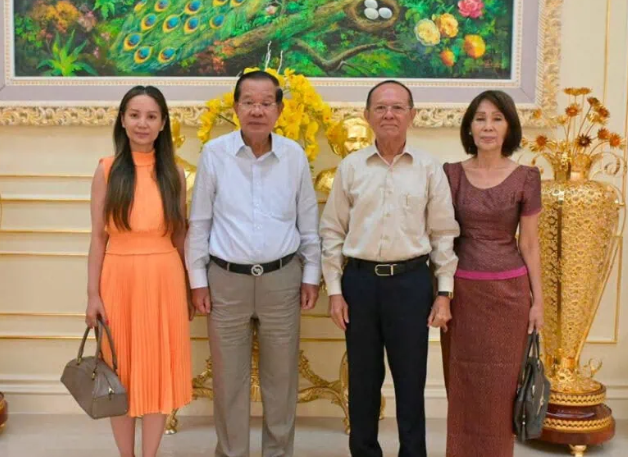
Cambodia's political landscape has shifted noticeably with Senate president Hun Sen welcoming former opposition leader Kem Sokha into his home, an encounter that underscores the dramatic transformation in relations between two figures who once dominated opposing ends of the country's political spectrum. The three-hour meeting on Sunday morning, attended by Sokha alongside his wife and daughter, represents a continuation of informal diplomatic contact between the rivals and marks yet another step in Sokha's gradual rehabilitation into public life following years of legal constraints.
The most conspicuous element of Hun Sen's announcement was his explicit commendation of Sokha's daughter, Kem Monovithya, whom he characterised as "an excellent human resource for the nation." This particular reference carries substantial weight given Monovithya's deep association with the Cambodia National Rescue Party, the opposition force her father previously led before its controversial dissolution by Cambodia's Supreme Court in 2017. Hun Sen's decision to highlight her capabilities in such glowing terms—claiming he spent much of their conversation engaging directly with her—suggests a possible opening toward a wider political accommodation.
Sokha's journey from prisoner to guest at the homes of Cambodia's ruling elite exemplifies the dramatic arc of contemporary Cambodian politics. Initially arrested in 2017, shortly after the CNRP's court-ordered dissolution, the former opposition leader faced a 27-year prison sentence handed down in 2023 on charges related to conspiracy with foreign powers. Following the Phnom Penh Appeal Court's confirmation of his conviction in April 2026, his prospects appeared bleak. Yet a royal pardon delivered on May 25 fundamentally altered his circumstances, terminating both his imprisonment and house arrest, though restrictions on political engagement initially persisted.
Subsequent legislative moves have steadily loosened the constraints encircling Sokha. A royal decree issued on July 24 eliminated his five-year ban on international travel, reinstating his freedom of movement beyond Cambodia's borders. Remarkably, these legal modifications occurred with apparent coordination between government and palace, suggesting consensus among Cambodia's leadership regarding Sokha's reintegration. However, his prohibition against engaging in political activities technically remains in place, a legal hedge that maintains official distance even as practical barriers dissolve.
The former opposition leader's public activities since receiving his pardon reveal a carefully calibrated approach to his return to prominence. His July 28 visit to Banteay Meanchey province to observe communities displaced by cross-border conflict demonstrated both his continued influence and his awareness of political sensitivities. Sokha framed his humanitarian intervention explicitly as the work of a private citizen rather than a political representative, a formulation that allows him to exercise agency without directly violating remaining restrictions.
Hun Sen's earlier mention of a previous visit by Sokha several weeks prior to the main meeting indicates that Sunday's encounter formed part of a broader pattern of contact rather than an isolated event. The Senate president noted that Sokha had called at his residence before departing to examine conditions for displaced civilians, suggesting that Hun Sen may have facilitated or encouraged the humanitarian mission. This sequencing implies coordination and possibly strategic alignment between the two former antagonists regarding issues of national concern.
The historical animosity between these figures cannot be understated for Malaysian and broader Southeast Asian observers assessing Cambodia's political stability. Hun Sen's Cambodian People's Party maintained overwhelming dominance throughout the 1990s and 2000s, yet the emergence of the CNRP in 2013 genuinely threatened that monopoly. The opposition force achieved remarkable electoral success, particularly in municipal elections in 2017, before being dissolved on legal grounds that international observers widely questioned. Sokha's arrest and extended detention were therefore understood globally as authoritarian suppression of political competition rather than genuine criminality.
The current rapprochement thus carries implications extending well beyond two individuals reconciling personal differences. It potentially signals Cambodia's ruling establishment becoming confident enough in its institutional control to accommodate former rivals within the political system. Alternatively, it may indicate negotiation toward Sokha's formal return to politics under conditions acceptable to the government, possibly as a moderate counterweight to any emerging left-wing or radical opposition forces. Hun Sen's specific praise of Monovithya warrants particular scrutiny; her elevation as a "human resource" could foreshadow a political role, perhaps positioning her as a bridge between her father's legacy and Cambodia's current political reality.
For Malaysia and the broader Association of Southeast Asian Nations, Cambodia's political trajectory matters substantially. ASEAN's commitment to non-interference in member states' internal affairs has historically constrained regional response to concerns about democratic backsliding or authoritarian consolidation. Yet economic partnerships, investment flows, and security cooperation all depend upon relative political stability. If Sokha's reintegration genuinely represents a softening of Cambodia's authoritarian posture and a reopening of space for opposition participation, it could stabilise the kingdom's political system while enhancing regional confidence in Cambodia's institutional development.
The ambiguity surrounding these meetings proves as significant as the meetings themselves. Neither party has publicly articulated the substance of their three-hour conversation, whether political accommodation figured among their discussions, or whether Hun Sen's flattery of Monovithya carried implicit promises of future prominence. This silence protects both sides—Hun Sen maintains the fiction that political restrictions remain enforceable while demonstrating flexibility, while Sokha avoids appearing to capitulate to pressure or abandon his principles. For observers tracking Cambodia's political evolution, these staged encounters merit close monitoring as indicators of whether genuine reconciliation is unfolding or whether they represent theatrical gestures masking continued restrictions on opposition activity.

