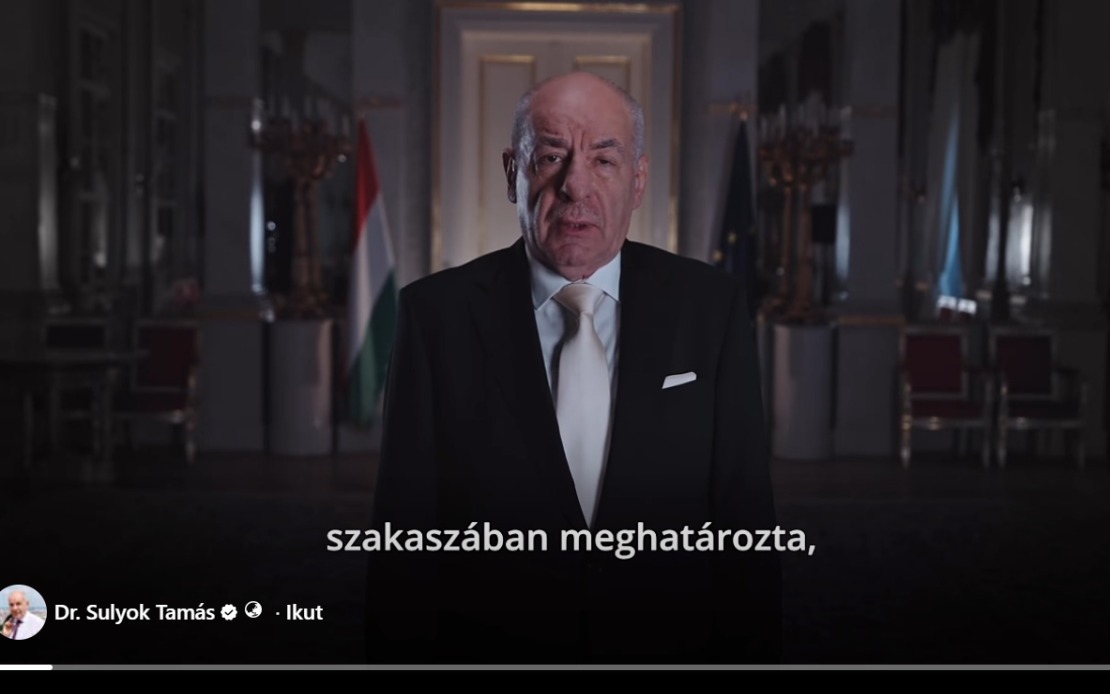
Hungary's political establishment has entered a dramatic new chapter following President Tamás Sulyok's decision to accept his own constitutional removal, a capitulation that concludes weeks of tension between the presidency and parliament over the country's governance structure. After initially resisting pressure from newly installed Prime Minister Péter Magyar, Sulyok announced on July 19 that he would formally countersign the constitutional changes, permitting them to take legal effect and rendering his office vacant by the following Monday. The development represents a significant turning point in Hungarian politics, marking the first tangible shift away from the institutional arrangements established during Viktor Orbán's lengthy tenure as premier.
The constitutional amendment that Sulyok endorsed had already secured parliamentary approval the previous week, but required presidential endorsement to become law. Magyar had imposed a five-day deadline on the head of state, warning that failure to comply would trigger impeachment proceedings. This ultimatum effectively removed any political wiggle room for the president, who found himself caught between constitutional principles and pragmatic reality. Though Sulyok maintained that parliament's decision to force his departure contradicted constitutional law, he acknowledged possessing no viable legal mechanism to resist the parliamentary majority. Even Hungary's constitutional court, legal analysts suggested, could have challenged only the procedural aspects of the amendment rather than its substantive content, leaving the president without meaningful recourse.
Sulyok's predicament underscores the precarious position of Hungary's ceremonial presidency within the country's power structure. In video remarks distributed through social media, the departing president articulated a broader critique of how Hungary's institutional design had evolved, contending that contemporary heads of state operate entirely at the discretion of the executive and legislative branches without meaningful supervisory capacity. His observations reflect legitimate concerns about executive dominance that have characterised Hungarian governance for years, though they came too late to prevent his removal. Parliamentary speaker Agnes Forsthoffer will temporarily exercise presidential functions until a successor is elected within thirty days, with the legislature itself selecting the new head of state—a system that concentrates presidential selection within parliament rather than distributing it more broadly.
Péter Magyar, who assumed the prime ministerial office following Orbán's electoral defeat in April, has positioned these constitutional modifications as foundational to his broader governance agenda. In a Facebook statement, Magyar framed the reforms as returning autonomy to ordinary Hungarian citizens after years of institutional constraints imposed by what he termed the Orbán regime. He emphasised that the constitutional changes would restore meaningful limitations on executive power, enable recovery of public assets allegedly misappropriated during the preceding administration, and reorient state institutions toward serving citizens rather than political interests. These rhetorical claims suggest Magyar's government intends to utilise the constitutional space created by Sulyok's ouster to implement comprehensive political and institutional reconstruction.
The constitutional amendment's passage and implementation represent consequences of the electoral shift that occurred three months prior, when Hungarian voters rejected Orbán's Fidesz party after more than a decade of political dominance. Magyar's party and its coalition partners interpreted this mandate as authorisation for substantial institutional reform, though the speed and scope of constitutional changes have provoked considerable scrutiny. The episode illustrates how decisively parliamentary majorities can reshape constitutional frameworks in systems where legislatures possess amendment authority, particularly when emergency conditions or political momentum persuades previously aligned institutional actors to yield.
For regional observers, Hungary's constitutional upheaval carries significance beyond its borders. The country has long occupied a contested position within European democratic structures, with international commentators divided over whether governance patterns represented democratic backsliding or legitimate conservative populism. The removal of an Orbán-aligned president and the acceleration of constitutional reforms signal a potential recalibration of Hungary's political trajectory, though questions persist regarding the depth and permanence of institutional change. Whether Magyar's administration can genuinely restore independent oversight functions and constrain executive prerogative, or whether these constitutional modifications will ultimately prove superficial, remains an open question that will substantially shape Hungary's democratic trajectory.
Sulyok's acceptance of the constitutional amendment, despite his stated misgivings about its legality, reflects a pragmatic calculation that active resistance would prove futile and potentially destructive. The president implicitly acknowledged that opposing an overwhelming parliamentary consensus, particularly when legal remedies appeared exhausted, would only prolong political crisis without changing the ultimate outcome. This acquiescence, while politically expedient, nonetheless illustrates the structural vulnerability of presidential office when legislative supermajorities unite against incumbent officeholders. His compliance also suggests that Hungary's political players, notwithstanding their ideological differences, retain sufficient institutional respect to avoid escalating constitutional disputes into outright confrontation.
The broader constitutional framework enabling such dramatic presidential displacement warrants examination. Hungary's system, inherited from the post-1989 transition period and subsequently amended repeatedly, concentrates substantial authority within parliament while allocating the presidency a largely symbolic role. This arrangement differs from presidential systems featuring independent executive election and considerable independent authority, and also differs from purely parliamentary systems where prime ministers derive authority exclusively from legislative confidence. Hungary's hybrid structure creates conditions where a parliament sufficiently determined can reshape fundamental institutions relatively rapidly, potentially enabling necessary reforms but also creating vulnerability to majoritarian excess.
Looking forward, Magyar's government faces substantial challenges in translating constitutional amendments into operational institutional reforms that meaningfully restore democratic constraints and public accountability. Constitutional text provides only foundational architecture; sustained political commitment, institutional resilience, and cultural reinforcement prove necessary for genuine democratic consolidation. The successive Polish and Hungarian governments have demonstrated that formal constitutional changes can coexist with persistent executive dominance and institutional imbalance when political commitment to genuine pluralism remains limited. Whether Magyar's administration will prove different depends on whether subsequent policy implementations demonstrate commitment to institutionalising constraints rather than merely redistributing power among elite factions.

