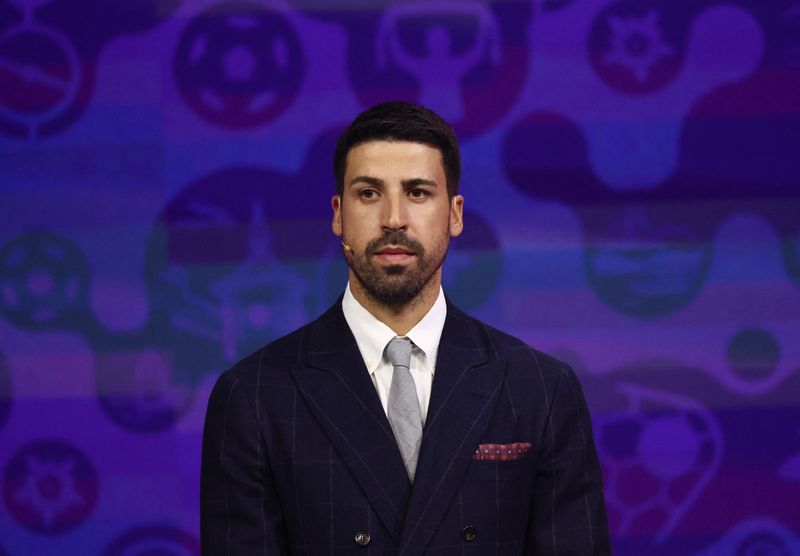
Sami Khedira, the German midfielder who won the World Cup in 2014, sees nothing troubling about brothers lining up on opposing sides when the 2026 tournament kicks off. Instead, the former Stuttgart and Juventus player views the phenomenon as an elegant expression of contemporary global identity—where citizenship and national allegiance need not align with a singular, inherited passport. Speaking at the Home of Football museum in New York, Khedira articulated a worldview shaped by his own lived experience: he represents Germany while his brother Rani wears Tunisia's colours, their father's homeland.
The sight of siblings split across different international sides has become increasingly common in modern football, and the 2026 World Cup will feature eight pairs of brothers navigating this complex terrain. Four of these sets will face each other directly in the tournament—a scenario that encapsulates the emotional and personal dimensions of belonging in an interconnected world. The Doue brothers, for instance, represent France and the Ivory Coast respectively, while Inaki and Nico Williams compete for Ghana and Spain. What might appear to some as a source of internal conflict—loyalty divided, identity fractured—Khedira reframes as proof of football's capacity to embrace human complexity rather than impose artificial boundaries.
Khedira's perspective is informed by the particular circumstances of his upbringing. Born and raised in Germany to a German mother and Tunisian father, he inhabits both cultures as natural extensions of his identity rather than competing claims. He acknowledges the social friction that sometimes arose from this duality: in Germany, some questioned his belonging because of his surname and physical appearance, while in Tunisia he remained distinctly foreign. Yet rather than experiencing this as tragic displacement, Khedira describes carrying dual cultural mentalities as something that renders him and his brother special. "We have both nations in our heart," he explained. "Both mentalities as well."
The expanded 48-team format for the 2026 World Cup has created unprecedented opportunities for smaller footballing nations to compete on sport's grandest stage. Countries such as Cape Verde, Curaçao, and Haiti now stand alongside traditional powerhouses, democratising access to the tournament in ways that benefit not only established programmes but also those still developing their infrastructure. Khedira observes that this expansion has contributed to a broader shift in competitive balance. African and Asian federations are systematically closing the gap on European and South American dominance, driven by investments in coaching education and institutional development. Yet he cautions that wealthy European nations bear a responsibility to support this development at source rather than simply harvesting talent through dual-nationality pathways.
The emotional resonance of these divided allegiances crystallised for Khedira during a recent friendly between France and the Ivory Coast. He watched as the Doue brothers sang both national anthems with full voices, a moment that transcended the tactical dimensions of the match itself. "How beautiful is that?" he reflected. "That's multicultural, and that's a strong message to the world because football is so powerful." This image—of young athletes honouring multiple identities within the ceremonial space of international football—captures what Khedira sees as the sport's unique capacity to articulate something about contemporary life that extends well beyond ninety minutes of play.
Yet for all this celebration of multicultural belonging, Khedira acknowledges the profound difficulty faced by adolescents who must navigate international federation approaches at formative ages. Young players find themselves courted by multiple national programmes, pressured to make decisions about lifelong allegiance before they possess the maturity to fully comprehend the implications. The choice cannot be dictated by politics, bloodline, or administrative pressure alone. Instead, Khedira argues, it must emerge from what he calls "a gut feeling"—an internal compass that points toward which community a player genuinely wishes to represent. This process demands genuine autonomy rather than coercion.
Khedira's own experience making this choice at eighteen remains vivid. He recognised the intensity of pressure that accompanies such a decision, the weight of expectations from family, federation officials, and the football establishment. He consulted respectfully with the Tunisian Football Association, honouring his father's heritage while ultimately choosing to represent Germany at senior level. This act of communication itself—maintaining dignity and respect across borders rather than viewing the choice as a rejection—reflects his philosophy that national selection need not entail the negation of other identities. Brothers can sing different anthems without erasing their shared blood.
The presence of eight pairs of brothers at the 2026 World Cup includes several other compelling cases. Derrick Luckassen and Brian Brobbey compete for Ghana and Netherlands respectively despite sharing a maternal bond, distinguishing themselves through their fathers' surnames and independent career trajectories. Harry and John Souttar represent Australia and Scotland, while Theo and Lucas Hernández both play for France—demonstrating that even sibling unity within a single nation's kit does not erase the broader reality of multicultural footballer identity. The Dutch contingent includes Jurrien and Quinten Timber, and the Caribbean nations contribute their own representation through Leandro and Juninho Bacuna of Curaçao. These cases collectively illustrate that there is no single template for how families navigate international football's allegiances.
What distinguishes Khedira's perspective from simplistic celebration of diversity is his recognition that the choice itself carries genuine weight. He does not dismiss the pressure as insignificant or treat the decision as merely a personal whim. Rather, he argues that the difficulty of the choice—the internal wrestling with identity, the respectful engagement with multiple cultural claims—constitutes precisely what makes the outcome meaningful. When a young player ultimately settles on a national team, having genuinely confronted the pull of multiple allegiances, that commitment possesses depth. The player carries authentic investment in the choice rather than defaulting to historical accident or demographic convenience.
For Malaysian and Southeast Asian audiences, Khedira's framing offers particular resonance. The region encompasses extraordinary ethnic, cultural, and religious diversity, with significant diaspora populations and multiple-nationality citizens navigating questions of belonging and allegiance. The principles he articulates—that identity need not fit neatly within single categories, that respect across cultural boundaries matters, that young people deserve genuine autonomy in choosing their communities—extend far beyond sport. Football in this context becomes not merely entertainment but a site where societies work through their deepest questions about inclusion, identity, and what it means to belong in an interconnected world. Khedira's vision suggests that instead of viewing multicultural allegiances as problems requiring resolution, we might recognise them as reflections of how people actually live in the twenty-first century.