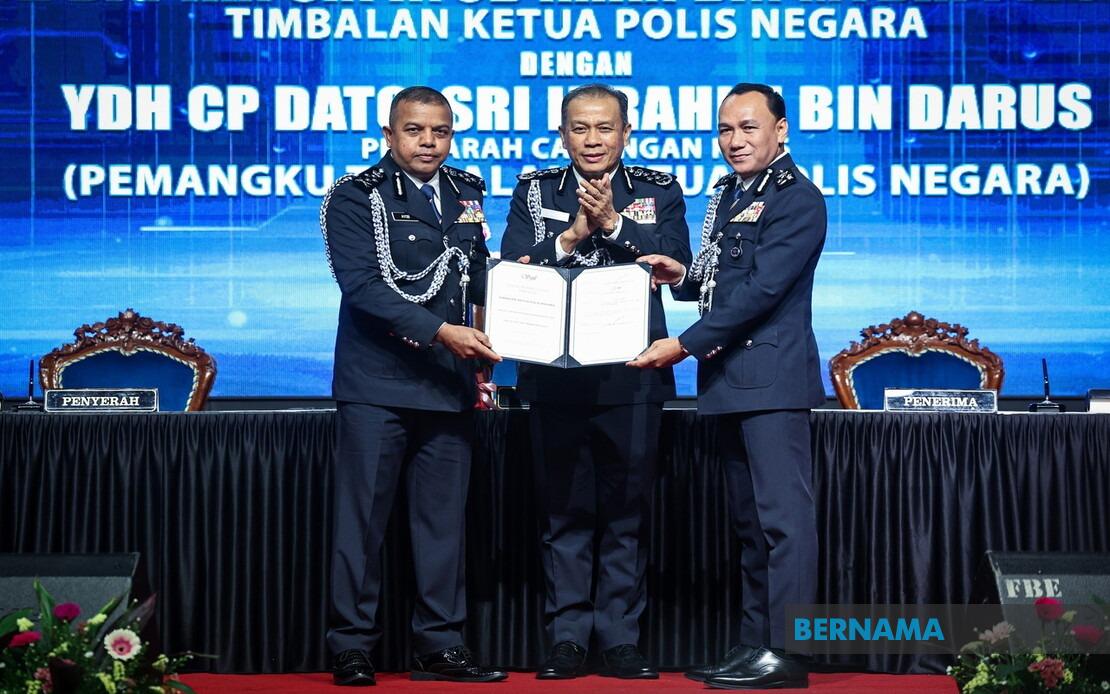
At a handover ceremony in Kuala Lumpur on July 26, Inspector-General of Police Tan Sri Mohd Khalid Ismail delivered a detailed tribute to Tan Sri Ayob Khan Mydin Pitchay as the latter concluded his tenure as Deputy Inspector-General of Police. Mohd Khalid characterised Ayob Khan's leadership as deeply rooted in commitment, firmness and personal integrity — qualities that defined his more than thirty years navigating the ranks of the Royal Malaysian Police.
The IGP emphasised that Ayob Khan embodied the qualities of a principled leader, one not easily swayed from the demanding responsibility of upholding the rule of law. This characterisation speaks to a particular leadership philosophy valued within Malaysia's policing establishment: steadfastness in ethical governance despite institutional and external pressures. In the Malaysian context, where police legitimacy has faced periodic scrutiny, Mohd Khalid's public endorsement of such principled conduct carries weight beyond ceremonial courtesy.
Mohd Khalid reflected on the personal dimension of their professional relationship, describing Ayob Khan not merely as a senior administrative deputy but as a trusted colleague who remained loyal through institutional challenges. The metaphor of "weathering storms" suggests the force has navigated complex periods during Ayob Khan's service. The IGP's appreciation for their "shared bittersweet and hard work" indicates both the demands placed on police leadership and the camaraderie required to sustain institutional direction during difficult periods.
Ayob Khan's career trajectory illustrates a progression through specialised and operationally sensitive portfolios. A graduate of Universiti Kebangsaan Malaysia, he accumulated nearly thirty-five years of service across critical divisions including the Special Branch, the Counter-Terrorism Division, and leadership positions in Johor. His appointment as the 29th Deputy Inspector-General in June 2023 represented the culmination of roles managing both intelligence and criminal investigation functions — areas where institutional credibility and ethical conduct intersect most pointedly.
The outgoing deputy's tenure encompassed command of the Narcotics Criminal Investigation Department and the Bukit Aman Criminal Investigation Department, positions requiring both operational effectiveness and integrity safeguards. Mohd Khalid specifically identified Ayob Khan's "determination in combating militant elements and safeguarding integrity" as exemplary for the broader leadership cohort. This dual emphasis — operational success against security threats combined with institutional integrity — reflects contemporary expectations of senior police leadership in Southeast Asia.
Datuk Seri Ibrahim Darus, previously serving as director of Bukit Aman Special Branch, assumes the acting Deputy Inspector-General position. The selection maintains continuity within the intelligence and investigation apparatus, as both the departing and incoming deputies possess Special Branch experience. Ibrahim's appointment suggests the force intends to preserve institutional knowledge and established protocols during the transition period.
Mohd Khalid extended formal confidence to Ibrahim, framing the acting deputy role as an opportunity to "strengthen the team's top leadership machinery" while maintaining "this legacy of excellence." The language emphasises continuity rather than transition, suggesting that both individuals operate within a shared institutional culture and command structure. For Malaysian police personnel, this messaging reinforces expectations of professional standards regardless of individual transitions at senior levels.
The ceremony underscores the institutional importance Malaysia's police leadership attaches to formal recognition of outgoing officers. Public acknowledgment of Ayob Khan's service — particularly the emphasis on principled leadership and rule of law commitment — serves multiple functions: it honours individual contribution, it signals institutional values to the broader force, and it addresses public perception of police conduct at a time when questions about institutional integrity remain relevant across Southeast Asia.
Ayob Khan's retirement marks the departure of an officer whose career reflected the evolution of Malaysian policing priorities across three decades. His early roles during periods of internal security focus, his later positions addressing transnational crime and counter-terrorism, and his recent deputy leadership all positioned him at the centre of operational and institutional development. Mohd Khalid's characterisation of this trajectory as exemplifying integrity and steadfast commitment attempts to establish a benchmark for leadership conduct within the force.
For Malaysian observers and regional counterparts in law enforcement, the transition illustrates how established police services manage leadership succession while maintaining public confidence in institutional direction. The emphasis placed on Ayob Khan's principled approach and Mohd Khalid's confidence in Ibrahim suggests a deliberate institutional effort to reinforce the legitimacy of police leadership at a moment when such reassurance proves periodically necessary in Malaysia's political environment.
The handover ceremony, though routine in procedural terms, carries significance in the context of Malaysian institutional governance. It provides public documentation of leadership transition, creates an opportunity for the IGP to articulate institutional values, and allows the incoming deputy to assume office with clearly articulated expectations. Ibrahim now inherits a portfolio that encompasses both operational security responsibilities and the burden of maintaining institutional reputation during periods when external scrutiny of police conduct remains present in Malaysian public discourse.

