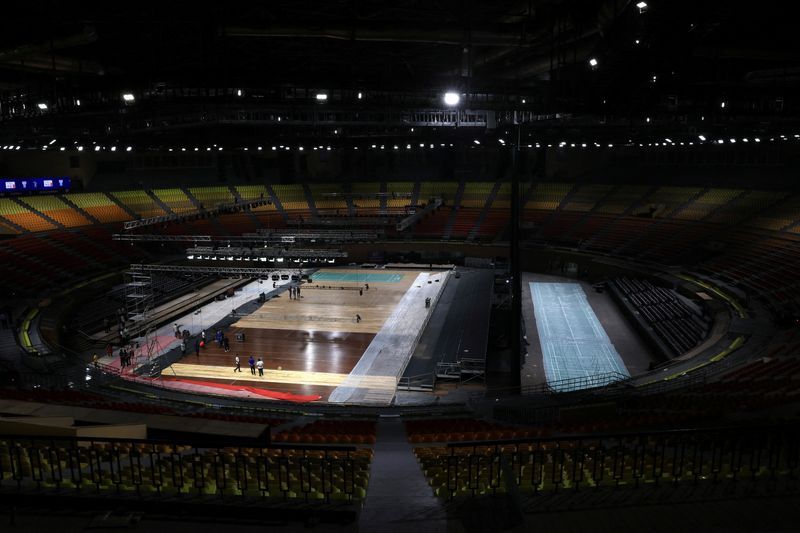
India's preparation for the Badminton World Federation World Championships in New Delhi next week includes an unconventional workforce component: a team of expert monkey mimics tasked with keeping disruptive primates away from the Indira Gandhi Indoor Stadium. The hiring of these specialists underscores the country's determination to prevent a repeat of the embarrassment that occurred during this year's Indian Open, when a monkey wandered into the spectator gallery, or the match interruptions caused by pigeons fouling the playing surface.
The deployment of monkey whisperers reflects a broader urban management challenge facing India's capital. Rhesus monkeys have become a persistent nuisance throughout New Delhi, regularly breaching secure buildings, attacking residents and pedestrians without warning, and disrupting public events. Rather than attempting to eliminate the animals, municipal authorities and event organisers have adopted a more pragmatic approach: using langur monkeys, larger primates with distinctive black faces, as natural deterrents. Langurs are known predators of rhesus monkeys, making their presence—or even the convincing mimicry of their calls—sufficient to drive away unwanted intruders.
Zafar, one of the hired specialists, represents a third generation of practitioners in what can only be described as a specialised profession in the Indian capital. During a recent media demonstration at the stadium, he showcased his hooting techniques, which produce vocalizations that trigger primal fear responses in rhesus monkeys. His expertise is not rooted in any formal training programme but rather in inherited knowledge passed down through his family. The philosophy underpinning his work emphasises non-lethal animal control: the objective is not to harm the monkeys but simply to discourage their presence in venues where human activity requires an animal-free environment.
The Badminton Association of India faced considerable embarrassment when the monkey intrusion occurred at the Indian Open earlier this year. The incident highlighted operational vulnerabilities in stadium management and raised questions about whether India could maintain the security and control standards necessary for hosting elite international sporting events. This concern carries particular weight given India's aspirations to showcase its capabilities as a host nation. The country is scheduled to organise the 2030 Commonwealth Games and is actively bidding for the 2036 Olympic Games—competitions of far greater scale and international visibility than the Badminton World Championships.
The animal control challenge extends beyond primates. New Delhi's pigeon population has emerged as an equally vexing problem for venue managers. During the Indian Open, matches were halted twice as birds soiled the court surface, and players expressed concerns about hygiene standards. The psychological and practical disruption caused by the pigeons during competition demonstrated that animal management strategies needed to address multiple species simultaneously. Solving these problems has therefore become integral to demonstrating competence in hosting world-class sporting events.
To address the pigeon issue, stadium operators have applied non-toxic gel—a substance routinely used on railway infrastructure to prevent bird roosting—across the roof and ventilation ducts of the Indira Gandhi Indoor Stadium. This preventative approach aims to eliminate the roosting sites that attract pigeons without causing harm to the birds or compromising the health and safety protocols that international sporting bodies demand. The application of such measures reflects the sophisticated operational approach that contemporary event management requires.
Sanjay Mishra, secretary general of the Badminton Association of India, has publicly stated that organisers have comprehensively addressed the deficiencies that became apparent during the Indian Open. He emphasised that India's sports ministry invested considerable effort in facility improvements and infrastructure upgrades. Mishra's assertions carry significance beyond mere stadium repairs; they represent official acknowledgement that the country takes its responsibilities as an international sporting venue seriously and is willing to invest resources in solving practical problems that could otherwise undermine the event's success.
Mishra further noted that the Badminton World Federation has expressed complete satisfaction with the arrangements in place for the World Championships. This explicit endorsement from the international governing body is crucial, as it suggests that Indian organisers have successfully implemented solutions that meet the technical and operational standards expected by the sport's premier competition. For a country positioning itself as a reliable host for major sporting events, such validation from international sports authorities carries considerable weight in future bidding processes.
The reliance on monkey mimics and anti-pigeon technology illustrates a distinctive challenge facing sporting event organisers in densely populated urban centres within South Asia. Unlike venues in cooler climates or regions with different ecological profiles, New Delhi must contend with wildlife management issues that are peculiar to its geographical and climatic context. This requirement has spawned specialised professions and novel solutions that blur the boundaries between traditional knowledge, practical innovation, and modern event management protocols.
For Malaysian observers, the Indian experience offers instructive insights. As Malaysia similarly hosts significant international sporting events—and as Southeast Asian countries generally compete for the prestige associated with major sports competitions—understanding how peers navigate operational challenges can inform domestic planning. The monkey and pigeon problems are not unique to India; cities across Southeast Asia face analogous wildlife management issues. The solutions employed at the Badminton World Championships, whether the cultural practice of monkey mimicry or the application of non-toxic bird deterrents, represent approaches that could have applicability in the region.
The broader narrative here concerns how emerging sporting powers address the gap between aspiration and execution. India's ambitions to host the Commonwealth Games and Olympic Games are significant and serve as a bellwether for other regional powers. The meticulous attention to animal management—addressing an issue that might seem peripheral to the core sporting competition—demonstrates the comprehensive approach that successful event hosting demands. Every detail, from monkey control to pigeon prevention, contributes to the overall impression of competence and organisational capability that shapes international perceptions of a nation's readiness for large-scale events.
As the Badminton World Championships proceed in New Delhi, the presence of monkey mimics working silently in the background will remain largely invisible to international viewers and commentators. Yet their contribution—like that of countless other specialised workers—will be fundamental to ensuring that the event unfolds without the disruptions that marred previous competitions. The championship thus becomes a test case not merely of badminton excellence but of India's ability to manage the complex logistics that hosting world-class sporting events entails.

