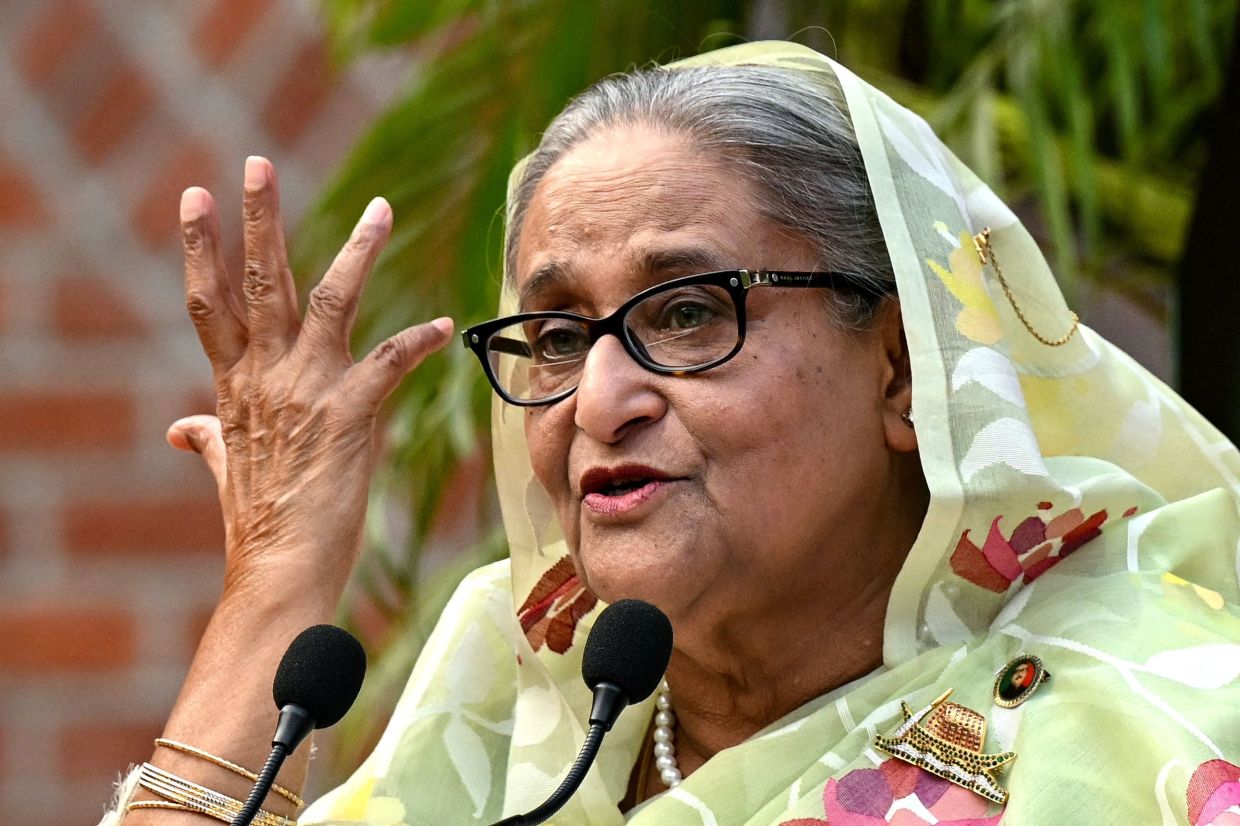
India's government has moved to distance itself from an upcoming virtual address by exiled Bangladesh former Prime Minister Sheikh Hasina, declaring that the event is entirely a private media initiative with no state involvement or endorsement. The clarification came after Bangladesh formally questioned New Delhi about its position on Hasina's planned appearance at a forum organised by the Foreign Correspondents' Club of South Asia scheduled for August 5, creating fresh diplomatic tension between the two South Asian neighbours.
Speaking at a regular media briefing, Indian foreign ministry spokesperson Randhir Jaiswal stated unequivocally that the government was neither organising the event nor backing any statements that might be delivered during it. The private media entity responsible for hosting the programme bears sole responsibility for its conduct. This careful distancing reflects India's delicate balancing act between harbouring a prominent political exile and maintaining increasingly important ties with Bangladesh's new leadership, which assumed power following elections in February.
The virtual appearance represents Hasina's first public communication since she fled to India in August 2024 following a student-led uprising that forced her from office. Now 78 years old, she has remained in India throughout the subsequent political upheaval in her home country. The format—a video address rather than in-person appearance—underscores both the constraints of her exile and the symbolic weight attached to her speaking out. She is scheduled to address the gathering alongside her son, Sajeeb Wazed Joy, and other speakers, though her aides have declined to preview the contents of her remarks.
Bangladesh's response has been notably aggressive, with authorities moving to prevent domestic media from reporting on the former prime minister's words. Information Adviser Zahed Ur Rahman issued a stark warning that any Bangladeshi news organisation or social media platform publishing Hasina's speech, statements, interviews, or multimedia content would breach a December 2024 order issued by the International Crimes Tribunal. This unprecedented media restriction reveals how seriously Dhaka regards the narrative challenge posed by the exile's continued voice and her political movement's potential resurgence.
The tribunal order that grounds this censorship directive was issued in the context of grave charges against Hasina. She faces a death sentence for crimes against humanity stemming from her government's violent response to the 2024 protests, a verdict she has denounced as legally invalid. The severity of these charges and Bangladesh's determination to enforce strict conditions on how her statements circulate domestically indicates official anxiety about her political durability and the Awami League party's capacity to recover its fortunes.
Rather than capitulating to Dhaka's pressure, Hasina's inner circle has signalled defiance. Abu Obaidha Arin, an adviser to the former prime minister, declared that the August 5 event would proceed as scheduled and that attempts at suppression would ultimately prove futile. He framed Bangladesh's actions as evidence of authoritarian impulses and suggested that silencing dissent within the country's borders cannot extinguish political voices operating from beyond them. This rhetoric speaks to a broader struggle between Hasina's supporters and the current Bangladeshi administration over the legitimacy of exile-based opposition politics.
The bilateral complications are substantial. Bangladesh has formally requested India's assistance in extraditing Hasina, a request that has not been granted and appears unlikely given India's historical patterns of offering asylum to political exiles from the region. Additionally, Dhaka's State Minister for Foreign Affairs Shama Obaed Islam has repeatedly raised concerns with New Delhi about Hasina and other senior Awami League figures conducting political activities from Indian soil. The message is plain: Bangladesh views such activity as incompatible with normal diplomatic relations and potentially destabilising to its fragile post-transition environment.
Relations between India and Bangladesh deteriorated significantly following Hasina's ouster, though both governments have recently signalled pragmatic willingness to rebuild the relationship under Prime Minister Tarique Rahman's administration. The current tensions over Hasina's address represent a test of that commitment. India's carefully calibrated statement—acknowledging the event while rejecting government responsibility—attempts to satisfy both sides: it allows the forum to proceed without state sponsorship while providing Bangladesh with a face-saving explanation that protects New Delhi's neutrality narrative.
For Malaysian and broader Southeast Asian observers, the episode illuminates persistent regional anxieties about political exile, state sovereignty, and transnational activism. Bangladesh's move to censor domestic media coverage of exile-based speech raises questions about information controls and the limits of press freedom in post-transition societies. The incident also demonstrates how former leaders can leverage international platforms to maintain political relevance even after forced departure, and how host countries navigate the diplomatic costs of providing refuge.
Hashina's stated intention to return to Bangladesh around December 2024 to present herself before the courts adds another dimension to these tensions. If she follows through on this plan, it would force a direct confrontation between the exile's determination to challenge her conviction and the current government's judicial apparatus. The prospect has clearly unsettled Bangladesh's leadership, prompting the aggressive media restrictions and diplomatic pressure on India. Her planned virtual address can be read as a preliminary test of how far her political movement can operate despite official suppression efforts.
The August 5 commemoration itself carries symbolic weight, marking two years since the uprising that fundamentally altered Bangladesh's political landscape. For supporters of the current government and the student protesters who drove regime change, the date represents democratic renewal. For Hasina's faction, it represents a rupture in their political dominance. The battle over who gets to narrate that anniversary—and whether her voice can reach Bangladeshi audiences—has become emblematic of the country's unresolved transition and the precarious position of a prominent exile monitoring events from neighbouring India.

