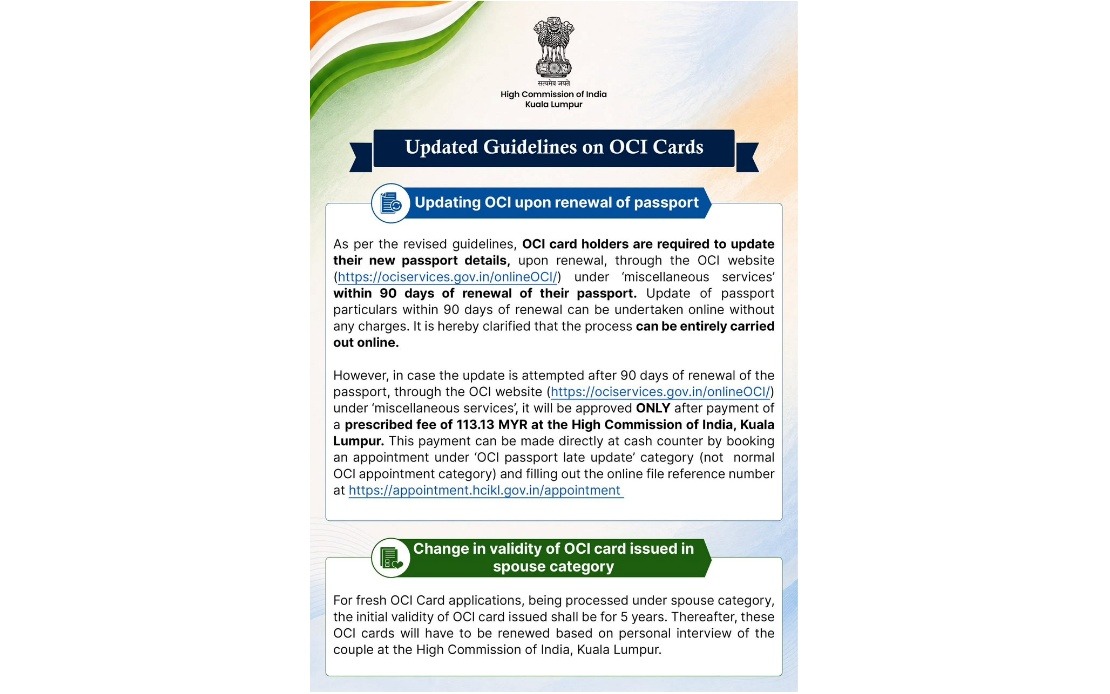
The High Commission of India in Kuala Lumpur has unveiled a series of revised administrative procedures governing Overseas Citizen of India (OCI) cards, marking a significant tightening of compliance requirements for the substantial population of Indian nationals and diaspora members throughout Malaysia. The updated framework introduces stricter timelines for passport-related documentation and fundamentally restructures the validity terms for applicants entering through the spouse sponsorship pathway, signalling New Delhi's push for enhanced record-keeping and security verification processes in its overseas missions.
At the heart of the new directives lies a 90-day mandate requiring OCI cardholders to register their newly issued passport particulars through the official OCI portal. The High Commission has positioned this update mechanism under the "miscellaneous services" segment of its online platform, enabling applicants to complete the entire submission process remotely at no cost. This digital-first approach aligns with broader Indian government initiatives to modernise consular services and reduce footfall at mission premises, though the transition relies heavily on applicants' awareness and proactive compliance.
The financial consequences of missing the initial deadline establish a clear incentive structure for timely compliance. Those who fail to update their passport information within the prescribed 90-day window face a mandatory fee of RM113.13 payable at the High Commission's physical location in Kuala Lumpur. This penalty tier effectively creates two classes of filers: those who comply promptly benefit from a costless process, whilst those who delay incur tangible financial charges alongside the administrative inconvenience of scheduling an in-person appointment.
The appointment booking mechanism for late updates introduces an additional procedural layer designed to manage workload at the mission. Applicants seeking to process overdue passport amendments must specifically reserve a slot under the "OCI passport late update" category rather than utilising the standard OCI appointment pathway. This segmentation enables the High Commission to track and process these submissions distinctly, whilst requiring filers to furnish their online file reference number as proof of their preliminary digital submission. The approach reflects operational efficiencies increasingly common among major missions managing high-volume consular services.
Perhaps more consequential for prospective applicants is the restructuring of validity periods for OCI cards issued under the spouse category, a pathway frequently utilised by Malaysian spouses of Indian citizens and Indian residents seeking to formalise their status. Previously, the validity framework for spouse-category OCI cards followed patterns established for primary applicants, but the revised guidelines now establish an initial five-year validity window for newly processed applications within this category. This compressed timeframe represents a meaningful departure from historical practice and necessitates earlier renewal cycles for this demographic.
The introduction of mandatory personal interviews as a prerequisite for spousal OCI card renewals signals heightened scrutiny of these applications by Indian authorities. Following the initial five-year period, couples must present themselves jointly at the High Commission in Kuala Lumpur to proceed with card renewal, a requirement absent from previous frameworks. This verification mechanism suggests deliberate efforts to authenticate marital relationships and ensure continued eligibility, potentially responding to concerns about fraudulent applications or changed circumstances that might affect sponsorship validity.
For Malaysian readers with Indian heritage or family connections, these procedural changes carry practical implications extending beyond mere administrative compliance. The compressed validity period for spouse-category applicants means renewal will demand periodic attention every five years, necessitating forward planning and timely coordination with Indian mission schedules. The joint interview requirement introduces an additional layer of bureaucratic engagement that couples must navigate, particularly given Malaysia's geographic distance from New Delhi and the potential visa and travel complications that might arise.
The High Commission has routed applicants toward two primary information sources for navigating the revised framework: the official OCI portal maintained by India's Ministry of External Affairs and the appointment booking system operated by the Kuala Lumpur mission itself. This dual-source approach aims to ensure widespread awareness, though experience with regulatory changes across consular services suggests that information dissemination gaps often persist despite official communications channels. The reliance on social media announcements by the mission itself underscores the digital communication strategies increasingly adopted by diplomatic establishments seeking to reach diaspora communities efficiently.
These revisions reflect broader strategic objectives within India's approach to overseas citizenship administration. By tightening verification procedures and establishing clearer compliance timelines, New Delhi appears intent on maintaining rigorous control over OCI status whilst modernising administrative practices through digitisation. For Malaysia's Indian diaspora community, estimated at several hundred thousand individuals, the changes introduce complexity that demands heightened awareness and proactive engagement with official channels. The spouse category modifications particularly warrant careful consideration by Malaysian nationals married to Indian citizens, as the five-year cycle and joint interview requirements represent material departures from previously established patterns.
The implementation of these guidelines occurred without announced transitional provisions, raising questions about how existing OCI cardholders should interpret their obligations. Whilst the High Commission appears to have applied the new passport update requirements going forward, clarity regarding grandfather clauses for previously issued spouse-category cards remains unclear from available official statements. This ambiguity underscores the importance of direct consultation with the mission rather than relying on secondary sources or assumed continuity with prior frameworks.
For Malaysia's broader Indian community and those with commercial or professional ties to India, these procedural refinements represent part of a larger ecosystem of consular services that warrant ongoing monitoring. The High Commission's apparent willingness to restructure long-standing frameworks suggests that additional modifications may follow as New Delhi continues modernising its diaspora engagement apparatus. Strategic awareness of these developments proves essential for those whose immigration status, family arrangements, or professional activities depend on maintaining compliant OCI standing within Malaysia's regulatory context.

