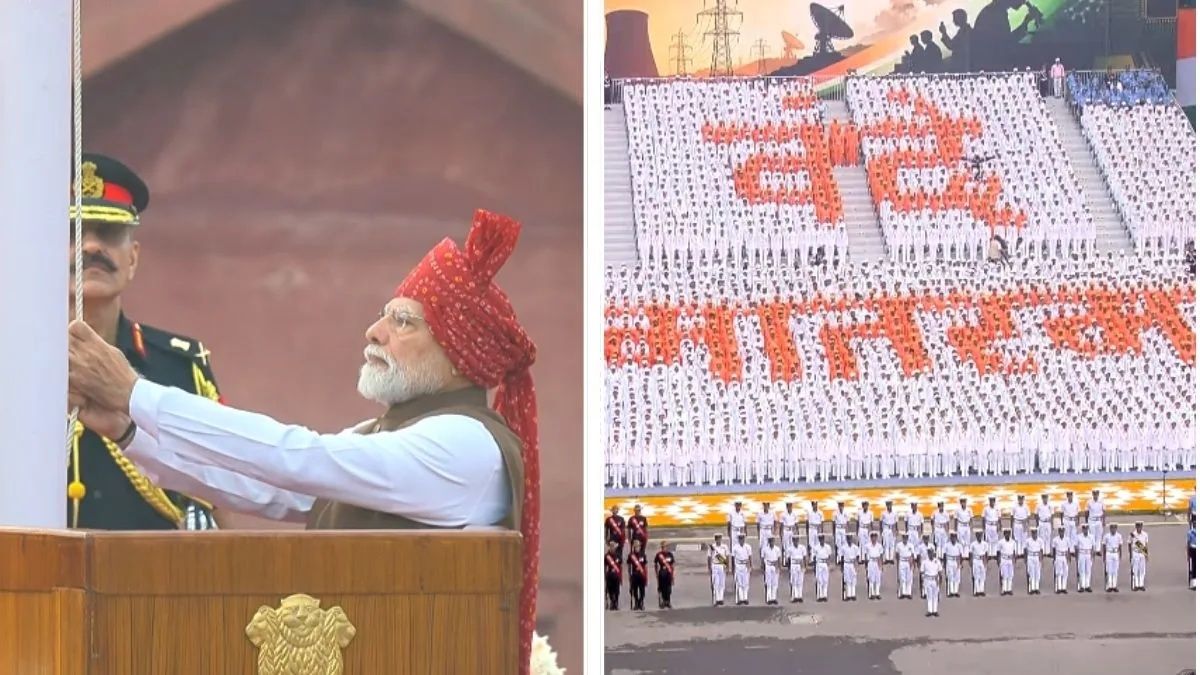
Prime Minister Narendra Modi has articulated a transformational vision for India's future, positioning the country's achievement of developed-nation status by 2047 as a defining national aspiration. Delivering his address from the Red Fort on India's 80th Independence Day, Modi framed this objective—termed 'Viksit Bharat'—as far more than an economic target, but rather a reflection of the nation's collective confidence and the inherent capabilities of its people. The 2047 timeline carries particular symbolic weight, marking a century since independence and providing a concrete generational benchmark for progress.
Modi's rhetoric centred on a departure from what he characterised as limited thinking, arguing that the scale of India's ambitions must expand proportionally with the nation's growing economic and geopolitical influence. He deliberately contrasted India's current trajectory with its earlier classification as one of the world's economically vulnerable nations, noting that the country had previously been grouped among the "Fragile Five"—a term applied by analysts to emerging markets facing significant economic headwinds. This framing allows Modi to emphasise the distance already travelled while mobilising political capital around the completion of an unfinished journey, a narrative strategy that resonates both domestically and internationally.
The implications of India's development aspirations extend considerably beyond New Delhi's borders. For Southeast Asian nations, India's emergence as a developed economy would fundamentally reshape regional economics, investment flows, and the balance of power within Asia. Malaysia and other ASEAN members have increasingly positioned themselves within India's strategic orbit, particularly through initiatives like the India-ASEAN partnership. A developed India would intensify competition for manufacturing investment, potentially redirecting supply chains that currently flow through Southeast Asia. Simultaneously, it would create opportunities for deeper technology partnerships and higher-value economic cooperation across the region.
In substantiating his vision, Modi cited concrete sectoral achievements accumulated over the preceding dozen years of his government's tenure. Defence production has expanded fourfold, reflecting India's push toward military self-sufficiency and reducing dependence on imported weaponry—a strategic priority for a nation increasingly conscious of its role as a counterweight to China in Indo-Pacific affairs. Khadi and traditional handicraft production, symbolically important to Indian national identity, has grown fivefold. More tellingly for economic modernisation, electronic manufacturing has expanded sevenfold, whilst mobile phone production increased by one-third. These figures illustrate a deliberate policy emphasis on building indigenous manufacturing capability across technology-intensive sectors rather than remaining dependent on imports or foreign production facilities.
The exponential growth in digital transactions—doubling over the period—deserves particular attention as an indicator of financial inclusion and the penetration of digital infrastructure into India's vast hinterland. This metric points toward the underlying structural changes necessary for sustained development: the expansion of banking services, technological literacy, and e-commerce ecosystems into regions historically underserved by formal financial institutions. For Malaysian policymakers observing India's trajectory, such metrics illustrate the scale of infrastructure investment and digital transformation required to shepherd a billion-plus population toward higher income levels.
Modi's emphasis on collective national purpose represents a political strategy designed to transcend sectarian and regional divisions within India's plural democracy. By invoking the language of shared ambition and national resolve, he attempts to position development goals as transcending partisan affiliation. The framing of 2047 as a generational mission positions younger Indians—those who will comprise the workforce and consumer base that drives growth—as custodians of a national project larger than any individual politician or administration. This generational framing carries particular weight in a democracy where electoral cycles are five years and political fortunes shift rapidly.
The ceremonial elements accompanying Modi's address underscore the symbolic dimensions of his vision. The full rendition of 'Vande Mataram', the nationalist song adopted during India's freedom struggle, at the Red Fort on Independence Day for the first time since 1947 carries layered meanings. Modi characterised this as a "historic moment", linking contemporary development aspirations to the nationalist project that culminated in independence. For Hindu nationalist constituencies that form a significant part of Modi's political base, such symbolic acts reaffirm connections between national pride, cultural assertion, and economic ambition.
Modi's address also incorporated reference to immediate humanitarian challenges, specifically the flood disasters then affecting multiple Indian states. This juxtaposition—combining transcendent long-term vision with acknowledgment of present-day suffering—serves multiple purposes. It demonstrates governmental attentiveness to citizens facing immediate hardship whilst situating disaster relief within a broader narrative of national solidarity and state capacity. The promise of national support to flood-affected families reinforces the notion of the Indian state as a guarantor of citizen welfare, a message particularly important in states where natural disasters periodically claim lives and destroy livelihoods.
The broader context for India's development vision includes intensifying competition with China for regional and global influence. By explicitly targeting developed-nation status, Modi positions India not merely as a rising economic power but as a nation determined to reach parity with the world's wealthiest economies. This aspiration, whilst ambitious, reflects genuine structural changes in India's economy over the past two decades, including the emergence of world-class technological and manufacturing sectors, significant foreign direct investment inflows, and the expansion of a consuming middle class numbering hundreds of millions.
However, substantial obstacles persist in realising this vision. India's infrastructure remains uneven, with significant portions of the population still lacking reliable electricity, clean water, and digital connectivity. Human capital development, whilst improving, continues to lag behind peer economies in Southeast Asia and East Asia. Agricultural productivity faces pressures from climate change, land fragmentation, and inadequate irrigation. The quality of secondary and tertiary education requires dramatic enhancement to support technology-intensive manufacturing and services sectors. These challenges do not invalidate Modi's vision so much as underscore the scale of sustained investment and institutional reform necessary to achieve it.
For Malaysian observers, Modi's 2047 vision carries both competitive and cooperative implications. An India that successfully transitions to developed status would emerge as a far more formidable economic and technological competitor, particularly in sectors where Malaysia has sought to develop competitive advantages. Yet it would simultaneously offer far larger markets for Malaysian exports and deeper opportunities for technology partnerships, venture capital flows, and talent circulation across the Bay of Bengal region. The trajectory Modi has outlined suggests that India-Southeast Asia economic relations will intensify considerably over coming decades, making the success or failure of this development vision consequential for the entire region's economic architecture.

