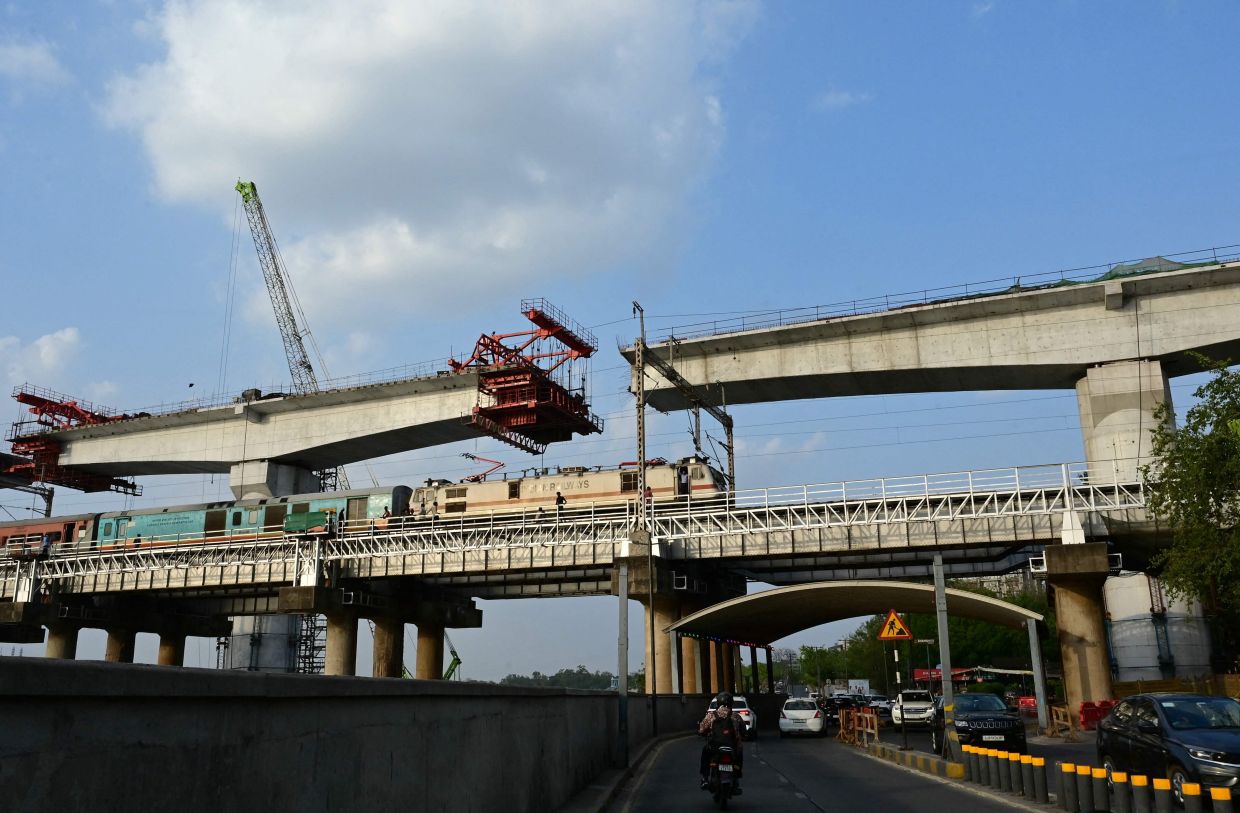
After nearly a decade of setbacks and false starts, India's flagship bullet train project is finally approaching tangible reality, with railway officials confirming that the first operational section will welcome passengers in 2027. The milestone represents a watershed moment for a nation that has staked considerable political and financial capital on transforming its transportation network through high-speed rail technology, though the long journey to this point underscores the formidable engineering and logistical challenges that India continues to grapple with in modernizing its infrastructure legacy.
The initial operational segment will connect two cities separated by roughly 100 kilometres—Surat, a global centre for diamond cutting and polishing, and Vapi, an industrial hub renowned for chemical manufacturing. This modest beginning will be part of the broader Mumbai-Ahmedabad High Speed Rail Corridor, a 508-kilometre project that promises to revolutionize connectivity along India's western coast. According to Dharmendra Tewari, additional director general of Indian Railways, a considerable proportion of work across the entire corridor has already reached advanced stages of completion, positioning the first phase for operation within the next three years.
The genesis of this ambitious undertaking traces back to 2017, when Prime Minister Narendra Modi and Japanese counterpart Shinzo Abe jointly launched the initiative, originally envisioned for completion in 2023. The partnership leveraged Japan's renowned Shinkansen technology, with Tokyo providing financing through the Japan International Cooperation Agency covering 81 percent of the projected US$17 billion budget. However, the project encountered substantial obstacles including cost escalations tied to land acquisition and persistent construction delays that have pushed the timeline forward by several years—a pattern familiar to observers of major infrastructure development in India.
When fully operational between Mumbai and Ahmedabad, the bullet train will dramatically compress travel times on one of India's most economically vital corridors. The journey will shrink from six hours via conventional rail to just under two hours, rivalling or exceeding the convenience of air travel when accounting for airport procedures and processing. This efficiency gains particular resonance for India's financial capital, a metropolis of 22 million inhabitants, and Ahmedabad, a major commercial centre in Modi's home state of Gujarat that holds strategic significance in the government's development agenda.
The complete corridor is slated for commissioning by the end of 2028, deliberately timed to support Ahmedabad's hosting of the 2030 Commonwealth Games. Indian officials view this scheduling as instrumental to broader ambitions, positioning the games as a showcase event and launching pad for India's ultimately more audacious goal of securing the 2036 Olympic Games. The symbolic weight of these timelines reflects how New Delhi has embedded the bullet train within a comprehensive vision of national development and global positioning.
The Mumbai-Ahmedabad route demanded engineering solutions of remarkable scope and ambition, including a 21-kilometre tunnel carved through mountainous terrain and, most notably, India's first undersea rail tunnel. These infrastructure features exemplify the technical competence India has cultivated despite historical obstacles, yet their completion remains outstanding as the project enters its critical final phases. These engineering achievements would represent genuine technological progression for a rail system that, while extensive, has been historically bound by the constraints of colonial-era design and maintenance philosophies.
India's transformation of its railway infrastructure over recent decades merits contextual appreciation. The nation operates one of the world's most extensive rail networks, moving 7.41 billion passengers and 1.67 billion tonnes of freight annually across approximately 85,000 kilometres of track capable of speeds of 110 kilometres per hour and above—representing roughly 80 percent of total network capacity. The introduction of domestically engineered Vande Bharat trains, capable of 180 kilometres per hour, has demonstrated India's growing capacity for indigenous technological development, with these services carrying nearly 40 million passengers in the previous year alone.
The bullet train represents a qualitative leap beyond these achievements, designed for speeds of 350 kilometres per hour with an operational ceiling of 320 kilometres per hour. This flagship project embodies Modi's stated commitment, made during his initial 2014 electoral victory, to establish comprehensive high-speed rail connectivity throughout the nation. Beyond the immediate Mumbai-Ahmedabad corridor, the government has articulated ambitions for seven additional high-speed rail corridors totaling approximately 4,000 kilometres, though these remain largely in the planning phase without defined implementation timelines.
These prospective networks reveal governmental thinking about economic geography and regional integration. A proposed east-west corridor would link New Delhi with Varanasi—Modi's parliamentary constituency and Hinduism's holiest city—extending onward to Siliguri, a strategic gateway connecting India's economically vital northeastern states to the broader national economy. A complementary north-south initiative would traverse from Ahmedabad through Mumbai and southward via the tech hubs of Pune, Hyderabad, and Chennai, effectively creating a trans-continental spine for high-speed passenger movement.
Government planning documents characterise these prospective routes as "growth connectors," framing high-speed rail not merely as transportation infrastructure but as catalysts for economic integration and interregional commerce. This conceptualisation reflects global best practices observed in developed nations where high-speed rail networks have demonstrably stimulated economic activity and competitiveness across previously disconnected regions. For Southeast Asian observers, India's initiative holds particular relevance, as successful implementation could establish a template for regional governments considering comparable projects.
The financial architecture undergirding the bullet train—particularly Japan's substantial loan commitment through Jica—demonstrates the continuing centrality of Japanese development financing in Asian infrastructure projects. Japanese technology transfer and project management expertise have historically commanded premium valuation in developing-country infrastructure contexts, and the Shinkansen system's reputation for reliability and safety makes it a natural choice for India's first high-speed venture. This partnership simultaneously reinforces the strategic alignment between Tokyo and New Delhi within regional geopolitics.
However, escalating costs threaten to undermine the project's financial sustainability. Indian media reports suggest that land acquisition expenses and implementation delays could substantially elevate the US$17 billion price tag, introducing budgetary pressures that could influence the trajectory of subsequent planned corridors. These cost dynamics merit monitoring, as they will likely determine whether India's broader high-speed rail ambitions evolve from aspirational policy documents into concrete infrastructure investments.
The 2027 opening of the Surat-Vapi section carries symbolic importance extending beyond mere transportation utility. It will validate India's capacity to execute technologically sophisticated infrastructure projects to international standards, building institutional and technical competencies essential for subsequent initiatives. For a nation with profound aspirations toward global infrastructure leadership and whose engineers and planners increasingly participate in projects across Asia and Africa, the bullet train represents a crucial proving ground—one whose success or failure will reverberate through India's development trajectory for decades.

