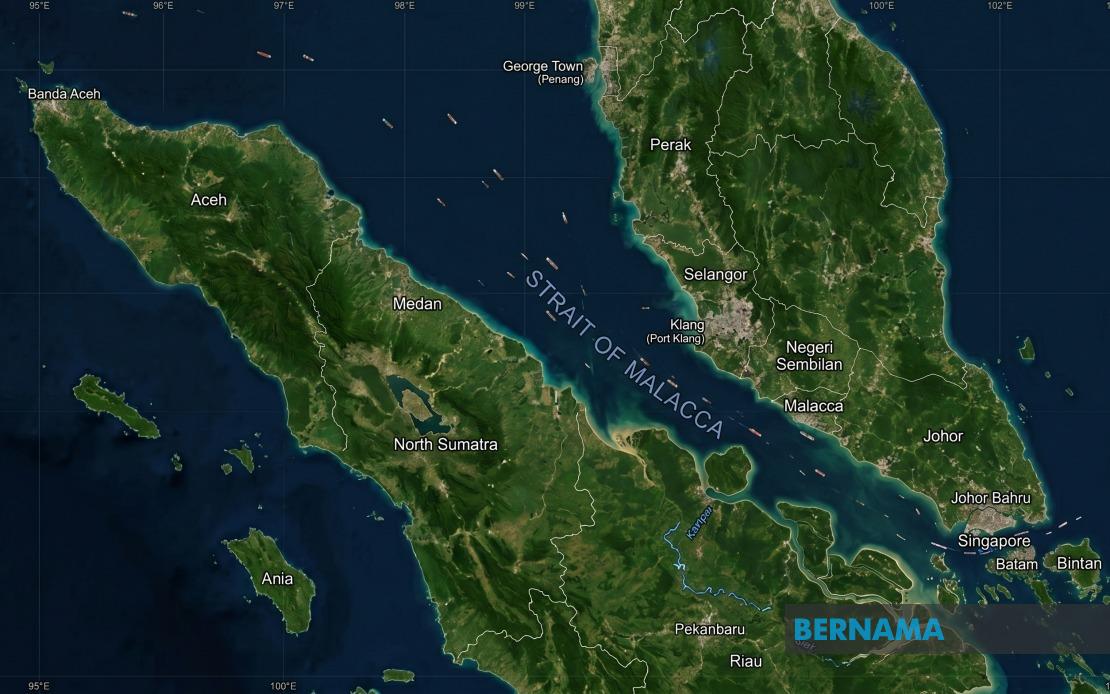
During their annual leaders' retreat in Jakarta on Monday, Indonesia's President Prabowo Subianto and Singapore Prime Minister Lawrence Wong underscored the strategic importance of the Strait of Malacca and their mutual obligation to preserve its security. The two leaders, meeting at Istana Merdeka in what Prabowo described as the second such gathering between them, reaffirmed Indonesia and Singapore's shared responsibility as nations directly bordering this vital maritime passage. Their joint commitment reflects growing recognition that the stability of the Strait—through which roughly one-third of global maritime trade passes—remains fundamental to the prosperity and security of both nations and the broader Southeast Asian region.
Prabowo emphasised that Indonesia and Singapore's defence of the Strait of Malacca operates within the framework established by the 1982 United Nations Convention on the Law of the Sea (UNCLOS). This legal foundation provides the basis for both countries to exercise their maritime rights while ensuring the waterway remains accessible to all vessels regardless of origin. The president stressed that maintaining an open passage serves not only the national interests of littoral states but also the broader international community dependent on unobstructed maritime commerce. By anchoring their commitment in UNCLOS, Indonesia and Singapore signal that their approach is grounded in established international law rather than unilateral assertion, a posture that carries significant weight in regional diplomatic discourse.
Beyond the bilateral framework, Prabowo explicitly mentioned the coordination mechanism involving Malaysia and Thailand, underscoring that effective stewardship of the Strait requires a four-nation approach. This emphasis on multilateral cooperation distinguishes the current effort from purely bilateral arrangements and reflects the reality that all four countries have legitimate interests in the waterway's security. The inclusion of Malaysia and Thailand in this arrangement has particular resonance for observers in Kuala Lumpur and Bangkok, as it validates their role in determining the Strait's future security architecture. This commitment to inclusive coordination also implicitly acknowledges that sustainable solutions to maritime challenges in the region must be developed through consensus among all stakeholders rather than imposed by dominant powers.
The leaders identified several specific threats requiring coordinated responses, including maritime pollution, navigational accidents, and piracy. Prabowo characterised these challenges as matters of vital interest to countries surrounding the Strait, a formulation that elevates environmental and safety concerns to the same strategic level as traditional security considerations. This broader conception of maritime security reflects contemporary understanding that threats to the Strait extend well beyond military or geopolitical concerns. Pollution incidents, shipping accidents, and organised piracy can disrupt commerce, damage ecosystems, and create humanitarian crises that affect multiple nations simultaneously. The willingness of Indonesia and Singapore to frame these diverse threats as collective responsibilities suggests a move towards comprehensive maritime governance.
Wong's visit to Jakarta represented the continuing deepening of Indonesia-Singapore ties at the highest levels of government. The timing of the annual leaders' retreat demonstrates that both nations view their relationship as substantial enough to warrant regular personal engagement between heads of state and government. For Singapore, a city-state heavily dependent on the security of surrounding sea lanes, this commitment carries existential importance. For Indonesia, as the country with the longest coastline bordering the Strait, the ability to work constructively with Singapore—historically a source of regional friction—reflects pragmatic acceptance that common interests outweigh historical grievances.
Prabowo's reference to the upcoming 60th anniversary of Indonesia-Singapore diplomatic relations provides historical context for understanding the significance of current cooperation. Six decades of diplomatic ties, despite the occasional tension, have created institutional mechanisms and mutual interests that facilitate collaboration on maritime security. The president's expression of confidence that continued cooperation would contribute to regional stability, growth, and prosperity suggests that Indonesia views the Strait's security not merely as a defensive necessity but as a foundation for broader economic development. This framing appeals to developmental interests shared across Southeast Asia and positions maritime security as integral to the region's aspirations for sustainable growth.
The joint press conference also addressed broader regional and global issues, with both leaders reaffirming ASEAN's preference for peaceful resolution of disputes through dialogue and diplomacy. This emphasis carries particular weight given ongoing tensions in the South China Sea and elsewhere in the region where military posturing occasionally overshadows diplomatic efforts. By publicly recommitting to peaceful dispute resolution, Indonesia and Singapore signal to other regional powers that the ASEAN community expects adherence to these principles. Prabowo's specific mention that disagreements and misperceptions should be resolved openly between friends suggests an implicit contrast with approaches based on unilateral assertions or coercive pressure.
The strategic location of the Strait of Malacca as a chokepoint for global commerce means that incidents affecting navigation directly influence prices and supply chains far beyond the region. Disruptions to shipping through the Strait impact Malaysian petrochemical industries, Singapore's refining sector, and Indonesia's resource exports. By strengthening bilateral coordination with Singapore while simultaneously engaging Malaysia and Thailand, Indonesia is positioning itself as a responsible guardian of international commerce rather than as a nation seeking to exploit its geographic position. This approach enhances Indonesia's standing in international discussions regarding maritime governance and strengthens its claim to legitimate authority over its territorial waters.
For Malaysian policymakers and observers, the Indonesia-Singapore commitment to coordinated stewardship of the Strait represents both reassurance and opportunity. The explicit inclusion of Malaysia in the coordination framework acknowledges Kuala Lumpur's indispensable role in the waterway's security. Simultaneously, the emphasis on international law and peaceful dispute resolution creates space for Malaysia to advance its own interests and concerns regarding the Strait without being marginalised by bilateral arrangements between larger powers. The commitment to addressing pollution and maritime accidents aligns with Malaysia's longstanding concerns about environmental protection in the region.
The meeting's focus on preparing the Indonesia-Singapore partnership for future challenges suggests that both countries recognise the need for adaptive governance structures as geopolitical and environmental circumstances evolve. Whether through enhanced information-sharing technologies, joint maritime patrols, or coordinated environmental monitoring, the framework established through this and previous meetings provides foundation for innovation in maritime security practices. The leaders' emphasis on forward-looking cooperation, rather than dwelling on historical disputes or grievances, sets a tone that encourages regional partners to invest in collaborative solutions.
The reaffirmation comes at a moment when maritime security challenges in Southeast Asia are intensifying. Piracy remains endemic in certain areas, climate change threatens to alter shipping patterns and maritime environments, and great power competition increasingly focuses on control of sea lanes. Within this complex environment, the willingness of Indonesia and Singapore to publicly commit to multilateral coordination with Malaysia and Thailand provides reassurance to global shipping interests that these waters will remain navigable and secure. The invocation of UNCLOS and established international law suggests that regional powers are seeking to manage competition through institutional frameworks rather than through power politics alone.

