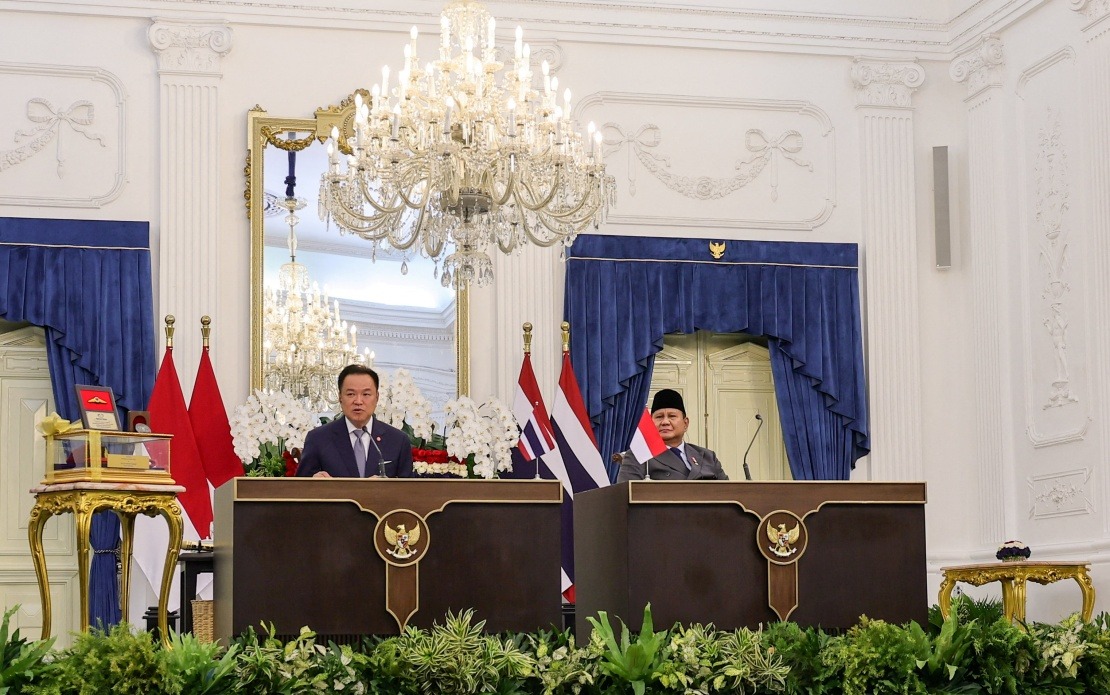
Indonesia and Thailand have jointly committed to sustaining ASEAN's peace initiatives in Myanmar, with both nations emphasising the importance of implementing the Five-Point Consensus through dialogue and humanitarian engagement. The pledge emerged from the second Leaders' Consultation between Indonesian President Prabowo Subianto and Thai Prime Minister Anutin Charnvirakul, held at Jakarta's Merdeka Palace on Monday, signalling renewed momentum in the regional bloc's efforts to address the protracted Myanmar crisis.
During the bilateral meeting, both leaders stressed that maintaining ASEAN unity and centrality remains the cornerstone for achieving lasting peace and stability throughout the region. President Prabowo articulated Indonesia's vision for ASEAN to play a constructive, leading role in securing sustainable solutions in Myanmar, positioning the grouping as a responsible regional actor capable of managing inter-state conflicts through consensus-building and inclusive dialogue. This emphasis on collective action reflects Jakarta's broader strategy of leveraging ASEAN mechanisms to address challenges that individual nations cannot resolve alone, particularly given the complex political dynamics within Myanmar's conflict landscape.
Beyond Myanmar-specific discussions, the bilateral engagement revealed a significant expansion of security and defence cooperation between the two countries. Indonesia and Thailand recognised that the contemporary threat environment transcends traditional military concerns, with transnational organised crime emerging as a pressing menace requiring coordinated responses. Both nations agreed to intensify joint operations against these criminal networks, committing to enhanced intelligence sharing, coordinated financial tracking investigations, and improved law enforcement coordination across borders. This comprehensive approach acknowledges that criminal syndicates increasingly operate across multiple jurisdictions, making bilateral and multilateral cooperation essential for effective disruption.
The scourge of online scam operations has emerged as a particularly acute concern for both nations, with sophisticated criminal networks exploiting vulnerable populations across Southeast Asia. President Prabowo noted that Indonesia and Thailand would prioritise dismantling these operations through closer coordination, recognising that such schemes often target citizens from multiple countries while being orchestrated from transnational bases. Thailand's Prime Minister Anutin highlighted his government's commitment to advancing law enforcement capacity and intelligence-sharing mechanisms specifically designed to counter these emerging threats, underscoring Bangkok's acknowledgement that cybercriminal networks represent a modern security challenge requiring innovative enforcement approaches.
A significant humanitarian dimension emerged through Thailand's facilitation of repatriation efforts for Indonesian victims of online scam syndicates. Jakarta expressed appreciation for Bangkok's cooperation in facilitating the return of nearly 1,000 Indonesians who had fallen victim to these criminal operations, demonstrating that bilateral security cooperation extends beyond prevention to encompassing victim support and repatriation services. This compassionate approach signals both governments' recognition that combating transnational crime involves not only apprehending perpetrators but also providing justice and assistance to affected citizens, enhancing the legitimacy of law enforcement efforts.
The two countries further agreed to establish a Transnational Referral Mechanism, a formal institutional framework designed to expedite the identification, protection, and dignified repatriation of victims of transnational crimes. This mechanism represents a substantive institutional innovation that could serve as a template for other ASEAN partnerships, creating standardised procedures for victim assistance across borders and ensuring that human trafficking victims, scam survivors, and other vulnerable populations receive appropriate protection and support. For Malaysian stakeholders and regional observers, this development carries significance as it demonstrates how bilateral cooperation can generate institutional solutions applicable across the broader ASEAN framework.
On the defence cooperation dimension, Thailand proposed substantive military-to-military collaboration, including the supply of 36 amphibious wheeled armoured vehicles to Indonesia. This defence industry proposal reflects Bangkok's strategic interest in deepening military-industrial partnerships within the region while supporting Jakarta's equipment modernisation efforts. Beyond hardware provision, Anutin committed Thailand to expanding regular joint military training exercises and maritime security operations, acknowledging that conventional military cooperation remains vital for regional stability even as non-traditional security challenges gain prominence. The emphasis on maritime cooperation carries particular relevance given ASEAN's strategic location astride vital global shipping lanes and the increasing prevalence of maritime security incidents.
Anutin's visit to Jakarta represented his first official trip to Indonesia since assuming Thailand's premiership in September 2025, underscoring the importance Indonesia places on bilateral relations with Bangkok. The fact that this engagement marked the first visit by a Thai prime minister to Indonesia in 15 years highlights a significant gap in high-level diplomatic engagement between the two nations, making the current bilateral reset particularly meaningful. This renewal of prime ministerial visits signals both countries' intention to elevate bilateral relations and coordinate more closely on shared regional challenges, potentially reversing a period of reduced high-level interaction.
For Malaysia and other ASEAN members, this Indonesian-Thai rapprochement carries several implications. The emphasis on institutionalising cooperation through mechanisms like the Transnational Referral Mechanism suggests that ASEAN members increasingly recognise the necessity of formal frameworks for addressing transnational threats that individual nations cannot manage unilaterally. Malaysia, which faces similar challenges with online scam networks and human trafficking, could potentially benefit from participating in or learning from these bilateral cooperation models. The bilateral focus on Myanmar peace efforts also reflects how ASEAN's larger members remain committed to addressing the Myanmar crisis despite the challenges in achieving consensus within the broader grouping.
The convergence of Myanmar peace efforts with expanded security cooperation reveals a comprehensive approach to regional challenges that acknowledges interconnections between political stability and human security. Transnational crime networks often flourish in conflict zones where governmental capacity is compromised, making parallel efforts to restore peace in Myanmar and combat organised crime strategically coherent. Indonesia and Thailand's bilateral partnership thus reflects sophisticated understanding that regional peace requires simultaneous attention to both traditional security concerns and the human security dimensions that affect ordinary citizens.
Looking forward, the sustainability of these cooperative commitments will depend on adequate resource allocation, consistent political will, and the ability of both governments to translate bilateral agreements into operational reality. The success of joint military exercises, intelligence-sharing protocols, and victim referral mechanisms requires institutional capacity building and ongoing coordination mechanisms. For Malaysia and the broader ASEAN region, these bilateral developments offer both opportunities and benchmarks for evaluating progress in addressing shared transnational challenges while maintaining the collective regional framework that underpins ASEAN's diplomatic unity.

