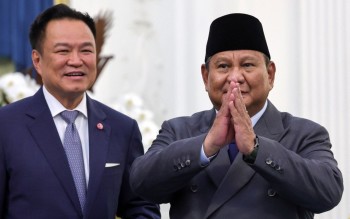
Indonesia and Thailand have set their sights on substantially deepening commercial ties, with both nations committing to achieve US$20 billion in annual bilateral trade by 2030 under a freshly adopted strategic partnership roadmap. The agreement, sealed during a bilateral meeting at Jakarta's Merdeka Palace on Monday between Indonesian President Prabowo Subianto and Thai Prime Minister Anutin Charnvirakul, represents a significant escalation in economic cooperation between Southeast Asia's second and eighth-largest economies. The roadmap, formally titled the Indonesia-Thailand Strategic Partnership Roadmap 2026-2030, establishes a comprehensive blueprint for coordinated action across multiple sectors critical to both nations' development priorities.
Anutin's visit marked a historic moment in recent bilateral relations, constituting the first official visit by a Thai prime minister to Indonesia in 15 years and Anutin's inaugural trip to the country since assuming Thailand's top political post in September 2025. The timing underscores both leaders' commitment to revitalizing institutional linkages that had atrophied during the intervening period. By hosting this visit, President Prabowo signalled Indonesia's strategic interest in positioning Thailand as a core partner within its regional economic architecture, moving beyond the previous Leaders' Consultation conducted during Prabowo's visit to Bangkok last year when the two countries formally elevated their relationship to Strategic Partnership status.
Central to the new framework is the establishment of the Indonesia-Thailand Joint Trade Commission, operating at the commerce minister level, marking the first institutional mechanism of its kind in the countries' diplomatic history. This JTC will function as a dedicated platform for identifying business opportunities, streamlining trade procedures, and systematically addressing tariff barriers and non-tariff obstacles that presently constrain commercial flow. The creation of this formal structure reflects recognition that achieving the ambitious US$20 billion target requires moving beyond ad hoc negotiations toward embedded institutional dialogue. Currently, Indonesia ranks as Thailand's fourth-largest trading partner within ASEAN, a ranking that both nations believe underutilizes the economic potential inherent in their combined GDP and complementary production bases.
Food security emerged as a principal pillar of the renewed partnership, with both governments identifying agriculture as strategically vital for regional stability and prosperity. Thailand has committed to maintaining its role as a dependable supplier of high-quality rice to Indonesian markets, while simultaneously seeking expanded Indonesian openness for Thai agricultural exports, including meat, dairy products, and specialized farming machinery. Most significantly, Anutin signalled Thailand's ambition to dramatically increase its purchases of Indonesian urea fertilizer, potentially escalating annual volumes from the current baseline of approximately 60,000 tonnes to several hundred thousand tonnes. This substantial increase would create meaningful new revenue streams for Indonesian producers while strengthening Thailand's agricultural productivity through access to competitively priced fertilizer inputs.
Energy cooperation represents another strategic dimension where both nations perceive mutual benefit. The two countries have agreed to establish an Indonesia-Thailand Energy Forum designed to fortify regional energy security and accelerate transitions toward renewable and sustainable energy systems. This collaborative mechanism will involve coordinated action between government entities and the private sector, recognizing that energy transitions require both policy frameworks and commercial investment. For Indonesia, which possesses substantial natural gas and renewable resources, deeper Thai engagement offers expanded market opportunities. For Thailand, such cooperation promises enhanced energy resilience through diversified sourcing and technological knowledge transfer.
Digital economy integration constitutes an increasingly salient dimension of the bilateral agenda. Both governments have committed to expanding cooperation in this rapidly expanding sector, with particular emphasis on promoting transactions denominated in local currencies—the Indonesian rupiah and Thai baht—rather than relying exclusively on US dollar settlement. Such arrangements improve transaction efficiency, reduce foreign exchange exposure, and strengthen the role of both currencies within regional commerce. This initiative carries broader significance for ASEAN's efforts to reduce dependence on extraregional payment systems and build intra-regional financial infrastructure.
The halal industry presents a compelling area for joint value creation with pronounced regional and global dimensions. Both Indonesia and Thailand possess significant halal production capabilities and export aspirations, suggesting potential for collaborative development of integrated halal value chains spanning production, certification, logistics, and marketing. Notably, Anutin underscored the urgency of renewing the mutual recognition agreement governing halal certification before its expiration in November, emphasizing that regulatory harmonization remains foundational to expanded commerce. For Malaysian readers, this development carries particular relevance given Malaysia's own strategic positioning in halal industries and ASEAN's collective ambitions to capture greater shares of global halal markets.
Education and human capital development featured prominently in the outcomes, with both leaders signing a memorandum of understanding aimed at strengthening educational cooperation. Such initiatives facilitate knowledge transfer across sectors, build professional networks linking the two countries' business communities, and create pathways for talent mobility. Additionally, secondary agreements concluded during the visit demonstrated the breadth of engagement, including cooperation between Thailand's Tourism Authority and Indonesia's TransNusa on tourism connectivity and a private-sector arrangement between Bio-Axel and Pro Konsilium addressing organic waste processing.
The bilateral trade target itself requires contextual understanding. Currently, Indonesia-Thailand trade substantially trails the potential indicated by the nations' combined economic scale and complementary resource endowments. Achieving US$20 billion annually by 2030 would require consistent double-digit growth rates, necessitating removal of existing impediments and proactive cultivation of new trade flows. The emphasis on institutional mechanisms—particularly the JTC—reflects both leaders' understanding that aspirational targets require supporting structures and sustained political commitment.
For Southeast Asia's broader economic architecture, this Indonesia-Thailand partnership development carries implications extending beyond bilateral commerce. Both nations occupy central positions within ASEAN's decision-making structures and economic corridors. Strengthening their bilateral relationship enhances ASEAN's overall cohesion and economic dynamism. Furthermore, as both countries navigate changing regional geopolitics and global economic transitions, deepened economic interdependence can serve stabilizing functions. For Malaysian policymakers and businesses, the Indonesia-Thailand initiative underscores the dynamism within ASEAN's intra-regional economic engagement and the importance of maintaining competitive positioning within Southeast Asian supply chains and markets.

