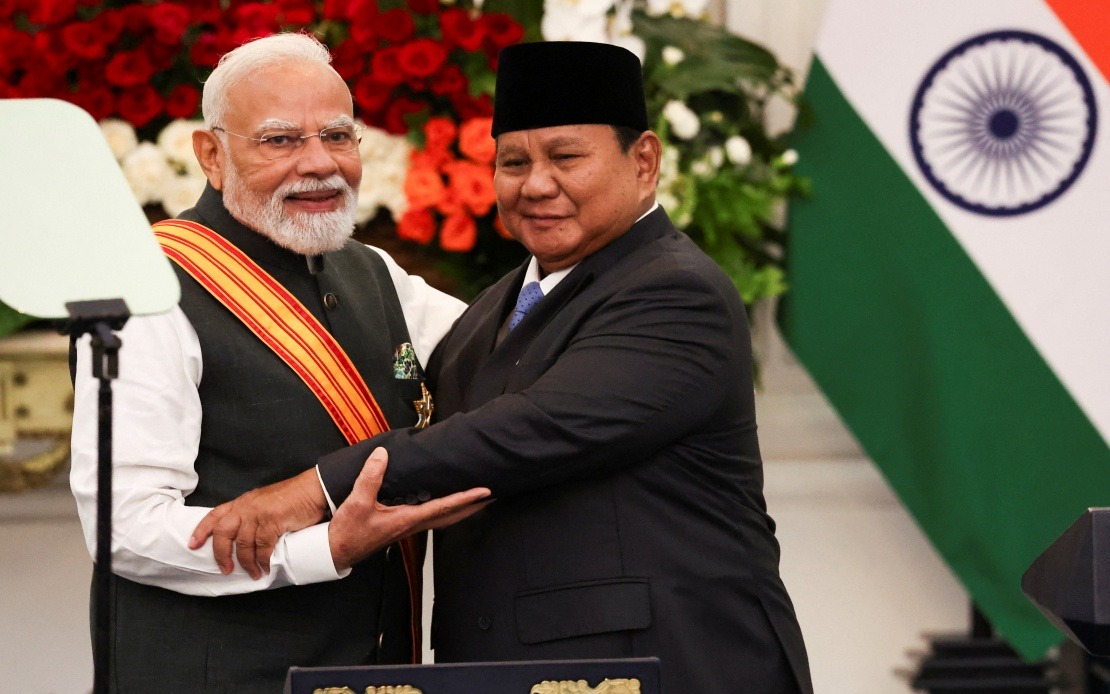
Indonesia has conferred its highest state honour upon Indian Prime Minister Narendra Modi during an official state visit, marking a significant diplomatic milestone in the expanding relationship between Southeast Asia's largest economy and South Asia's dominant power. The award, presented by President Prabowo Subianto at the Merdeka Palace in Jakarta on Tuesday, underscores the deepening strategic alignment between the two nations as they navigate an increasingly complex Indo-Pacific landscape.
Prabowo's decision to grant this prestigious recognition reflects Jakarta's deliberate effort to cement India's role as a cornerstone partner in Indonesia's broader regional and global strategy. The Indonesian president emphasised that the honour acknowledges not merely Modi's personal leadership qualities, but the tangible contributions he has made towards elevating Indonesia-India relations to the status of a Comprehensive Strategic Partnership. This elevation represents a qualitative shift in how the two countries frame their engagement, moving beyond traditional diplomatic courtesies to institutionalised, multi-faceted cooperation across defence, trade, technology, and maritime security.
The symbolic weight of this award gains further significance when considered alongside historical precedent. Prabowo noted that India's first prime minister, Jawaharlal Nehru, previously received this same honour, a connection that carries particular meaning for both nations. Nehru's foundational role in establishing the Non-Aligned Movement and his influence on Indonesia's early foreign policy under Sukarno created enduring institutional and ideological links between New Delhi and Jakarta. By honouring Modi in the same manner, Indonesia signals continuity in its commitment to the Indian relationship whilst simultaneously acknowledging how that partnership has evolved to meet contemporary strategic challenges.
The bilateral meeting at Merdeka Palace, livestreamed for public consumption, served as the formal platform for articulating shared priorities. Modi's visit represents reciprocal diplomacy, following Prabowo's own journey to India earlier in the year. This pattern of high-level exchanges demonstrates both countries' commitment to maintaining sustained political engagement at the highest levels, a practice that buttresses broader institutional relationships and provides regular opportunities for recalibrating strategic positions.
Indonesia's explicit recognition of India's support for its BRICS membership bid reveals how the honour extends beyond bilateral sentiment into concrete strategic alignment. Jakarta's pursuit of BRICS membership reflects its desire to diversify its great power partnerships and reduce dependence on any single strategic architecture. India's backing of this ambition signals New Delhi's willingness to facilitate Indonesia's access to an expanded forum that includes China, Russia, Brazil, and South Africa, strengthening Jakarta's negotiating position on the global stage.
For Malaysian and broader Southeast Asian observers, this development carries important implications for regional geopolitical balance. Indonesia's cultivation of India as a strategic partner complements its existing relationships within ASEAN and its engagement with other dialogue partners. The Comprehensive Strategic Partnership framework suggests expanding collaboration in areas where Indonesia has traditionally sought external support, including maritime security, capacity building, and technology transfer. India's growing naval presence in the Indian Ocean and its strategic interests in maintaining freedom of navigation align closely with Indonesia's own regional security concerns.
The characterisation of Modi's visit as a historic milestone by Prabowo underscores Jakarta's assessment that India's role in the Indo-Pacific is entering a new phase of maturity and strategic significance. Both countries face overlapping concerns regarding great power competition, maritime security in contested waters, and the preservation of rules-based international order. By elevating this partnership through ceremonial and substantive measures simultaneously, Indonesia positions itself as a trusted bridge between South and Southeast Asia.
Prabowo's emphasis on the deep historical and cultural ties binding the two nations provides crucial context for understanding contemporary strategic decisions. These civilisational connections, rooted in Buddhism and Hinduism's historical influence on Southeast Asian kingdoms, provide a foundation of mutual understanding that transcends transactional diplomacy. When Prabowo speaks of preserving friendship and cooperation, he invokes this longer historical memory whilst directing it toward present-day geopolitical requirements.
The practical manifestations of this partnership will likely crystallise in expanded defence cooperation, joint exercises, technology collaborations, and possibly deeper integration within regional economic frameworks. Indonesian defence acquisitions, technological upgrades, and capacity-building initiatives increasingly involve Indian participation, reflecting Jakarta's confidence in New Delhi as a reliable partner. The emphasis during their joint statement on "concrete and mutually beneficial cooperation" signals that both capitals intend to move beyond symbolic gestures toward substantive institutional arrangements.
For Malaysia and other ASEAN members, Indonesia's deepening India engagement presents both opportunities and considerations. Closer Indonesia-India ties could enhance ASEAN's collective strategic autonomy in dealing with great powers, whilst also potentially creating new layers of complexity in regional diplomacy. The recognition of Indonesia's permanent BRICS membership aspirations within this bilateral context illustrates how regional partnerships increasingly intersect with extra-regional alignments, creating networks of interdependency that shape policy outcomes across multiple domains.
The award to Modi ultimately represents Indonesia's strategic calculation that India's trajectory as an economic and military power, combined with its geographic position and democratic governance, makes it an indispensable partner for Jakarta's long-term interests. By honouring Modi through its highest state recognition, Prabowo has signalled that this partnership ranks among Indonesia's most important bilateral relationships, a declaration that will reverberate through regional diplomatic circles and influence how other countries calibrate their own approaches to both Indonesian and Indian foreign policy.

