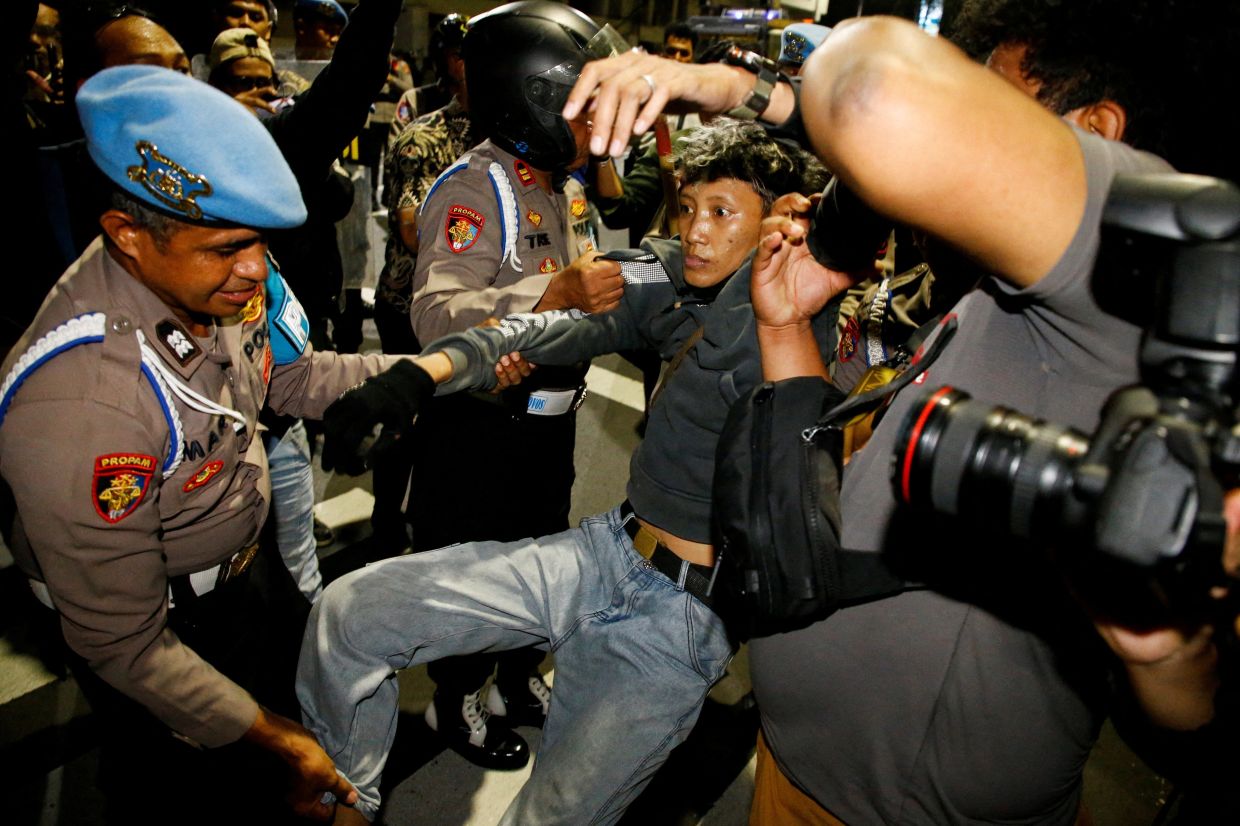
Indonesian police have filed charges against four individuals in connection with an anti-government rally held in Surabaya on Friday, marking the latest friction between citizens and authorities over economic hardship and a scandal-plagued national programme. The demonstration, which drew approximately 100 participants near a government building in the country's second-largest city, reflected mounting public discontent with a recent fuel price adjustment and a federally-funded school meals scheme that has been embroiled in corruption allegations and widespread food poisoning incidents.
The Surabaya police chief, Luthfie Sulistiawan, disclosed on Sunday that officers deemed the protest unruly after some participants threw objects including firecrackers and rocks. In response, law enforcement deployed what Sulistiawan characterised as "firm actions" to break up the gathering. The four individuals facing charges stand accused of property destruction and assault against police officers, though authorities initially detained 24 people at the scene and released most without prosecution.
The fuel price controversy stems from the Indonesian government's decision earlier this month to raise the cost of non-subsidised gasoline by roughly 30 per cent. This adjustment reflects Jakarta's broader effort to relieve strain on the national budget, particularly as conflict in the Middle East has disrupted global energy markets and pushed oil prices higher. The timing has inflamed public sentiment in Southeast Asia's largest economy, where petrol costs directly influence transportation expenses, food prices, and household budgets across the income spectrum.
Indonesia's paradoxical energy situation complicates this policy challenge. As an oil-producing nation with significant reserves, the country has long maintained heavily subsidised fuel prices to shield consumers from global market volatility. Yet despite domestic production, Indonesia remains a net importer, meaning it must purchase additional crude to satisfy domestic demand. This structural vulnerability became acute as geopolitical tensions abroad rippled through energy markets, pushing the government toward raising prices as a fiscal necessity rather than mere economic preference.
Parallel to fuel protests, larger demonstrations have erupted in Jakarta and other urban centres opposing both the petrol hikes and the government's multi-billion-dollar free meal programme for schoolchildren. Launched as a policy to combat child malnutrition and improve educational outcomes, the initiative has instead become a symbol of administrative failure and suspected graft. Since its rollout, tens of thousands of people have reported falling ill from contaminated food distributed through the scheme, and investigations have uncovered evidence of corruption among officials responsible for procurement and implementation.
The free meals controversy has proven particularly damaging to government credibility because it couples idealistic ambition with practical catastrophe. Officials promoted the scheme as a signature anti-poverty measure, yet its partial suspension came only after mass food poisoning cases generated headlines across Southeast Asia and prompted public health concerns. Critics argue that beyond the health crisis, the programme's bloated budget and murky financial dealings have siphoned resources that could have been deployed more effectively.
Additionally, six individuals detained during the Surabaya gathering remain under investigation after police detected controlled substances in their systems. This detail suggests authorities may pursue broader charges, though it remains unclear whether the drug findings relate to protest activities or constitute separate matters. The continued detention of these six individuals underscores how Indonesian law enforcement sometimes expands charges during demonstrations, a practice that rights groups have scrutinised.
The police response to Friday's demonstration reflects official determination to restrict anti-government street activity, a consistent approach in Indonesia despite the country's democratic institutions and constitutional protections for assembly. By charging four participants while releasing others without prosecution, authorities signal selectivity in enforcement, potentially deterring future protesters while maintaining a facade of proportionality. This calculated approach has characterised Indonesian responses to recent civil unrest, balancing the need to demonstrate governmental strength against international and domestic pressure to respect democratic freedoms.
For Malaysian and Southeast Asian observers, Indonesia's current turmoil carries instructive lessons. Fuel subsidy reforms trigger predictable public backlash across the region, as demonstrated previously in Malaysia, and governments must weigh economic necessity against political stability. Similarly, large-scale welfare initiatives require robust institutional capacity and transparency mechanisms; corruption and mismanagement can swiftly erode public trust. The Indonesian case exemplifies how policymakers attempting simultaneously to address multiple crises—geopolitical oil supply disruptions, budget deficits, and child welfare—risk compounding public grievance when implementation fails.
The coming weeks will reveal whether the Surabaya charges discourage further protests or catalyse broader demonstrations. Student movements in Jakarta have shown resilience and organisational sophistication, suggesting that fuel price resistance and concerns about the meals programme will likely persist. Indonesia's government faces mounting pressure to either reverse the fuel increase, demonstrate demonstrable progress in the free meals scheme, or articulate a compelling rationale that persuades citizens to tolerate immediate hardship for purported long-term stability.

