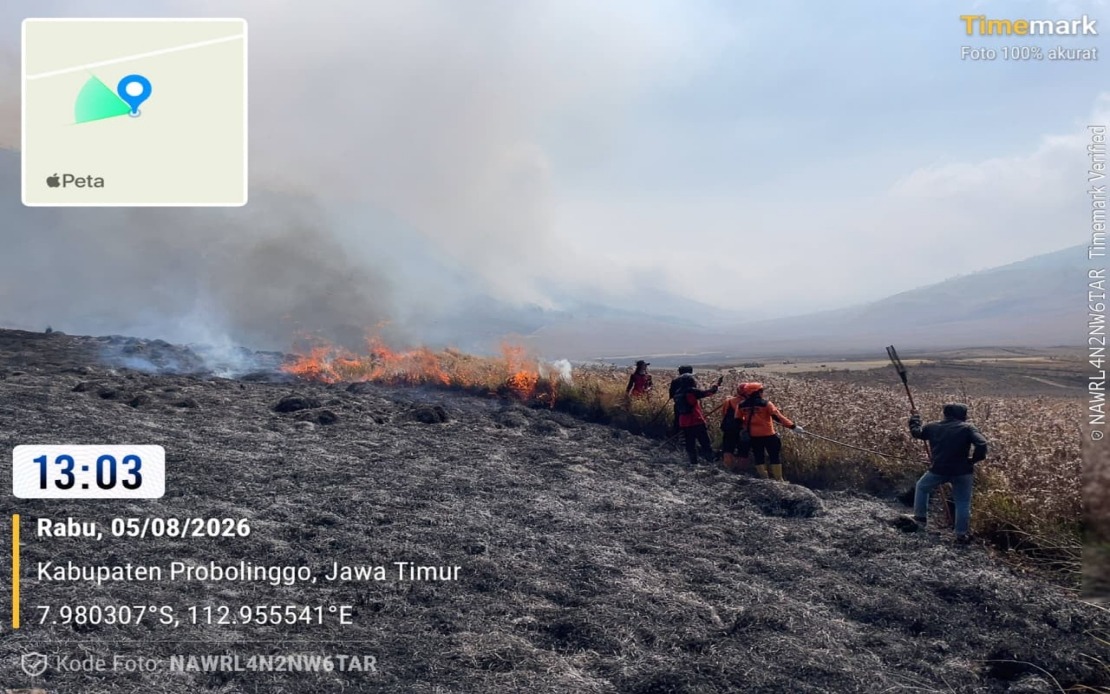
Indonesian disaster management authorities have escalated their response to a major wildfire ravaging Mount Bromo by deploying two water-bombing helicopters to tackle the blaze in East Java. The fire, which erupted on Monday, has consumed roughly 60 hectares of vegetation across the Probolinggo and Malang regencies, posing challenges for ground personnel attempting to suppress the inferno in one of Indonesia's most geologically active and culturally significant regions.
According to Abdul Muhari, head of the National Disaster Management Agency's Disaster Data, Information and Communication Centre, the conflagration has affected two distinct jurisdictions. Approximately 10 hectares have burned in Probolinggo Regency, while the remaining 50 hectares fall within the Bromo Tengger Semeru National Park in Malang Regency. The distribution of damage across two administrative boundaries has necessitated coordinated response efforts between provincial and national authorities, illustrating the complexity of managing natural disasters in mountainous terrain straddling multiple jurisdictions.
The deployment of aerial assets represents a strategic shift in containment efforts after ground crews achieved significant progress by Wednesday afternoon. BNPB's decision to bring in helicopters reflects the particular challenges posed by the fire's location on steep, difficult-to-access slopes where conventional firefighting teams face severe logistical constraints. The rugged topography of Mount Bromo, combined with dense vegetation and unpredictable wind patterns common to volcanic highlands, has necessitated this advanced intervention to reach isolated hotspots that remain inaccessible to personnel on foot.
Despite gains in suppressing the primary fire zone, several active hotspots continue to smoulder in the most treacherous terrain. Emergency responders have maintained continuous surveillance and engagement with these remaining flare-ups, recognizing that incomplete extinction in such environments can lead to rapid reignition if conditions shift. The extended timeline of the fire, now burning for several days, suggests that environmental factors such as fuel moisture and atmospheric conditions have complicated rapid resolution.
Beyond helicopter deployment, authorities are preparing additional interventions to enhance suppression capabilities. BNPB is planning a Weather Modification Operation contingent upon favourable atmospheric conditions, a technique that introduces cloud-seeding materials to induce precipitation over the affected areas. This complementary approach, combined with ongoing ground operations by the joint emergency response team, demonstrates the multi-layered strategy being employed to overcome the fire's persistence in challenging geography.
The incident has prompted the Bromo Tengger Semeru National Park Authority to implement precautionary closure of sections of the Mount Bromo tourist area indefinitely. This decision prioritizes both operational efficiency for firefighting efforts and the safety of visitors who might otherwise be exposed to smoke, falling embers, or unstable terrain destabilized by heat and fire. The closure carries significant implications for local tourism economies that depend heavily on visitors to this UNESCO-recognised national park, though authorities have deemed public safety the paramount concern.
Investigators are examining evidence suggesting that an unattended campfire abandoned by hikers may have ignited the wildfire, though formal determination of cause remains ongoing. If confirmed, this incident would highlight recurring challenges in managing recreational activities within protected natural areas where visitor compliance with fire safety protocols remains inconsistent. The sprawling nature of Mount Bromo's slopes and the substantial footfall from domestic and international tourists create inherent fire risks that require robust prevention messaging and enforcement mechanisms.
The Mount Bromo wildfire carries implications extending beyond immediate environmental and economic concerns. As climate patterns shift and temperatures rise across Southeast Asia, volcanic regions with significant vegetation coverage face elevated fire risk during dry seasons. Indonesia, with its extensive national park system and critical forest reserves, is particularly vulnerable to cascading wildfire events that can degrade ecosystems, affect air quality across regional boundaries, and strain emergency response infrastructure. This incident underscores the need for enhanced preparedness investments and early detection systems.
For Malaysian observers, the Mount Bromo situation serves as a reminder of shared vulnerability within the broader region to transboundary environmental crises. Large-scale Indonesian wildfires have previously triggered air pollution episodes affecting Malaysia and neighbouring countries. Enhanced regional cooperation on fire prevention, early warning systems, and resource-sharing arrangements would strengthen collective resilience. The commitment of Indonesian authorities to deploy advanced firefighting technology demonstrates recognition that modern environmental challenges require contemporary solutions and cross-border coordination.

