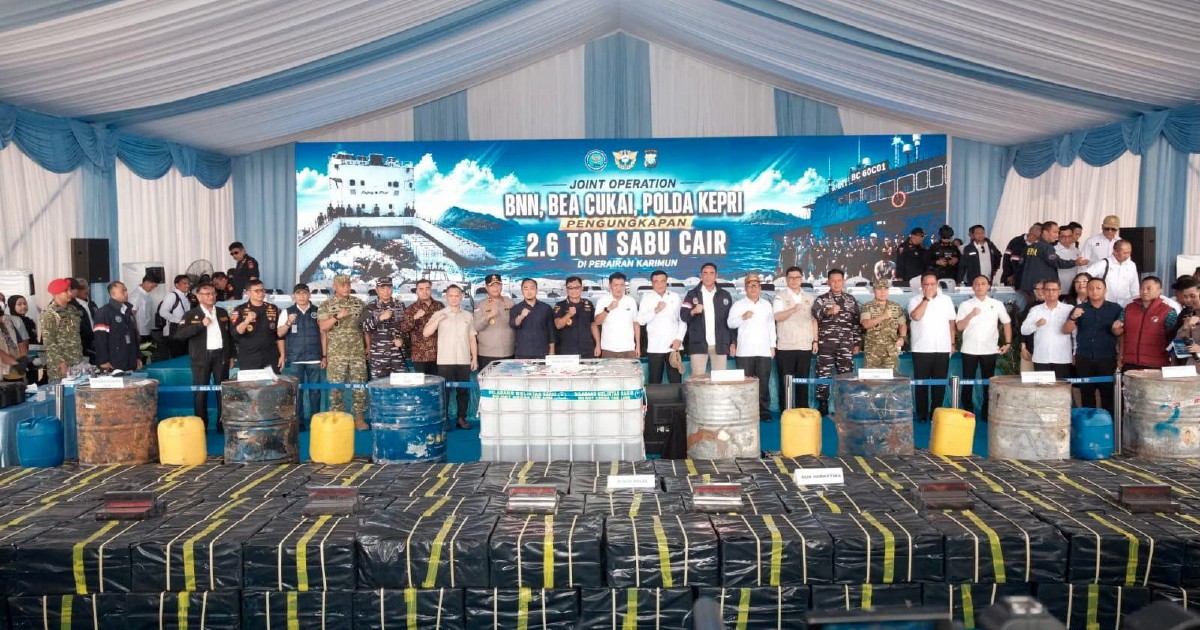
Indonesian law enforcement officials announced the arrest of ten Myanmar nationals on Friday, concluding a major drug enforcement operation that yielded one of the region's largest liquid methamphetamine seizures in recent years. The 2.6 metric tonne haul, discovered aboard a commercial vessel flying Tanzanian registry, underscores Indonesia's strategic position along key shipping corridors used by transnational criminal organisations to move synthetic drugs throughout Asia-Pacific waters.
The vessel's Tanzanian flag highlights a common practise among smugglers who register ships under flags of convenience to obscure their origins and intended destinations. This technique has become increasingly prevalent among organised crime syndicates operating across the Indian Ocean and Southeast Asian maritime routes. By using third-country registrations, trafficking networks create layers of bureaucratic complexity that can delay international law enforcement responses and complicate attribution of the cargo to specific criminal enterprises.
The Myanmar connection reflects broader concerns about Myanmar's emergence as a major production hub for synthetic drugs destined for regional and global markets. The country's porous borders, limited law enforcement capacity in border regions, and the presence of armed groups involved in narcotics manufacturing have created ideal conditions for large-scale methamphetamine operations. This particular seizure suggests these production facilities are ramping up output capacity, with traffickers becoming bolder in transporting bulk quantities through international shipping lanes.
Liquid methamphetamine represents a particularly concerning trafficking innovation. The chemical form allows smugglers to transport drugs in containers that may be labelled as legitimate industrial chemicals or solvents, complicating detection at ports and checkpoints. Once refined at destination locations, liquid meth can be converted into crystal methamphetamine for retail distribution. The sophistication of this approach indicates the involvement of well-organised, well-resourced criminal enterprises rather than street-level operators.
Indonesia's successful interdiction demonstrates improving maritime surveillance capabilities and international cooperation mechanisms. The country's strategic location astride major shipping lanes makes it a critical chokepoint for drug traffickers moving product between production zones in Myanmar and consumption markets across the region, including Australia, Thailand, and the Philippines. Enhanced port screening, intelligence sharing with regional partners, and coordinated naval operations have made it increasingly risky for smugglers to transit Indonesian waters with large shipments.
The arrest of ten Myanmar nationals raises questions about supply chains and distribution networks. These individuals likely occupied specific roles within a larger trafficking hierarchy, potentially including crew members, coordinators, and handlers. Their detention provides Indonesian authorities with an opportunity to gather intelligence on organisational structures, methods of concealment, alternative routes, and downstream distribution networks across Southeast Asia and beyond. Such information proves invaluable for dismantling interconnected trafficking operations.
This seizure carries significant implications for Malaysia and the broader region. Malaysian ports, particularly in the Strait of Malacca, face comparable vulnerabilities to transnational drug trafficking. The methods used in this Myanmar-registered vessel operation—flag of convenience, liquid chemical disguise, maritime transport—represent tactics that Malaysian authorities and regional maritime agencies must actively monitor. Malaysian law enforcement agencies frequently coordinate with Indonesian counterparts on shared maritime security challenges, and this case provides operational lessons applicable across borders.
The scale of the seizure also reflects the enormous profit margins driving synthetic drug trafficking. A 2.6 metric tonne shipment represents hundreds of millions of dollars at street-level prices, motivating sophisticated criminal organisations to invest in complex supply chains, vessel chartering, crew recruitment, and corruption networks. Despite significant enforcement successes like this bust, these economic incentives ensure that traffickers continue innovating and attempting new routes and methods.
Regional demand for methamphetamine remains stubbornly high across Asia-Pacific markets. Thailand, Philippines, Indonesia, and Malaysia all face escalating consumption problems, particularly among younger demographics and in urban centres. Supply-side enforcement operations, while important symbolically and tactically, cannot alone address the underlying demand drivers. Complementary public health approaches, treatment expansion, and community-based prevention programmes remain underdeveloped across most Southeast Asian nations, creating recurring opportunities for traffickers to establish distribution networks.
Indonesia's commitment to narcotics enforcement contrasts with persistent challenges in neighbouring jurisdictions. Myanmar's fractured governance structure, ongoing civil conflict, and limited state capacity in border regions mean that drug production facilities often operate with impunity. While countries like Indonesia, Malaysia, and Thailand have progressively strengthened enforcement mechanisms, the source-country problem remains largely intractable through bilateral cooperation alone. Regional strategies must increasingly address instability and state capacity deficits in production zones.
The Friday press conference announcement serves multiple audiences. Domestically, it demonstrates government competence in combating organised crime and protecting citizens from synthetic drug proliferation. Internationally, it signals Indonesia's value as a cooperative partner in transnational law enforcement operations. However, enforcement officials acknowledge that seizures, however impressive in scale, represent only a fraction of drugs in transit. This single bust likely represents just one operation among dozens occurring simultaneously across regional shipping lanes.

