Indonesian law enforcement agencies have successfully broken up an international drug syndicate operating across the Malaysia-Indonesia border, with authorities detaining six local operatives and launching a manhunt for two Malaysian nationals allegedly orchestrating the supply chain. The National Narcotics Agency (BNN) and the Customs and Excise Directorate General, working in coordination, dismantled the network following months of surveillance and border investigations, revealing an unexpectedly complex operation that moved dangerous substances through legal channels disguised as food products.
The breakthrough came in an unexpected manner when Customs officers screening parcels at Soekarno-Hatta International Airport in Jakarta intercepted a package ostensibly containing Orange Fiber Xtra food supplement arriving from Malaysia. Laboratory analysis revealed the true contents: MDMA, ketamine and other controlled substances concealed within seemingly legitimate packaging. This discovery triggered a comprehensive joint investigation that would ultimately expose the full extent of the syndicate's reach and operational sophistication across the Riau Islands.
According to BNN's deputy for enforcement, Insp. Gen. Aswin Sipayung, the organisation operated with remarkable compartmentalisation and discipline. The network managed multiple stages of illegal activity, from orchestrating smuggling operations through unmonitored ports to receiving shipments, repackaging contraband into smaller distribution units, and maintaining retail operations throughout the region. This layered structure, while typical of mature trafficking organisations, suggests the syndicate had been operating undetected for a considerable period before the airport discovery exposed their supply route.
The enforcement operation unfolded rapidly after the initial arrest of a suspect identified as BAP, who was apprehended while attempting to collect the intercepted package at a hotel in Batam on Wednesday. His subsequent cooperation with investigators proved instrumental, leading officers to three additional suspects at a nearby Baloi hotel within hours. The speed of the follow-up arrests indicates that once the syndicate's identity became known to authorities, the decentralised network structure offered limited resilience against coordinated law enforcement action.
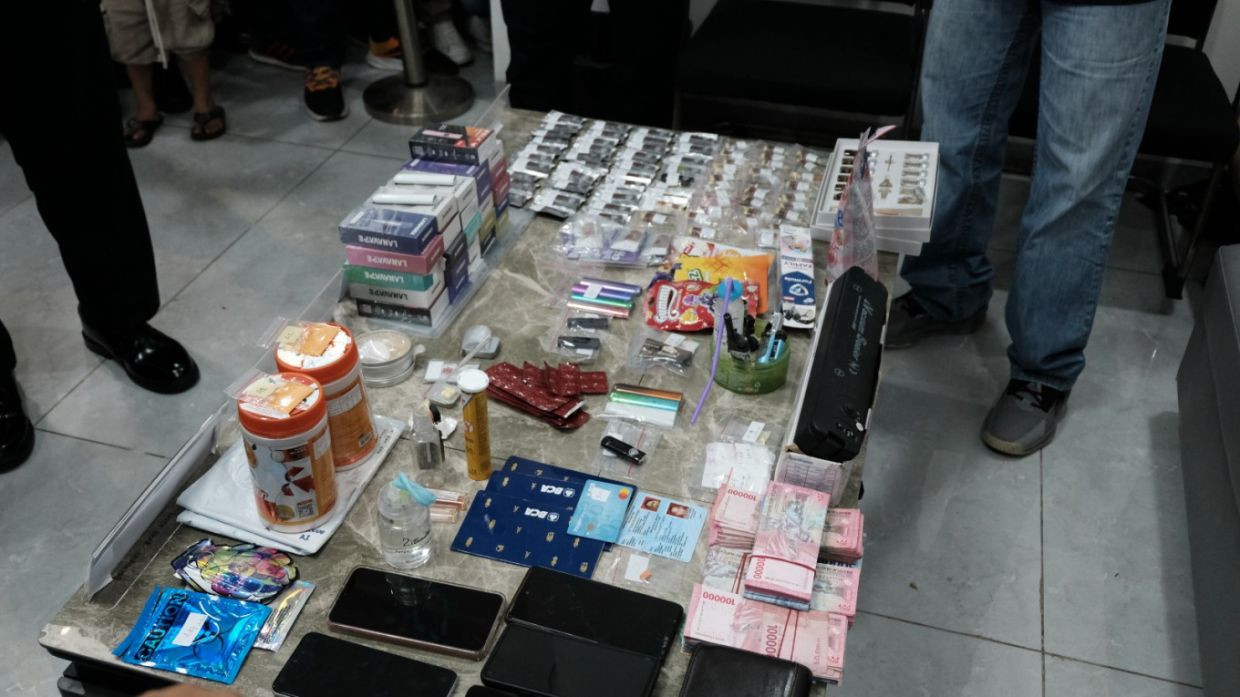
Raids on four separate premises yielded a substantial seizure of narcotics and paraphernalia. Officers discovered dozens of etomidate-filled vape cartridges at multiple locations, alongside quantities of methamphetamine powder, ecstasy tablets, ketamine and Happy Water drinks laced with controlled substances. The recovery of electronic sealing equipment and digital scales at various locations confirmed that the operation included a repackaging component, transforming bulk shipments into smaller units suitable for street-level distribution. The deployment of a K-9 unit during the Batu Ampar raid suggested officers expected to uncover additional concealed substances at that shophouse location.
The investigation revealed a particularly concerning trafficking methodology. Syndicate members meticulously concealed drugs within food packaging and supplement sachets, then resealed containers using professional-grade plastic devices to maintain authentic appearances that would likely pass cursory visual inspection at checkpoints. This deceptive practice underscores how Malaysian and Indonesian traffickers are adapting smuggling techniques to exploit the volume of legitimate cross-border commerce. The sophistication of this concealment strategy suggests technical knowledge about detection methods and border inspection protocols.
While the Batam operation yielded six arrests and significant seizures, the hunt continues for two Malaysian nationals identified as SL and WKC, who authorities believe functioned as the operation's primary suppliers. These individuals have been placed on wanted lists across both countries, though international arrest coordination in Southeast Asia remains inconsistent. Their successful evasion despite law enforcement attention indicates either sophisticated counter-surveillance capabilities or assistance from complicit individuals within border management systems—a concern that extends beyond this particular case.
The parallel discovery of smuggling activity at Batam Centre International Ferry Terminal, where Customs officers intercepted 48 etomidate cartridges from a Malaysian passenger arriving from Johor Bahru, underscores the pervasiveness of drug trafficking through maritime routes. The proximity of this arrest to the main operation raises questions about whether these represented connected segments of the same larger network or merely similar operations exploiting comparable vulnerabilities in cross-border enforcement.
Authorities are investigating potential links between this dismantled syndicate and a narcotics manufacturing facility recently raided elsewhere in Batam, suggesting the possibility of local production capacity supplementing Malaysian imports. Should these investigations confirm integration between manufacturing and distribution networks, it would indicate a far more developed criminal infrastructure than a simple import-distribution model. Such vertical integration typically emerges only after trafficking organisations achieve sufficient scale and operational security to justify capital investment in production facilities.
The total confiscation included over 1kg of MDMA, 170 vape cartridges containing etomidate, substantial quantities of ketamine and methamphetamine, multiple vehicles and motorcycles. Batam Customs chief Agung Widodo claimed the enforcement action prevented potential public health costs estimated at Rp10.8 billion while saving approximately 6,770 individuals from narcotic dependency. These calculations, while demonstrating bureaucratic quantification of law enforcement impact, represent an important argument for resource allocation to cross-border drug enforcement.
The legal framework applied against the detained suspects carries severe consequences. Prosecution under Indonesia's Law No. 35/2009 on Narcotics allows sentences ranging from five years' imprisonment to capital punishment, alongside potential fines reaching Rp10 billion. The severity of these penalties reflects Indonesia's uncompromising stance on trafficking, particularly for large-scale operations involving synthetic drugs and organised distribution networks. For Malaysian readers, this case illustrates the escalating consequences for nationals caught supplying Indonesian criminal networks, as Indonesian courts have consistently applied maximum sentencing for cross-border trafficking cases involving significant quantities.
The operation reflects broader regional challenges in controlling synthetic drug flows through Southeast Asia. Malaysia's position as a transit and source nation for narcotics destined for Indonesia, Australia and other markets remains a persistent law enforcement priority. The Batam case demonstrates how even well-organised networks eventually leave detectable traces—airport parcels, hotel registrations, electronic transfers—but also how the sheer volume of cross-border commerce provides protective cover for ongoing operations. Sustained dismantling of these networks requires continuous intelligence gathering and international cooperation mechanisms that remain inconsistently implemented across the region.

