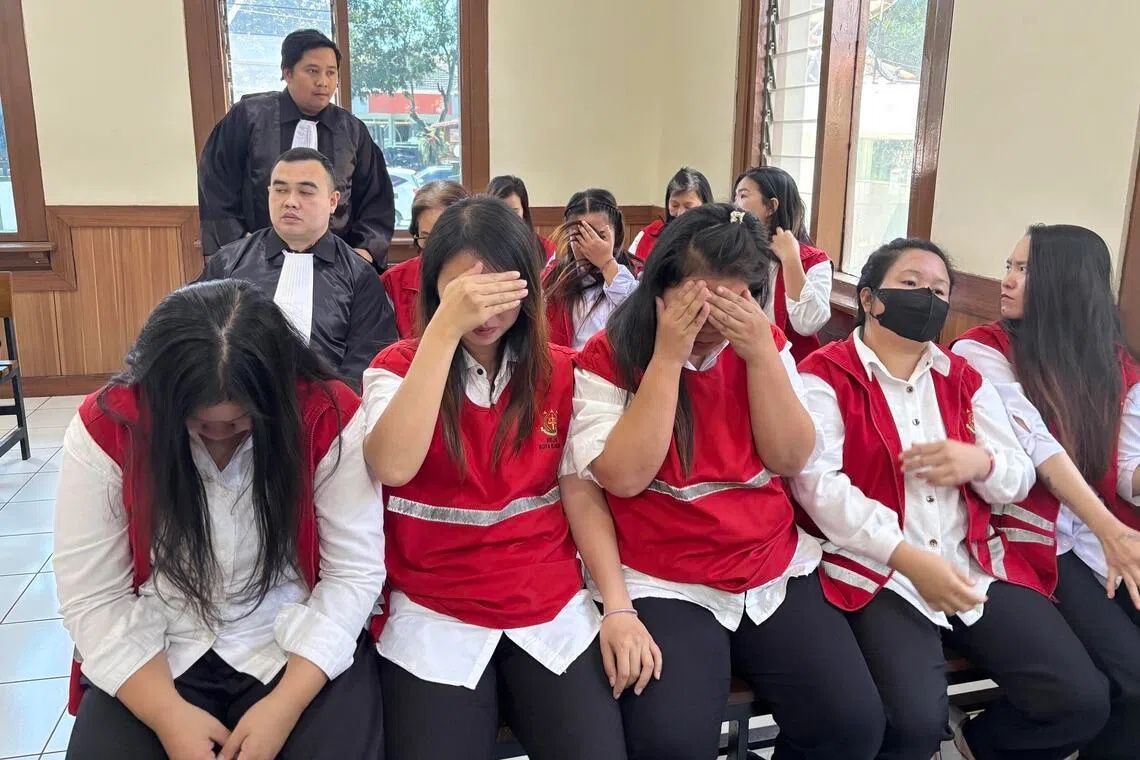
Indonesian prosecutors on Tuesday sought sentences of up to 10 years imprisonment for members of an alleged baby trafficking syndicate accused of selling at least 34 infants, including numerous victims sent to Singapore, in what officials describe as among the country's most significant cross-border human trafficking cases in recent memory. The 19 defendants—18 women and one man—have faced trial since April at Bandung District Court on charges related to the illicit movement of babies between 2023 and 2025, with prosecutors alleging that at least a dozen infants were transported across the border to Singapore at prices ranging from 200 to 250 million rupiah, approximately S$18,110 per child.
At the heart of this complex trafficking network stands 70-year-old Lie Siu Luan, known colloquially as Lily or Popo, whom investigators have identified as the operation's principal architect. Prosecutors contend that Lie orchestrated the entire scheme, personally directing the recruitment of vulnerable infants, overseeing the preparation of falsified documentation, and coordinating the logistics of transferring babies across international borders. During Tuesday's hearing, Prosecutor Cucu Gantina formally requested that the court find Lie guilty of recruiting, harbouring, sending, transferring, and receiving persons for exploitative purposes under Indonesian law.
The prosecution's sentencing recommendations reflect a hierarchical assessment of culpability within the accused network. Lie faces the maximum 10-year sentence, alongside three other key operatives identified as essential to the ring's functioning: Astri Fitrinika, described as one of the primary recruiters; Djaka Hamdani, another alleged recruitment specialist; and Elin, who prosecutors say played a comparable role. Additionally, Lai Su Hua has been targeted with the 10-year recommendation due to her alleged involvement in fabricating state documents required for fraudulent adoption proceedings. The remaining 14 defendants, whose primary function centred on providing care for the infants prior to handover, face prosecution requests for five-year sentences, reflecting their secondary involvement in the operation.
The courtroom reaction to the prosecution's sentencing demands underscored the emotional weight of the proceedings. Both Lie and Astri visibly wept as the prosecutor articulated the charges against them, a moment that captured the human dimensions of a case involving vulnerable newborns and the systematic corruption of adoption processes. Yet the emotional response did little to sway the legal strategies being mounted by the defendants' counsel, who immediately signalled their intent to contest key elements of the prosecution's narrative.
Lie's attorney, Sendi Sanjaya, articulated a defence position centring on what he characterised as the prosecution's failure to establish a critical legal element: exploitation. Sanjaya argued that the factual evidence presented throughout the trial contradicted the exploitation narrative, noting that medical records demonstrated the infants remained in good health and that their subsequent locations were known and monitored. This defence strategy attempts to undermine the fundamental legal basis of the charges by questioning whether the defendants' actions actually met the legal threshold for human trafficking as defined under Indonesian statute, which requires proof of exploitation for the definition to apply.
The defence mounted by Astri's counsel, Hendri Samuel Tampubolon, pursued a markedly different tactical approach, one grounded in hierarchical culpability and cooperation with authorities. Tampubolon expressed considerable frustration that prosecutors had recommended an identical 10-year sentence for his client as for Lie, arguing that such parity failed to account for the substantial difference between orchestrating a sophisticated international trafficking operation and participating in one under another's direction. Tampubolon emphasised that Astri operated under Lie's control and dominance, suggesting her role derived from coercion rather than autonomous criminal agency. Critically, he highlighted Astri's cooperation with both police and prosecution investigators, positioning such collaboration as mitigating circumstances that should materially reduce her exposure to lengthy imprisonment.
The origins of this investigation trace to July 2025, when Indonesian authorities in West Java arrested approximately a dozen suspects following a report filed by a local resident named Dani Hidayat. Hidayat's involvement in the case emerged through what appeared to be a routine online interaction: he had joined a Facebook group dedicated to prospective adoptive parents, prompted by his wife's advanced pregnancy. Through this forum, Astri made contact with him and allegedly offered him 8 million rupiah in exchange for his wife's newborn, an overture that triggered his suspicions and ultimately led him to report the matter to authorities. This seemingly ordinary breach of the scheme's operational security unravelled the entire network and initiated a prosecution that would eventually ensnare 19 individuals.
The transnational dimensions of this case have warranted explicit diplomatic engagement between Indonesia and Singapore. Both governments announced on January 9 that they were coordinating their investigative and prosecutorial efforts, recognising that the systematic trafficking of infants across their shared maritime border represented a matter of mutual concern requiring coordinated response. During trial proceedings, Lie identified four Singaporean individuals whom she claimed functioned as adoption agents facilitating placements within Singapore: individuals she referred to only as "Petter," "John," "Mr Tan," and "Mr Chew." The identification of these alleged Singapore-based facilitators underscores how the operation functioned as a transnational criminal enterprise, with recruitment and processing occurring in Indonesia while placement and integration occurred across borders in jurisdictions offering both demand for adoptable infants and sufficient legal complexity to obscure the traffic's illicit origins.
For Malaysian observers, this case carries significant implications regarding regional vulnerabilities to human trafficking and the adequacy of cooperative law enforcement frameworks across Southeast Asia. The sophistication demonstrated by this network—particularly its exploitation of adoption channels and falsification of critical documentation—suggests that similar operations may exist across the region, potentially affecting Malaysian families seeking to adopt while simultaneously exposing Malaysian jurisdictions to transit or placement roles in larger trafficking networks. The case further illustrates how online platforms, while facilitating legitimate community connection, simultaneously create conduits for criminal recruitment and coordination that can escape detection until patterns of suspicious activity accumulate sufficiently to trigger investigation.
The trial's continuation will see the defendants present their formal defences during hearings scheduled for the following week, at which point the court will receive detailed responses to the prosecution's characterisation of events and a full accounting of the defence strategies that have thus far been merely sketched in preliminary hearings. The outcome will establish important precedent regarding how Indonesian courts balance the systematic nature of trafficking operations against individual degrees of participation and the evidentiary threshold required to establish exploitation as a legal element. Beyond the immediate sentences that the judges eventually impose, this case will shape how Southeast Asian jurisdictions respond to the trafficking of infants through adoption channels, a particular vulnerability that requires sustained attention across the region's law enforcement and child protection apparatus.

