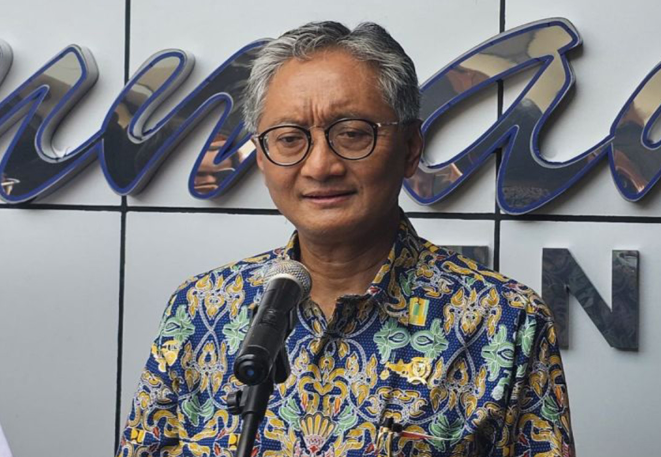
Indonesia's Public Works Ministry faces mounting internal instability following the emergence of a classified travel document that listed Minister Dody Hanggodo's family members among delegates scheduled to attend a United Nations meeting in New York last month. The disclosure has ignited a cascade of institutional challenges, including personnel transfers and growing employee anxiety, laying bare the governance tensions within one of the nation's largest bureaucracies.
The controversy centres on an official ministry document circulated through social media in early July, which outlined plans for an eight-member delegation to travel to New York between July 13 and 19 to participate in a UN-organised meeting scheduled for July 16 and 17. The document, signed by ministry secretary-general Apri Artoto on June 29, included the names of Dody's wife Irma Hermawati and daughter Aurellia Tsabitha Meidirama alongside six officials. The presence of family members on what was ostensibly a government working visit immediately drew public criticism and allegations of misuse of state resources, ultimately leading the ministry to cancel the entire trip.
Within days of the document's viral circulation, social media became awash with reports claiming that Dody had responded by reassigning numerous officials to regional offices, predominantly located outside Java. The timing of these transfers fuelled speculation that the minister was retaliating against those he suspected of leaking the sensitive document. When confronted by journalists on Wednesday, Dody acknowledged the reassignments but categorically rejected suggestions they constituted punishment, arguing that as head of a massive 38,600-person workforce, he retained full authority to redeploy personnel as organisational needs dictated.
Apri's subsequent explanation during a July 7 press briefing attempted to provide justification for the family members' inclusion on the delegation. He contended that their presence was necessary to streamline visa applications through Indonesia's Foreign Ministry, while assuring the public that state funds would not finance their participation in the New York meeting. Nevertheless, Apri pledged to identify and pursue legal action against whoever leaked the confidential document, characterising it as sensitive material never intended for public disclosure. This defensive posturing underscored the ministry's apparent anxiety about external scrutiny of its operations.
The current upheaval represents merely the latest chapter in a pattern of aggressive personnel restructuring under Dody's leadership since his appointment in October 2024. The 60-year-old minister, who brings an engineering background and documented business connections to South Kalimantan entrepreneur Andi "Haji Isam" Syamsuddin Arsyad, has overseen successive rounds of staffing changes that have affected more than 100 employees. Posts circulating on social media tracking these movements reveal a broad purge spanning from senior director-general positions down to lower-ranking civil servants, suggesting a comprehensive institutional overhaul rather than routine administrative adjustments.
Most notably, in May Dody appointed seven high-ranking officials to key positions, including Apri as secretary-general, replacing Wida Nurfaida who had occupied the role for less than a year. This May reshuffling followed another significant restructuring in July 2025, demonstrating a pattern of frequent senior-level changes that few observers regard as coincidental or routine. The succession of shake-ups has created an unsettled institutional environment where career trajectories become unpredictable and loyalty to the minister appears to determine advancement prospects.
Concern about these management practices has reached Indonesia's legislative branch. During June discussions, Yasto Soepredjo Mokoagow, a House of Representatives Commission V member overseeing infrastructure matters and representative of the Indonesian Democratic Party of Struggle (PDI-P), raised formal alarm about disciplinary measures including demotions of directors to non-structural positions. Mokoagow specifically warned that such practices were instilling fear among civil servants, hampering their willingness to implement development programmes and threatening the ministry's operational effectiveness. His June 11 statement reflected broader parliamentary concerns that internal purges were becoming counterproductive to the ministry's core development mission.
Dody's justification for the repeated restructuring invokes what he characterises as a "deep state" within the ministry—a parallel power structure he likens to termites systematically weakening institutional foundations. In his view, identifying and eliminating these embedded networks of resistance justifies the continuous personnel churn. This framing, however, raises questions about whether legitimate bureaucratic concerns or procedural dissent are being recharacterised as subversive resistance, potentially discouraging open communication and institutional transparency essential to effective governance.
Complications have deepened with an ongoing corruption investigation targeting senior ministry officials involved in water resources projects. In June, the Jakarta High Prosecutor's Office named several suspects, including former water resources director-general Dwi Purwantoro and former acting irrigation and swamp director Yosiandi Radi Wicaksono. These criminal allegations cast a shadow over the ministry's operational credibility and raise questions about oversight mechanisms that may have permitted irregularities to develop. When responding to the suspect designations, Dody pledged non-interference with law enforcement and stated his commitment to supporting prosecutorial efforts, though his sweeping personnel reassignments create ambiguity about whether all witnesses and potential evidence holders remain adequately positioned for investigation.
Recent social media videos have further complicated Dody's public standing, circulating footage of his interactions with subordinates that many observers characterise as abrasive. One widely-shared recording documented him reprimanding an employee at an East Java school construction site in April, visibly pointing while dismissing the official's explanation as "dumb excuses." Such imagery, amplified through digital platforms, contributes to a perception of managerial style that, regardless of substantive performance, reinforces concerns among ministry staff about the psychological tenor of the workplace. For Malaysia and other Southeast Asian nations observing Indonesia's public administration challenges, the Public Works Ministry situation illustrates broader questions about how centralised leadership models, institutional loyalty expectations, and perceived threats from embedded bureaucratic structures can erode institutional effectiveness and employee morale even within critical infrastructure agencies.

