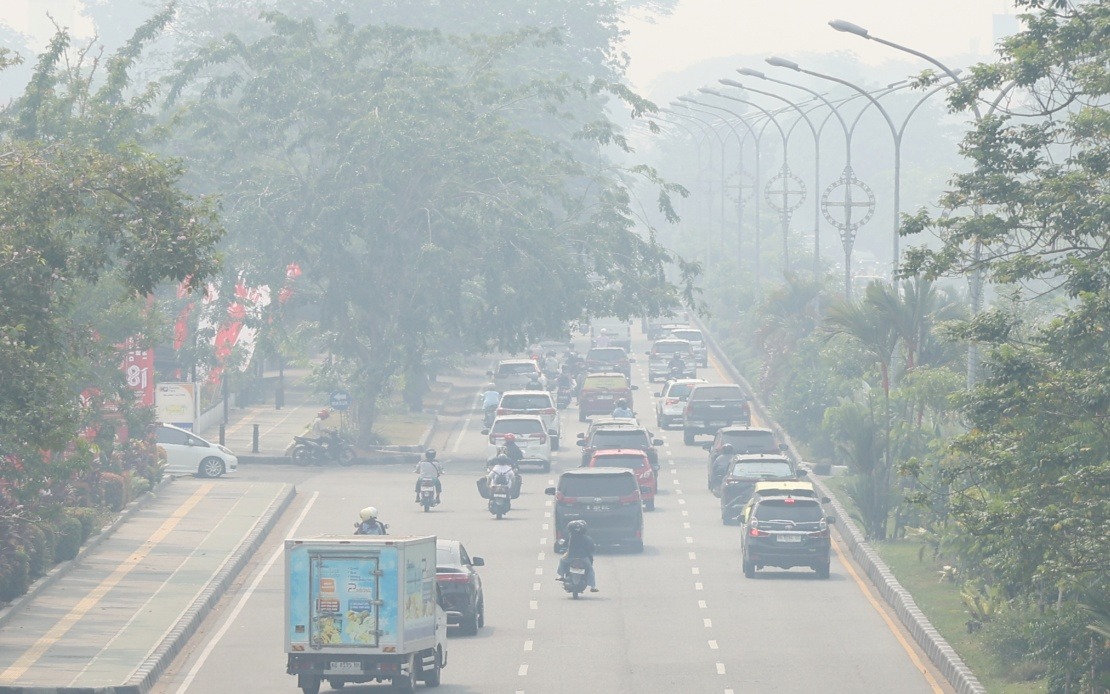
Indonesia is grappling with a serious air quality crisis as forest and peatland fires continue to ravage multiple provinces, with pollution readings reaching dangerous levels that pose immediate health threats to millions. The Air Pollutant Index in Jekan Raya, a subdistrict within Palangka Raya in Central Kalimantan, has surged to an alarming 573—a reading that falls into the hazardous category and demands urgent public health intervention. Data collected from 17 air-quality monitoring stations as of Wednesday morning revealed the severity of the situation, with health authorities now scrambling to implement protective measures and coordinate emergency responses across affected regions.
The geographic spread of the pollution crisis underscores the scale of Indonesia's challenge. Beyond the critical situation in Central Kalimantan, Muaro Jambi Regency in Jambi Province has also recorded hazardous levels, reaching an API of 302. Multiple other areas spanning from Riau to South Sumatra and across the Kalimantan island chain are experiencing very unhealthy air quality readings between 201 and 300, including Pelalawan, Penukal Abab Lematang Ilir, Ogan Ilir, Southeast Pontianak, Gunung Mas, and Katingan. This widespread contamination reflects how forest fires, particularly those burning carbon-rich peatlands, create transboundary pollution episodes that affect entire regions simultaneously rather than isolated communities.
Health authorities have issued explicit guidance to the public about protective actions needed during hazardous air conditions. The Environmental Health Director has advised that when pollution reaches hazardous levels, residents should completely avoid outdoor activities—a significant disruption to daily life that acknowledges the serious health consequences of exposure. For areas experiencing very unhealthy conditions, officials recommend minimizing time spent outdoors, particularly for vulnerable populations including children, elderly residents, and those with respiratory or cardiovascular conditions. This tiered approach to public guidance reflects the varying severity of pollution across different locations and the need for proportionate responses.
The Indonesian Health Ministry is preparing to formalize these recommendations through official channels, with a circular expected within two days that will institutionalize emergency protocols. Among the measures being developed is authorization for schools to transition to distance learning when air quality deteriorates to dangerous levels—a direct parallel to measures seen during pandemic lockdowns but driven by environmental rather than epidemiological factors. These administrative steps represent an acknowledgment that severe air pollution episodes require society-wide adjustments to normal operations, extending far beyond simple health warnings to individuals.
The human impact has already begun to materialize across the affected provinces. The Ministry's Health Crisis Centre reports that fires have impacted approximately 3.4 million people across seven provinces: Riau, Jambi, and South Sumatra on Sumatra island, plus West, Central, East, and South Kalimantan on the Borneo island of Kalimantan. While these provinces have declared emergency alert status rather than full emergency response protocols, the breadth of affected population indicates a disaster of national significance. Fortunately, the situation has not yet escalated to the most severe outcomes, with no deaths or mass evacuations reported to date.
Casually recorded injuries suggest that while the immediate health emergency has been contained so far, the situation remains precarious. Officials have documented 42 people with minor injuries related to the fires and smoke exposure, alongside two more serious cases involving burn victims in South Kalimantan who required hospitalization. To manage these health consequences, authorities have deployed 321 health personnel across the affected provinces, establishing emergency medical capacity where needed. This rapid mobilization of human resources reflects the government's attempt to prevent minor health issues from escalating into a broader public health catastrophe.
Satellite monitoring data reveals that the underlying fire situation continues to pose substantial risk despite ongoing suppression efforts. The Forestry Ministry detected 805 high-confidence hotspots and 11,313 medium-confidence hotspots nationwide as of Tuesday evening, indicating that hundreds of active fires remain burning across Indonesia's landscape. Among the six priority provinces, South Sumatra leads with 239 high-confidence hotspots, followed by Central Kalimantan with 113, South Kalimantan with 89, and West Kalimantan with 86. This concentration of high-confidence detections in Sumatra and Kalimantan suggests that fire suppression efforts have had limited impact in halting the spread of new fires, despite deployment of resources and personnel.
The medium-confidence hotspot distribution presents an equally concerning picture, with West Kalimantan recording 2,447 such locations, Central Kalimantan 2,168, and South Sumatra 1,161. These larger numbers of medium-confidence detections indicate numerous potential fire ignition points that could rapidly escalate into active burns if weather conditions become favorable or if suppression resources prove insufficient. The combination of thousands of potential fire sources across a vast geographic area suggests that Indonesian firefighting capabilities may be stretched thin, raising questions about whether current resource allocation can prevent further expansion of the crisis.
For Malaysia and other Southeast Asian nations, Indonesia's air pollution emergency carries significant transboundary implications. During previous severe fire seasons, particularly 2015 and 2019, neighboring countries including Malaysia, Singapore, and Brunei experienced hazardous air quality episodes as smoke drifted across maritime borders. The current Indonesian crisis, concentrated in the equatorial interior of Sumatra and Kalimantan, has potential to generate transboundary haze depending on atmospheric circulation patterns. Malaysian environmental and health authorities typically monitor such developments closely and prepare contingency responses including air quality advisories, distribution of protective masks, and activation of emergency medical protocols when pollution indices reach unhealthy levels.
The underlying drivers of Indonesia's recurring fire crisis remain rooted in land-use practices and peatland management. Forest and peatland fires typically ignite through agricultural clearing, accidental ignition near settlements, or deliberate burning by actors seeking to open land for development. Peatlands, which are particularly common in Sumatra and Kalimantan, contain enormous quantities of partially decomposed organic matter and burn with particular intensity and persistence once ignited. Climate variations, including dry seasons intensified by El Niño conditions, create windows when fires spread most rapidly and burn most extensively. Addressing this recurring crisis requires Indonesia to strengthen fire prevention and early detection systems, improve peatland protection and restoration, and enhance law enforcement against illegal burning.
The Indonesian government's response mechanisms, while activated, reflect broader structural challenges in managing environmental crises at the national level. The emergency alert status declaration by seven provinces provides legal authorization for emergency expenditures and resource mobilization, but does not necessarily translate to rapid or comprehensive suppression of geographically dispersed fires. The mobilization of health personnel and preparation of administrative protocols demonstrates responsiveness to the immediate human health threat, yet these measures are largely reactive—managing consequences rather than preventing underlying causes. Long-term reduction in fire frequency and intensity will require sustained investment in prevention infrastructure, peatland management, and enforcement against illegal land clearing.
For Malaysian policymakers and citizens, Indonesia's current crisis offers important reminders about regional environmental interdependence. Air pollution does not respect borders, and Indonesia's land management practices directly affect air quality across Southeast Asia. Previous episodes of transboundary haze have generated diplomatic tensions and calls for stronger bilateral environmental cooperation. The current situation provides an opportunity to advocate for strengthened regional mechanisms for fire prevention, real-time information sharing about air quality and fire locations, and coordinated suppression efforts in border regions. Malaysia's own peatland management policies and forest fire prevention systems merit evaluation against these regional challenges.

