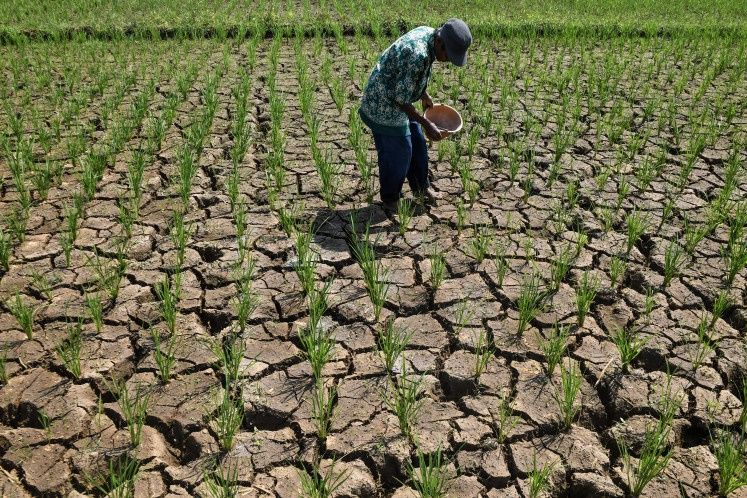
Indonesia is confronting a rapidly expanding water crisis as El Niño-induced atmospheric conditions push the country deeper into an exceptionally dry period, with disaster authorities projecting that inadequate rainfall in coming months could trigger severe nationwide shortages. The National Disaster Mitigation Agency has begun expanding the official list of affected districts, now encompassing regions from Java to the eastern islands, as tens of thousands of residents endure weeks without sufficient water supply. Officials are increasingly concerned that the convergence of climate phenomena and structural vulnerabilities in water infrastructure could precipitate multiple cascading emergencies spanning agriculture, public health, and economic stability across the archipelago.
The scale of current hardship has become measurable in household numbers rather than abstract projections. At least 7,100 households were already documented as lacking reliable clean water access across Central Java, Yogyakarta, West Java, and Maluku before fresh drought declarations expanded the crisis on July 3. The National Disaster Mitigation Agency subsequently identified an additional 700 households in Gunungkidul, Semarang, and Jember facing acute shortages, prompting local governments to commence emergency tanker-truck deliveries. In West Nusa Tenggara, the situation proved sufficiently dire that West Lombok authorities implemented a full drought emergency declaration in mid-June, affecting approximately 3,600 households, while Banten province remained in assessment mode before determining whether to activate provincial-level drought protocols.
Meteorological data indicates that contemporary conditions are entering genuinely extreme territory. The Meteorology, Climatology and Geophysics Agency reported that by mid-June, only about 63 per cent of Indonesia's climatic zones remained outside the formal dry season, with nearly half the nation already recording precipitation levels substantially beneath historical norms. The agency forecasts that the dry period will reach peak intensity between July and September, with projections suggesting that more than 80 per cent of the Indonesian archipelago will experience below-normal rainfall during this critical window. This concentration of adverse conditions during a period when agricultural demand for irrigation water traditionally surges creates acute pressure on both natural water reserves and engineered water distribution systems.
Multiple regions have invoked emergency protocols designed to accelerate government response mechanisms. Gunungkidul initiated its 90-day drought alert framework in June, whilst West Java followed suit early in July. These designations theoretically enable faster mobilisation of resources and suspension of standard bureaucratic timelines for resource allocation. The decision by West Nusa Tenggara to formally declare a drought emergency rather than merely activate alert status signals that some provincial administrations believe circumstances have deteriorated beyond the preliminary response phase. The variation in declaration statuses across different regions reflects both genuine disparities in local conditions and differing administrative approaches to interpreting drought severity metrics.
Agricultural implications loom with particular urgency as El Niño intensifies. The Meteorology, Climatology and Geophysics Agency has cautioned that sustained inadequate rainfall threatens Indonesia's agricultural productivity, with specific risks including crop failures stemming from insufficient irrigation water. Deputy director Ardhasena Sopaheluwakan articulated a menu of immediate adjustments that agricultural communities should consider, encompassing modifications to planting schedules, adoption of drought-tolerant crop varieties with shortened growing periods, and deliberate diversification away from water-intensive staple crops. These recommendations implicitly acknowledge that some regions may face structural constraints that prevent conventional agricultural production during the current dry cycle.
The government's stated response combines immediate distribution logistics with reassurances about strategic reserves. Agriculture Minister Amran Sulaiman indicated that the ministry has expanded the deployment of irrigation pumping equipment to maintain water availability in farming regions, whilst simultaneously amplifying distribution capacity to preserve agricultural output. The minister has repeatedly emphasised that national rice reserves remain at what he characterises as historically elevated levels, ostensibly sufficient to satisfy domestic demand through the following planting cycle. However, this messaging may reflect anxiety about public perception of food security risks, suggesting underlying concerns that widespread drought could generate inflationary pressure on commodity prices and provoke consumer anxiety regarding supply continuity.
Parliamentary oversight bodies have begun exerting pressure on the government to accelerate targeted assistance to drought-vulnerable communities. The House of Representatives' Commission IV, which exercises legislative responsibility for agricultural and food production portfolios, has called for expedited distribution of seeds, fertilisers, farm implements, and livestock feed to affected regions. This parliamentary positioning indicates that legislators anticipate that emergency water delivery alone will prove insufficient to prevent collateral damage to rural livelihoods, particularly for smallholder farmers and pastoral communities with limited capacity to absorb production disruptions. The commission's activist stance suggests developing political pressure on the executive to prioritise agricultural communities in resource allocation decisions.
Water policy researchers are articulating a perspective that transcends emergency response frameworks, arguing for structural investments in permanent water supply infrastructure. Bagas Yusuf Kausan, a specialist at water policy analysis organisation Yayasan Amerta Air Indonesia, contends that drought-vulnerable regions require subsidised piped water systems administered through regional water utilities to provide durable solutions beyond temporary tanker distributions. He emphasises that recurring drought impacts reflect not merely climatic variation but rather accumulated environmental degradation driven by human activities including land-use conversion and unsustainable groundwater extraction. This analysis implies that communities experiencing repeated droughts represent not merely victims of weather variation but populations inhabiting areas where cumulative environmental damage has eroded natural buffers against climatic stress.
The underlying environmental vulnerability that exacerbates contemporary drought impacts deserves particular scrutiny in the Malaysian context. Bagas advocates that the government seize the current crisis as an opportunity to impose stricter restrictions on land conversion, particularly in water catchment zones that maintain hydrological function across broader regions. This perspective suggests that El Niño conditions are not autonomous climatic events but rather phenomena that acquire their destructive potency through interaction with pre-existing landscape degradation. Southeast Asian nations including Malaysia that share similar tropical and sub-tropical geographies, comparable agricultural systems, and analogous patterns of environmental modification face structurally similar vulnerabilities to intensified drought cycles. Indonesia's current crisis therefore carries cautionary implications for regional water security and food system resilience across Southeast Asia.
The economic implications extend beyond agricultural sectors into urban water supply systems and associated service provision. When acute water shortages develop in urbanising regions, municipal governments face pressure to implement rationing systems, invest in temporary supply alternatives, and manage public health risks from inadequate sanitation water. These municipal costs ultimately burden local government budgets already constrained by competing demands. The cascading fiscal impacts on local administration, combined with potential agricultural productivity losses, suggest that sustained drought could depress regional economic activity and constrain government capacity for investment in other development priorities. The broader Southeast Asian region should therefore monitor Indonesia's drought management effectiveness as a practical case study regarding governmental responses to intensifying climate stress.
Looking forward, the convergence of peak dry season timing between July and September with critical agricultural periods creates a narrow window during which the effectiveness of mitigation measures will become apparent. If current precipitation patterns persist through this period as meteorologists warn, the combination of agricultural disruption, water supply strain, and potential food price movements could establish conditions for broader economic adjustment. Malaysia's own agricultural and water sectors, whilst benefiting from higher rainfall profiles than Indonesia's drier regions, operate within the same broader meteorological systems and face analogous long-term pressures from environmental degradation and freshwater depletion. The Indonesian experience currently unfolding thus provides important empirical evidence regarding how regional nations must adapt water and food systems to cope with intensifying climate volatility and accumulated environmental stress.

