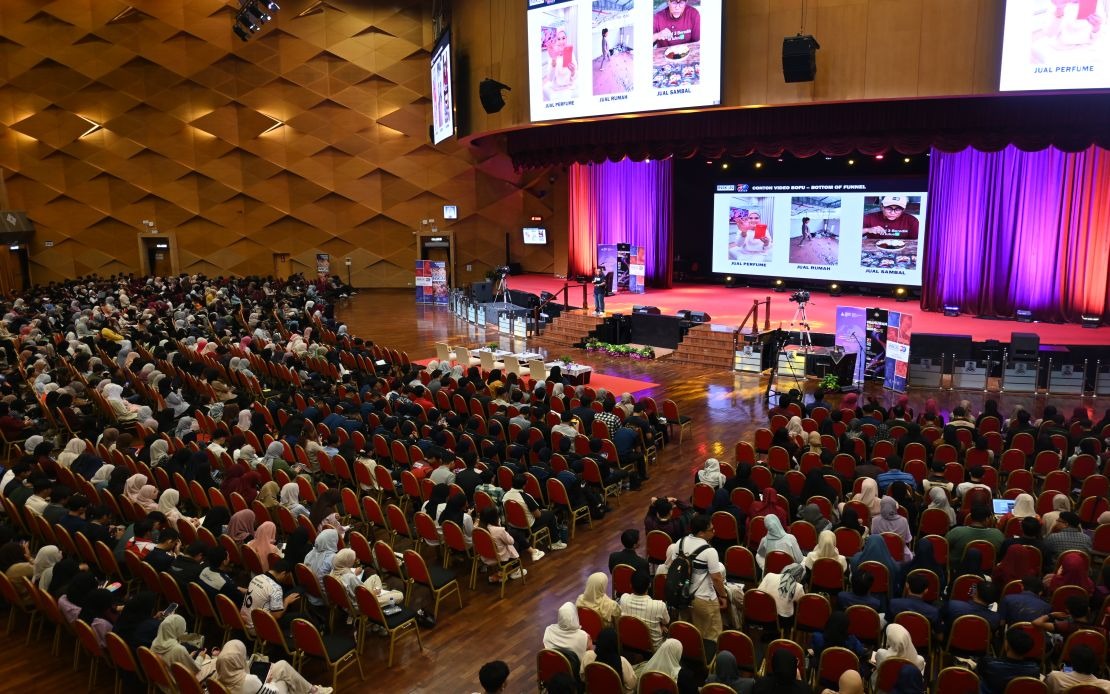
The National Entrepreneurship Institute (INSKEN), in partnership with the Malaysian Academy of SME and Entrepreneurship Development (MASMED) and Universiti Teknologi MARA (UiTM), successfully convened the Usahawan MADANI Mega (SUM MEGA) 2026 entrepreneurship seminar at the Dewan Agung Tuanku Canselor in Shah Alam on June 23. The event drew 6,877 participants across both physical and virtual platforms, a achievement significant enough to secure recognition from the Malaysia Book of Records as the largest student participation in a single entrepreneurship seminar.
The scale of attendance underscores a fundamental shift in how Malaysian youth perceive business creation and self-employment. Rather than viewing entrepreneurship as a fallback option or risky proposition, an increasingly substantial cohort of university students now regard it as a legitimate and attractive career trajectory. This cultural transition carries profound implications for Malaysia's economic future, particularly in an era when traditional employment pathways are becoming less predictable and the demand for innovation-driven solutions continues to accelerate. The MADANI government recognises this momentum and has positioned entrepreneurship as central to its broader economic agenda.
During his address at the seminar, Deputy Minister of Entrepreneur and Cooperatives Development Datuk Mohamad Alamin emphasised that entrepreneurship extends far beyond individual career advancement. He framed it as a critical economic multiplier—a mechanism through which Malaysia can generate employment, strengthen regional supply chains, catalyse innovation, and ultimately enhance national prosperity. This framing reflects a strategic reorientation at the government level, where startups and small-to-medium enterprises (SMEs) are being elevated from peripheral concerns to cornerstones of economic resilience and competitive positioning in the global marketplace.
The Ministry of Entrepreneur and Cooperatives Development (KUSKOP), under the MADANI administration, has committed substantial resources across multiple dimensions of entrepreneurial support. These pillars—capacity building, financing mechanisms, market access facilitation, digitalisation enablement, and business development counselling—represent a comprehensive ecosystem designed to reduce friction and lower barriers to entry. For Malaysian students and graduates contemplating entrepreneurial ventures, this infrastructure translates to tangible advantages: access to training programmes, clearer pathways to funding, and institutional backing that was substantially less accessible in previous decades.
Central to the SUM MEGA 2026 experience was the MOFA methodology, a practical framework organised around four fundamental business pillars: marketing, operations, finance, and administration. Rather than delivering abstract entrepreneurial theory, the seminar structured its knowledge-sharing sessions around these operational domains, enabling participants to develop concrete competencies in areas where nascent entrepreneurs often struggle most. This applied approach acknowledges that successful business creation requires more than enthusiasm or innovative thinking; it demands mastery of foundational management disciplines and operational excellence.
Insken Board of Trustees chairman Datuk Mustaffa Kamil Ayub contextualised the seminar within a broader cultural movement. He argued that entrepreneurship must evolve from being perceived merely as an occupational choice to becoming embedded as a mindset and cultural value within Malaysian society. This perspective aligns with what researchers have observed in high-growth economies: nations that cultivate entrepreneurial thinking at the educational level, where risk-taking, problem-solving, and innovation are normalised and celebrated, tend to generate higher densities of successful ventures and more resilient economic systems. By directing this message to student populations, INSKEN and its collaborators are attempting to reshape foundational attitudes towards business creation at a formative stage.
The SUM MEGA 2026 seminar also served as a crucial convening platform, bringing together multiple stakeholders within Malaysia's entrepreneurial ecosystem. Government agencies, higher education institutions, financial service providers, enterprise development organisations, and established business players all participated in the event. This multi-stakeholder approach recognises that sustainable entrepreneurship requires seamless coordination across the entire value chain—from initial training and ideation through to capital provision, market entry, and scaling operations. When these actors operate in silos, promising ventures often falter due to information gaps or misaligned incentives; integrated platforms like SUM MEGA 2026 begin to address these coordination failures.
InSKEN's broader portfolio of entrepreneurship programmes—including the INSKEN Masterclass, the BANGKIT initiative, and the PROTÉGÉ mentorship scheme—situates the SUM MEGA seminar within a more comprehensive capacity-building architecture. Rather than treating the seminar as a standalone event, these programmes create multiple entry points and progression pathways for aspiring entrepreneurs at different stages of development. A student exposed to entrepreneurial thinking at SUM MEGA 2026 could subsequently enrol in the Masterclass for deeper technical training, progress to BANGKIT for intensive acceleration, and ultimately benefit from PROTÉGÉ's mentorship linkages with experienced business leaders. This staggered, multi-level approach increases the likelihood of converting exposure into sustained entrepreneurial action.
The alignment of SUM MEGA 2026 with the National Entrepreneurship Policy 2030 demonstrates governmental intentionality about long-term economic transformation. Rather than ad-hoc initiatives, Malaysia is implementing a coordinated, decade-spanning framework designed to systematically elevate entrepreneurship's role within the national economy. For Southeast Asia more broadly, Malaysia's approach offers instructive lessons about how policy, institutional capacity, and cultural messaging can be orchestrated to generate widespread entrepreneurial participation. Regional competitors—from Thailand to Vietnam to Indonesia—are observing how Malaysia is attempting to convert large student cohorts into a generation of business creators and job generators, and similar initiatives are being replicated across the region.
The practical implications for Malaysian students extend beyond the seminar itself. Participants gain access to networks of peers pursuing similar entrepreneurial journeys, exposure to successful business models, and connections to mentors and capital providers who can facilitate early-stage venture development. For UiTM in particular, the seminar reinforces the institution's positioning as not merely an academic provider but as a genuine incubator of enterprise and innovation. As Malaysia competes for regional talent and investment, universities that successfully combine rigorous education with active entrepreneurship facilitation gain substantial competitive advantages in attracting ambitious students and positioning graduates for high-impact careers.
Looking forward, the record attendance at SUM MEGA 2026 signals that the supply-side challenge for Malaysia's entrepreneurial ecosystem—generating sufficient numbers of motivated, capable individuals willing to attempt venture creation—may be partially resolved. The bottleneck increasingly lies elsewhere: ensuring that this enthusiasm is channelled into high-quality, scalable ventures that generate substantial economic value rather than marginal self-employment. This transition from volume to quality will likely define the success of Malaysia's entrepreneurship agenda over the coming decade, requiring sustained refinement of support mechanisms and increasingly selective backing for ventures demonstrating genuine innovation potential and market traction. The MADANI government's emphasis on 'high-impact' entrepreneurship, as articulated through the National Entrepreneurship Policy 2030, reflects this emerging focus.