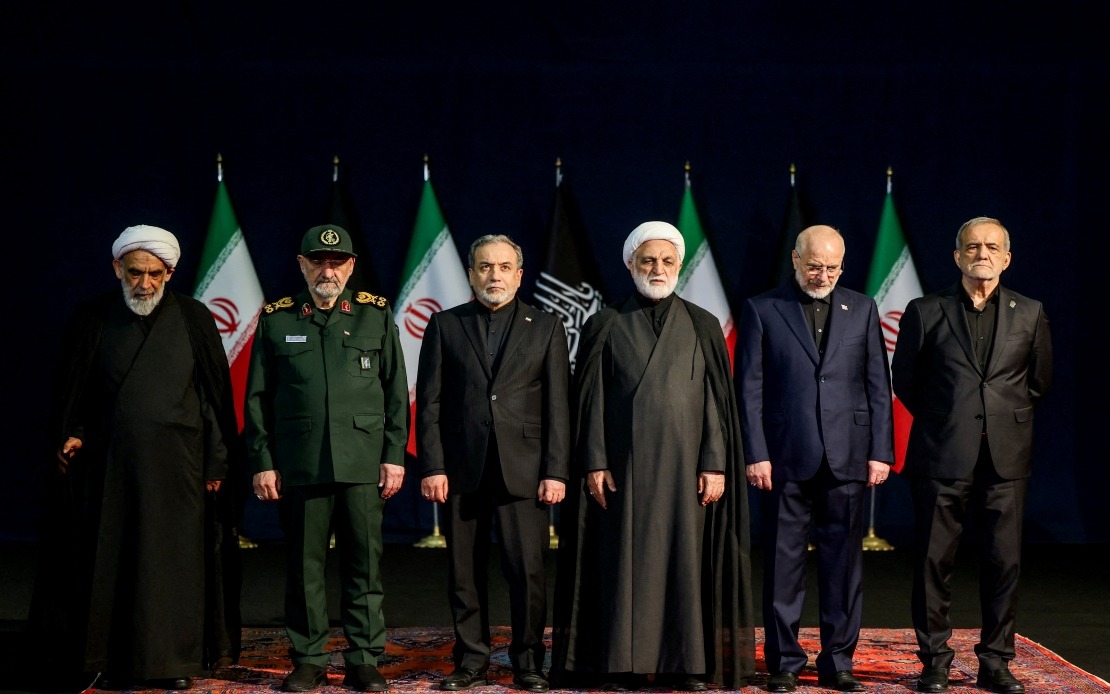
A significant show of international solidarity marked the funeral observances for Iran's late Supreme Leader Ayatollah Ali Khamenei as senior officials from across the Middle East, South Asia, and beyond converged on Tehran on Friday to participate in tribute ceremonies. The gathering underscored not only the regional importance of Iran's leadership but also the complex diplomatic relationships that continue to define Middle Eastern politics despite ongoing tensions and conflicts.
The ceremony took place at Imam Khomeini's Mosalla prayer hall in central Tehran, commencing in the morning and extending throughout the entire day. The venue, a significant religious and ceremonial site, provided the backdrop for what Iranian authorities have positioned as a moment of national reflection and international recognition of Khamenei's three-decade tenure as the Islamic Republic's supreme leader and religious figurehead.
Among the Iranian leadership attending were President Masoud Pezeshkian, Parliament Speaker Mohammad Baqer Qalibaf, Judiciary Chief Gholamhossein Mohseni-Ejei, and Chairman of the Expediency Discernment Council Sadeq Amoli Larijani. The presence of these senior officials reflected the gravity Iran attached to the occasion, bringing together the executive, legislative, and judicial branches of government in a rare unified display. The breadth of institutional representation signalled continuity of state functions during a period of succession.
The international delegation proved particularly noteworthy for its geographic and political diversity. Pakistan's Prime Minister Shehbaz Sharif and Chief of Army Staff Field Marshal Syed Asim Munir attended, representing a traditionally close neighbour whose relationship with Iran has oscillated between cooperation and caution. Their presence demonstrated Pakistan's interest in maintaining stable ties with Tehran despite regional security challenges. Armenian Prime Minister Nikol Pashinyan's participation highlighted ongoing diplomatic engagement between Iran and the South Caucasus, a region where Iran has maintained influence despite recent conflicts.
Georgian President Mikheil Kavelashvili, Iraqi President Nizar Amedi, and Tajik President Emomali Rahmon each brought their own strategic considerations to the event. Georgia's representation was particularly significant given the country's complex position between Western and Russian spheres of influence, suggesting an attempt to maintain pragmatic relations with Iran. Iraq's delegation, including President Nizar Amedi and Kurdistan Region President Nechirvan Barzani, underscored the deep interconnections between Iraqi and Iranian politics, where shared Shia populations and historical ties create enduring bonds despite periodic tensions.
Senior representatives from China and Russia also attended, reflecting the major powers' continued engagement with Iran despite international sanctions and ongoing geopolitical rivalry. Their presence indicated that despite fundamentally different approaches to Middle Eastern affairs, both Beijing and Moscow view Iran as a strategically significant partner worthy of high-level diplomatic recognition during periods of leadership transition.
Beyond government officials, the ceremonies drew religious scholars, tribal leaders, and other figures from Iran's social and cultural landscape. This broader representation allowed the tribute to function not merely as a state ceremony but as a moment of national mourning that encompassed diverse segments of Iranian society. The inclusion of religious figures was particularly meaningful given Khamenei's role as the supreme leader of the Islamic Republic, a position that intertwines religious and political authority in a manner distinct from secular governance structures.
Khamenei's death on February 28 resulted from what Iranian officials characterized as a joint United States and Israeli military strike targeting Tehran. His demise marked the conclusion of a 34-year tenure as supreme leader, during which he navigated Iran through periods of extreme international isolation, including comprehensive sanctions regimes, as well as moments of diplomatic engagement. His successor, his son Mojtaba Khamenei, was selected as the new supreme leader in March, establishing what could become a dynastic element in Iran's otherwise ideologically-driven system of governance.
The extended mourning period, which will continue through July 9, encompasses processions and ceremonies across multiple Iranian cities including Tehran, Qom, and Mashhad, with additional observances planned in Iraq. Iranian authorities have implemented significant logistical measures, including public closures and airspace restrictions in major cities, reflecting both security concerns and the desire to manage mass gatherings. Thursday has been declared a national day of mourning, allowing the state apparatus to coordinate a comprehensive response to the transition.
For Malaysia and Southeast Asian nations, Iran's leadership transition carries implications for regional stability and energy markets. While Iran's direct influence on Southeast Asian affairs remains modest compared to its role in Middle Eastern geopolitics, Iranian policies regarding oil production and international relations affect global commodity prices and trade patterns that impact the region's economies. The smooth transition of power, evidenced by the international recognition demonstrated at these ceremonies, suggests the Iranian state maintained institutional stability despite the traumatic circumstances of Khamenei's death.
The gathering also illustrated how even in an era of intensified great power competition and regional fragmentation, funeral diplomacy continues to create space for dialogue and acknowledgment of shared humanity. The attendance of officials from countries with vastly different political systems and strategic interests demonstrated that Iran remains a consequential actor in international affairs, capable of commanding respectful attention during moments of national significance.
The tribute ceremonies thus represented more than religious observance or state pageantry. They constituted a critical moment in which Iran's new leadership consolidated its legitimacy through international recognition, while the visiting delegations signalled their respective countries' strategic interests in maintaining engagement with Iran regardless of broader geopolitical divisions. As Iranian officials manage the transition to new leadership, the international response provided early indication that the change would not substantially alter Iran's regional role or international standing.

