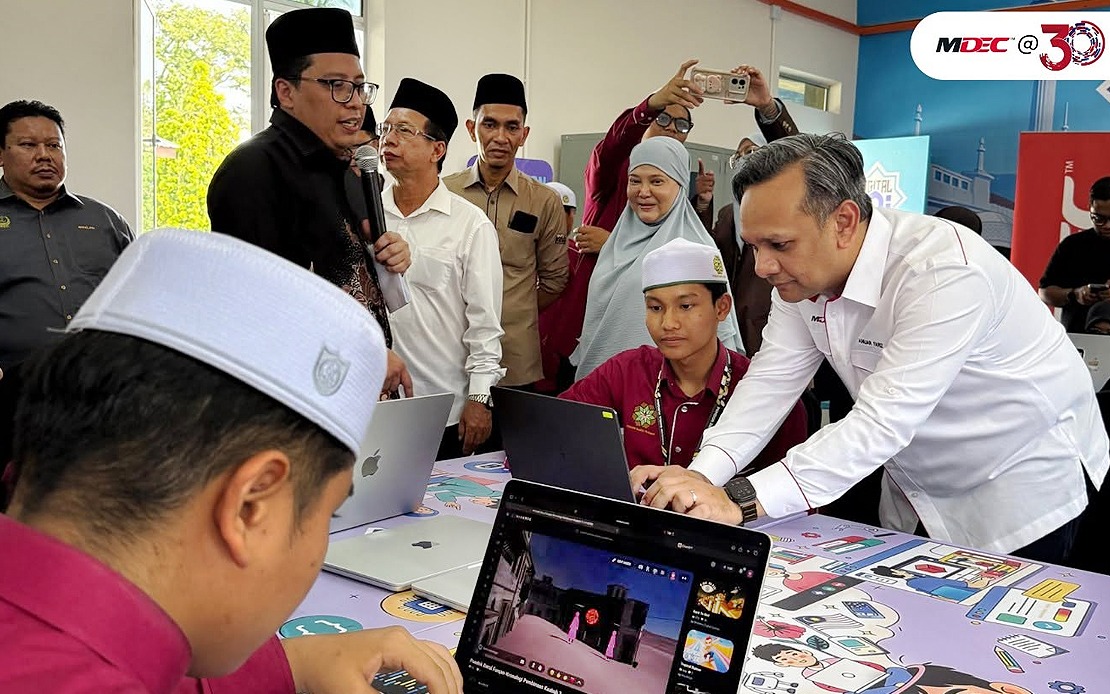
The Malaysia Digital Economy Corporation (MDEC) has formally inaugurated a Digital Maker Hub at Pondok Darul Furqan in Tambun, Ipoh, marking an important step in expanding technological literacy among students and educators within Malaysia's Islamic education sector. The initiative represents a deliberate effort to bridge the digital divide within institutions that have traditionally operated outside mainstream technology adoption frameworks, ensuring that faith-based learning environments keep pace with the broader national digital transformation agenda.
MDEC chief executive officer Anuar Fariz Fadzil describes the hub as a sophisticated interactive learning environment featuring a comprehensive suite of equipment designed for hands-on engagement with emerging technologies. The facility incorporates laptops, high-speed internet access, interactive smartboards, robotics engineering kits, microcontroller platforms, and supplementary tools that enable students and teachers to move beyond theoretical understanding into practical experimentation. This shift from passive consumption to active creation addresses a critical gap in technical skill development within Islamic institutions, where resource constraints have historically limited exposure to cutting-edge technology.
The Digital Maker Hub operates as the physical manifestation of the Islamic Education Institution Digital Transformation Programme, commonly known as Digital IPI, a collaborative undertaking between MDEC and the Department of Islamic Development Malaysia (JAKIM). This partnership reflects recognition at the highest levels of government that Islamic education institutions represent a substantial constituency deserving direct inclusion in Malaysia's digital economy building efforts. Rather than treating religious schools as peripheral to the digital agenda, the collaboration positions them as integral to achieving national technological ambitions.
The underlying rationale for this initiative extends beyond mere access to equipment. Malaysian policymakers have articulated an explicit national objective to establish the country as a leading AI nation by 2030, a goal that demands cultivating digital talent across all demographic segments and institutional types. Anuar Fariz Fadzil emphasizes that technological capability cannot remain concentrated in secular or urban institutions if Malaysia is to compete globally in AI-driven sectors. By distributing Digital Maker Hubs throughout the Islamic education ecosystem, authorities acknowledge that innovation and technological contribution must emerge from diverse sources, including communities traditionally underrepresented in tech sectors.
Beyond infrastructure provision, MDEC articulates a vision of cultural transformation within Islamic institutions. The objective involves reshaping teacher and student self-perception, moving from passive technology users to active technology creators capable of driving innovation within Malaysia's digital economy. This reframing carries psychological and social significance, as it challenges potential stereotypes about Islamic education and technology compatibility while simultaneously signaling to students within these institutions that technology careers and leadership roles represent viable pathways.
The inaugural cohort at Pondok Darul Furqan participated in a specialized two-day MetaSkool Metaverse Programme, wherein 30 students and five teachers underwent immersive training introducing metaverse technologies through experiential learning methodologies. Rather than delivering content through traditional lectures, the programme emphasized hands-on exploration and creative application, encouraging participants to experiment with virtual environments and collaborative digital spaces. This pedagogical approach mirrors contemporary best practices in technology education globally, demonstrating that Islamic institutions are accessing internationally current training methodologies.
The pilot phase encompasses five additional selected Islamic education institutions distributed strategically across Kedah, Kelantan, Negeri Sembilan, Pahang, and Penang, indicating that the initiative extends beyond Ipoh and represents a nationwide rollout strategy. This geographic distribution ensures that digital transformation reaches Islamic institutions in both Peninsular Malaysia's northern and eastern regions, acknowledging that technological disparities often align with geographic boundaries.
Prime Minister Datuk Seri Anwar Ibrahim officially launched Digital IPI in March, signifying the programme's status as a government priority rather than a marginal initiative. The projected scope is substantial, with expectations that more than 3,000 students and 50 teachers will benefit through structured training modules addressing digital literacy, artificial intelligence fundamentals, digital creative expression, immersive learning technologies, metaverse applications, and digital content production. This comprehensive curriculum reflects evolving understandings of what digital literacy entails in contemporary economies, extending beyond basic computer skills to encompass emerging technologies reshaping professional and creative landscapes.
The programme's design deliberately integrates religious education principles with technological training, avoiding the potential false dichotomy between faith-based learning and technical advancement. By embedding values such as trustworthiness alongside technological instruction, the initiative presents technology as a domain where Islamic ethical frameworks remain applicable and relevant. This integration proves particularly significant in Southeast Asia, where questions about technology's relationship to cultural and religious values generate substantial community discourse.
For Malaysian policymakers, the Digital IPI programme and its infrastructure components address multiple policy objectives simultaneously. It demonstrates commitment to inclusive digital development, supports the broader AI nation agenda, expands the potential talent pipeline for technology sectors, and reinforces the compatibility between Islamic education and technological innovation. Islamic institutions themselves gain tangible resources and training previously unavailable, potentially shifting educational outcomes and student aspirations.
The initiative carries implications extending beyond Malaysia's borders. Other Southeast Asian nations with substantial Islamic education sectors may observe this model as evidence that technology integration and religious education need not remain separate domains. As digital economy competition intensifies regionally, any nation failing to leverage all available human capital and institutional infrastructure risks falling behind peers who comprehensively mobilize their entire educational ecosystem.
The Digital Maker Hubs ultimately represent more than physical spaces containing equipment. They function as symbolic and practical anchors demonstrating that technology adoption in Malaysia encompasses religious institutions, that Islamic educators and students deserve direct inclusion in digital transformation efforts, and that national economic competitiveness increasingly depends on ensuring no communities remain disconnected from technological opportunity and innovation.

