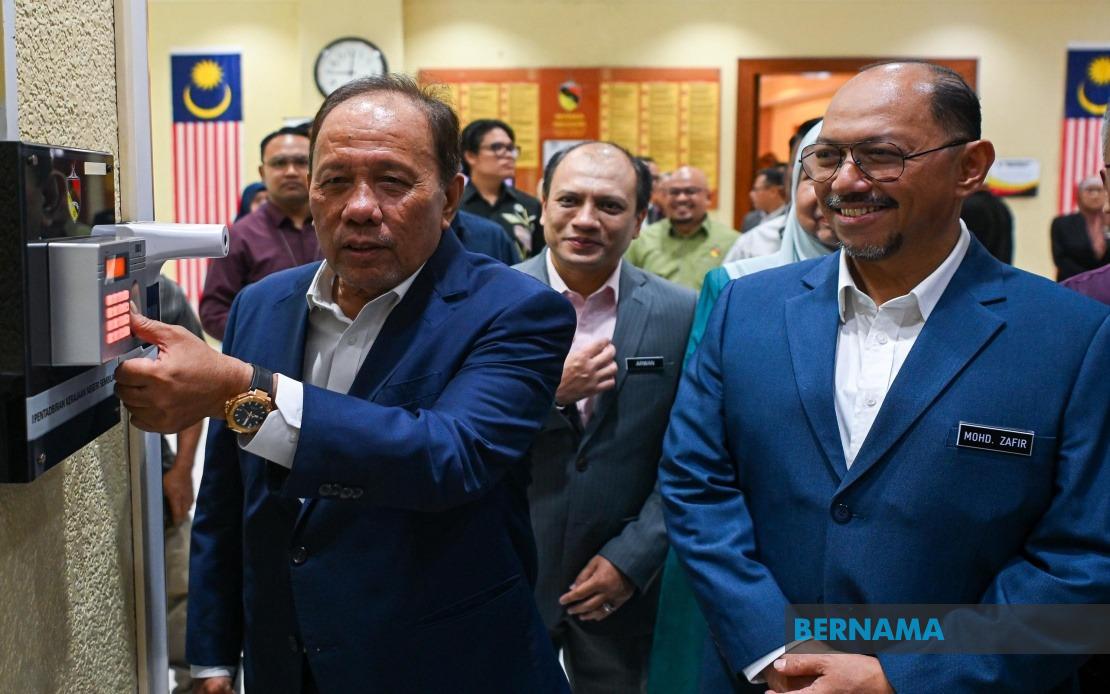
Datuk Ismail Lasim, the newly appointed Menteri Besar of Negeri Sembilan, moved swiftly to defend the legitimacy of his appointment on August 4, asserting that the selection process adhered strictly to established constitutional and administrative procedures. Speaking from Wisma Negeri in Seremban, Ismail expressed confidence that his elevation to the position had been conducted according to prescribed protocols, offering reassurance at a moment when questions about the appointment had surfaced in public discourse.
The timing of Ismail's statement proved significant, coming in direct response to public remarks made by Tan Sri Rais Yatim, chairman of the Wawasan movement, who had raised concerns regarding the methodology employed in selecting Negeri Sembilan's chief executive. Rais Yatim had specifically flagged potential external influence in decisions affecting the state's constitutional and customary frameworks, allegations that struck at the heart of state autonomy and proper governance structures.
Ismail, who secured the Juasseh state assembly seat during the most recent Negeri Sembilan state election, had been formally sworn in before Yang Dipertuan Besar Tuanku Muhriz Tuanku Munawir at Istana Besar Seri Menanti the preceding Sunday. This ceremonial investiture, conducted before the state's traditional ruler, traditionally carries profound symbolic weight in Malaysian federalism, where sultans retain constitutional authority over such matters in their respective states.
The electoral landscape that preceded Ismail's appointment reflected a decisive outcome in Negeri Sembilan's political contest. Barisan Nasional captured 18 of the 36 state assembly seats, a commanding position that nonetheless required coalition support to govern effectively. Perikatan Nasional secured seven seats, a substantially smaller allocation that underscored the dominant coalition's clear majority. Together, these results granted BN a comfortable two-thirds supermajority, providing substantial latitude in legislative affairs and constitutional matters.
The controversy surrounding Ismail's appointment, however, touched on deeper structural anxieties within Malaysia's political system. Questions about external interference in state-level appointments resonate beyond Negeri Sembilan, reflecting ongoing tensions between federal oversight and state autonomy that have periodically surfaced in Malaysian politics. For readers across Southeast Asia observing Malaysian governance patterns, such disputes often illuminate the region's broader concerns about the appropriate boundaries between different levels of administration and the potential for centralized power to encroach upon provincial prerogatives.
Ismail's defence warrants particular attention given Malaysia's constitutional arrangement, wherein state rulers retain genuine executive authority over appointments to chief executive positions within their respective domains. The involvement of Tuanku Muhriz in the formal appointment process thus represented a constitutionally significant moment, one that theoretically insulates the decision from purely partisan considerations and grounds it in traditional authority structures.
The emergence of Rais Yatim as a critical voice in this controversy introduced an additional complexity. As chairman of Wawasan, Rais Yatim occupies a position that commands respect across Malaysia's political spectrum, his criticisms potentially carrying considerable weight among observers concerned with procedural propriety. His specific allegations concerning external interference suggested not merely technical objections but fundamental questions about whether the appointment reflected genuine state-level decision-making or instead represented imposition from external quarters.
For Malaysian governance analysts and regional observers, the Negeri Sembilan situation encapsulates recurring tensions within the country's federal structure. The interplay between traditional authority vested in state rulers, electoral outcomes that produce political coalitions, and concerns about procedural integrity reflects the complexity inherent in Malaysia's hybrid constitutional arrangement. These dynamics become particularly significant in smaller states like Negeri Sembilan, where electoral margins, though substantial in absolute terms, nonetheless represent concentrated influence susceptible to coalition dynamics.
Ismail's assertion of procedural compliance carries implications beyond mere self-defence. By specifically invoking adherence to prescribed protocols and constitutional procedures, he sought to position his appointment within the legitimate framework of Malaysian governance, anchoring his legitimacy not merely in electoral outcomes but in constitutional propriety. This rhetorical strategy reflects awareness that in Malaysian politics, where institutions carry considerable symbolic importance, the perception of proper procedure often matters as profoundly as the substantive outcomes such procedures generate.
Moving forward, the resolution of these concerns will likely depend partly on the transparency with which the appointment process is ultimately documented and explained to relevant stakeholders. Negeri Sembilan's political establishment and Malaysian observers more broadly will presumably monitor whether additional clarification emerges regarding the specific procedures followed and the roles performed by various actors—whether sultanic authorities, political party structures, or other institutional players—in reaching the final decision.

