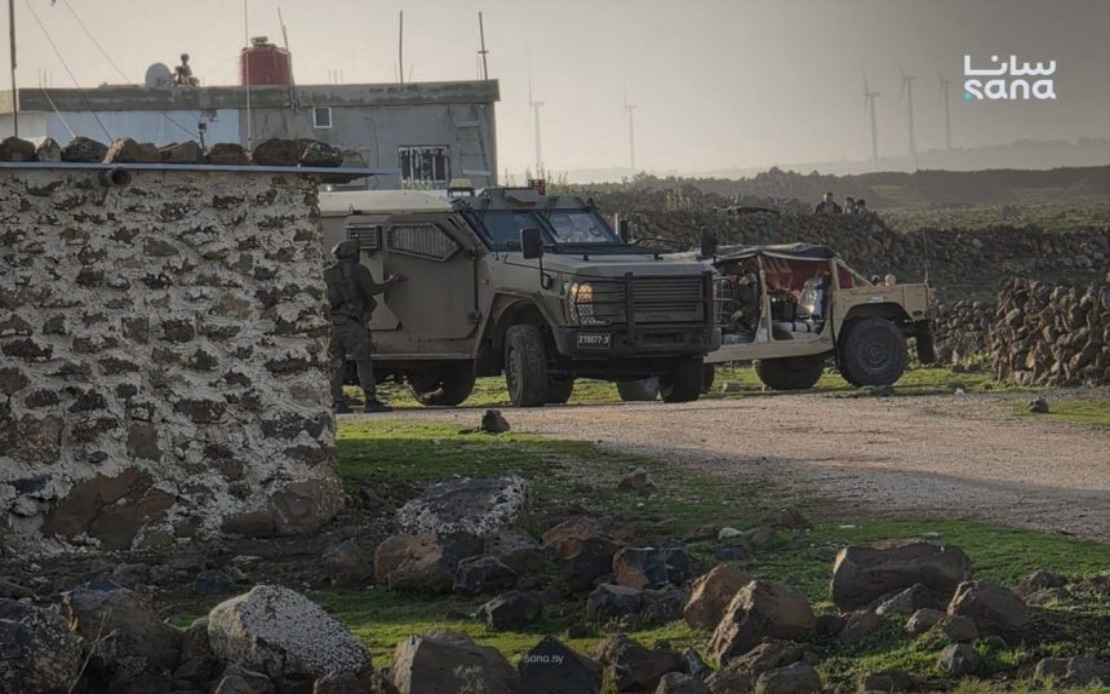
Six Israeli military vehicles penetrated Syria's southwestern Quneitra province on Saturday in what Syrian Arab News Agency (SANA) characterized as an armed incursion, reflecting the dramatic shift in security dynamics across the Levantine border region following political upheaval in Damascus. The vehicles reportedly moved toward the Kudna Dam in central Quneitra while unmanned aircraft circled overhead, conducting what appeared to be reconnaissance operations in an increasingly volatile territory.
The Saturday operation represents merely the latest chapter in a sequence of Israeli military activities that have fundamentally altered the security landscape of southern Syria. Since the December 2024 collapse of Bashar al-Assad's authoritarian regime, Israel has significantly expanded its operational footprint across previously restricted areas, moving beyond the limited military activities that characterized the decades-long ceasefire arrangement. The Israeli government formally repudiated the 1974 disengagement agreement—a cornerstone of regional stability for fifty years—and moved to consolidate control over the Syrian buffer zone that had been demilitarized since the Cold War era.
For several months preceding and following Assad's downfall, southern Syrian regions have experienced an escalating pattern of Israeli military engagement that extends well beyond isolated incidents. Raids have become routine occurrences, accompanied by systematic ground searches of villages and populated areas. Israeli forces have conducted arrests of individuals deemed security threats, effectively establishing military checkpoints throughout the region that functionally restrict movement and assert de facto territorial control. These operations suggest a coordinated strategy rather than reactive responses to immediate security concerns.
The intensification of Israeli activities directly correlates with the geopolitical vacuum created by Assad's departure. For decades, the Assad regime maintained an iron grip over southern Syria despite the formal ceasefire, preventing armed groups from using the territory for attacks against Israel while simultaneously resisting Israeli military expansion. That balance, however precarious, has now evaporated entirely. With Syria's new transitional authorities still consolidating power and struggling to establish effective governance across liberated territories, the country possesses neither the military capacity nor the political authority to resist Israeli operations along the frontier.
From a regional perspective, these developments carry profound implications for the broader Middle Eastern security architecture. The Quneitra region sits at the intersection of Syrian, Israeli, and Lebanese territories, making it strategically crucial for understanding emerging power dynamics. Israeli expansion into this zone signals confidence in their military superiority and a willingness to unilaterally reshape the post-Assad settlement without international mediation. This approach contrasts sharply with the negotiated frameworks that typically govern disputed border territories in other regions.
For Malaysia and Southeast Asian nations with interests in Middle Eastern stability, the situation underscores how rapidly geopolitical equations can shift when authoritarian regimes collapse without clear transition mechanisms. The Assad regime's fall was neither negotiated nor managed through international institutions, creating space for military actors to pursue unilateral advantage. This pattern mirrors concerns across Asia regarding how power vacuums following regime change can enable external military intervention and destabilize established international agreements.
The Syrian government's formal renunciation of the 1974 disengagement agreement carries legal and historical significance that extends beyond bilateral Israeli-Syrian relations. That accord, brokered by the United States following the 1973 war, represented one of the Middle East's most durable conflict management mechanisms. Its collapse signals that post-conflict agreements, however longstanding, remain vulnerable to unilateral rejection when governments change. For Southeast Asian states that have invested heavily in international legal frameworks and conflict resolution mechanisms, this precedent carries cautionary implications.
The presence of drones during Saturday's incursion indicates sophisticated surveillance and reconnaissance capabilities deployed by Israeli forces to monitor Syrian territory comprehensively. This technological asymmetry effectively eliminates Syrian capacity to prevent or even accurately track Israeli military movements, reinforcing the power imbalance along the border. The combination of ground forces and aerial surveillance suggests coordinated operations designed to establish persistent military presence rather than conduct temporary raids.
Observers monitoring the Syrian situation recognize that the current pattern likely represents an early phase of what could become permanent Israeli military restructuring of southern Syria. Each incursion, arrest, and checkpoint establishes facts on the ground that become increasingly difficult to reverse diplomatically. Without significant external pressure or a dramatic reversal of Syrian political circumstances, the trajectory points toward deeper Israeli military entrenchment across the buffer zone and surrounding territories. The international community's limited response thus far suggests that Israel faces minimal diplomatic costs for these violations of Syrian sovereignty.

