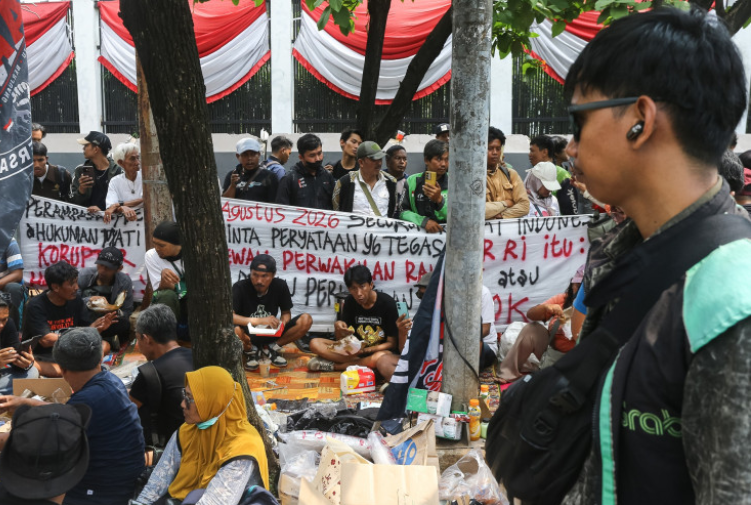
Demonstrators from across Indonesia converged on the Senayan Legislative Complex in Jakarta on Thursday morning, their placards and speeches reflecting mounting public frustration with corruption and economic hardship. The multifaceted protest saw participants pushing several interconnected demands: accelerated passage of the asset forfeiture bill, implementation of capital punishment for high-ranking corrupt officials, and government action to reduce prices on essential goods. The scale and timing of the demonstration underscored deepening public impatience with the pace of anti-corruption reform, even as newly elected President Prabowo Subianto has positioned himself as a champion of clean governance.
A significant contingent of the protesters originated from Pati in Central Java, organised under the United Pati People's Alliance (AMPB), which had been methodically mobilising supporters and coordinating transportation to the capital since the previous week. The group's ability to marshal resources and rally disparate constituencies illustrated how anti-corruption messaging continues to resonate powerfully across Indonesian communities, transcending geographic and demographic boundaries. AMPB coordinator Supriyono publicly revealed that his organisation had received sufficient public donations to fund five additional buses beyond those initially planned, a testament to grassroots momentum building around the asset forfeiture issue.
The state's response to the mobilisation revealed underlying tensions between enabling democratic participation and maintaining security control. Police temporarily halted several buses transporting protesters before they reached Jakarta, a preventive measure that some viewed as heavy-handed. More controversially, state-owned Bank Mandiri froze the bank account belonging to AMPB coordinator Supriyono, an action that triggered swift public backlash and sparked calls for a consumer boycott of the institution. These interventions seemed designed to discourage participation, yet paradoxically may have amplified the protesters' narrative that establishment institutions obstruct anti-corruption efforts.
Authorities nonetheless proceeded with comprehensive security measures aimed at managing the demonstration while minimising disruption to normal city operations. Jakarta Police implemented significant traffic diversions across central zones, including closure of both lanes on Jl. Gatot Subroto from Senayan Park extending to the legislative complex entrance. Senior police spokesperson Sr. Comr. Budi Hermanto projected initial participation at roughly 500 individuals, though acknowledged the likelihood of additional arrivals from organisations outside Pati throughout the day. Dozens of uniformed and plainclothes security personnel positioned themselves strategically throughout the area, though police maintained they were committed to permitting peaceful assembly while safeguarding public infrastructure and commercial activity.
The asset forfeiture bill at the centre of Thursday's demands represents a long-stalled legislative initiative with a fraught history in Indonesian politics. Originally proposed in 2008 but repeatedly derailed through subsequent years, the legislation would fundamentally alter how the state pursues financial crimes by enabling asset seizure based on suspicion or preliminary findings of criminal origin, completely circumventing the requirement for prior conviction. This radical departure from traditional criminal procedure reflects broader global trends toward aggressive financial investigation, yet carries substantial risks. Legal experts and civil liberties advocates have cautioned that such expansive forfeiture authority could readily transform into a mechanism for political persecution, weaponised against opposition figures, or facilitate extortion by unscrupulous officials.
The House of Representatives commenced formal deliberations on the bill in January of this year, signalling elevated priority status within the legislative agenda. When Pati residents visited the Senayan complex on Monday to present their demands, parliamentary officials responded with commitments to expedite the process, publicly assuring protesters that passage would occur by December at the latest. Gerindra Party lawmaker Habiburokhman, who chairs House Commission III responsible for legal and judicial affairs, quantified the outstanding work, estimating that approximately eight weeks of additional committee deliberations remained before the bill could advance toward a floor vote.
President Prabowo Subianto's administration has actively signalled its backing for rapid legislative movement on asset forfeiture, positioning the initiative as a cornerstone of its anti-corruption platform. Government Communications Agency director Muhammad Qodari articulated this support through characteristically diplomatic language, framing the situation by stating that responsibility for further progress now rests with the House, effectively placing public pressure squarely on parliamentarians. This rhetorical move served dual purposes: demonstrating executive commitment to reform while simultaneously positioning the presidency as responsive to popular demands, a politically astute positioning ahead of subsequent budget and legislative battles.
The convergence of these political forces—grassroots mobilisation, executive backing, and parliamentary momentum—creates a compelling legislative environment for the bill's passage, yet questions persist regarding implementation mechanics and safeguards. Malaysia and other Southeast Asian nations monitoring Indonesia's approach to asset forfeiture will likely observe how Indonesian lawmakers address civil liberties protections, judicial oversight mechanisms, and procedural guarantees against abuse. The outcome carries implications extending beyond Indonesia, potentially influencing regional attitudes toward aggressive financial investigation and asset recovery in corruption cases.
Thursday's demonstration reflected broader Indonesian societal dynamics wherein anti-corruption sentiment commands near-universal rhetorical support across the political spectrum, yet implementation details generate substantive controversy. The protesters' other demands—capital punishment for corrupt officials and price reductions for essentials—highlighted how graft narratives intertwine with economic grievance in public consciousness. For policymakers and observers across Southeast Asia, Indonesia's struggle to balance enforcement vigour against civil liberties protections offers crucial lessons about navigating corruption-fighting measures that maintain democratic legitimacy and legal safeguards.

