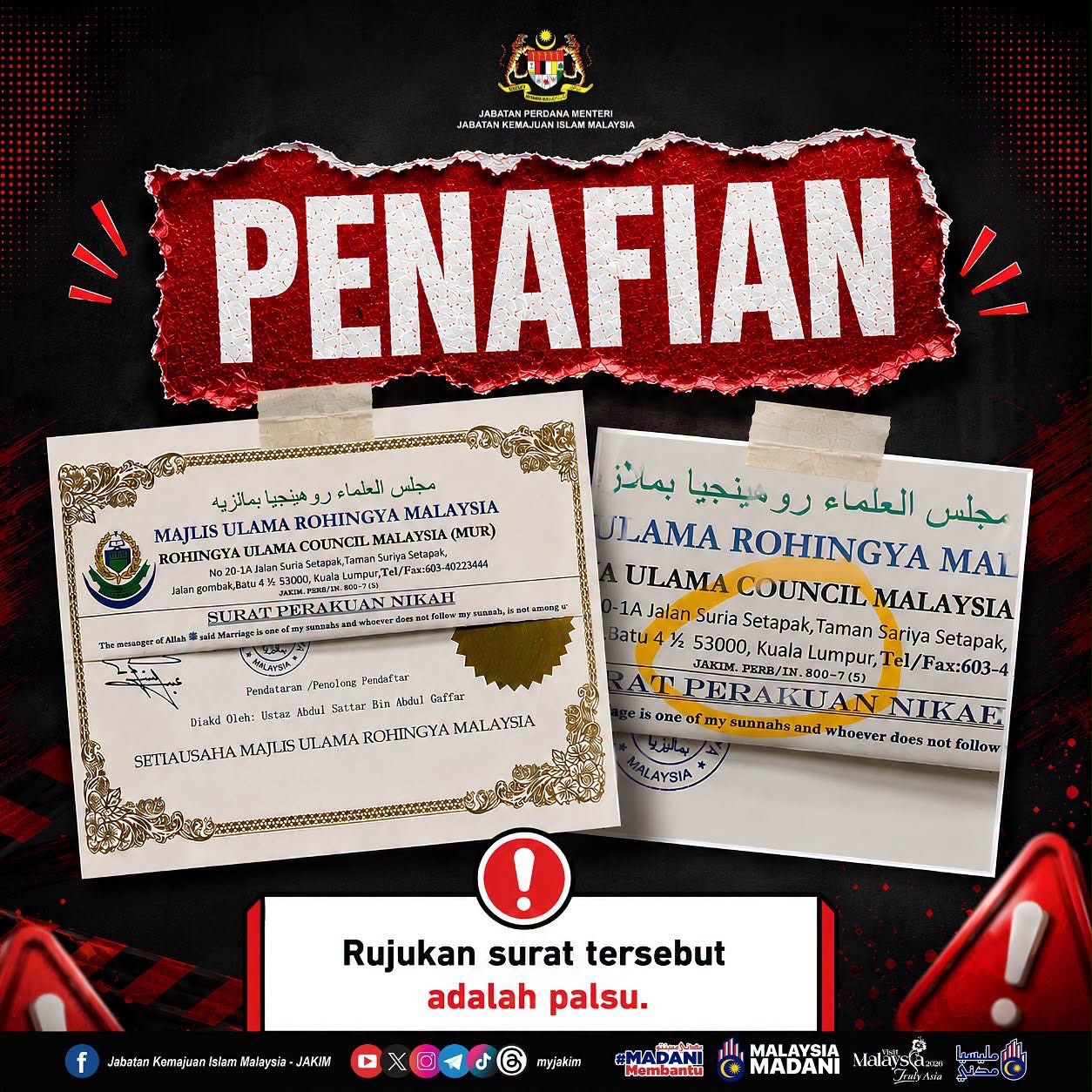
Malaysia's Department of Islamic Development (JAKIM) has issued a clear warning to the public following the circulation of a fraudulent document on social media that falsely claims institutional backing for handling marriage-related matters. The agency confirmed on July 15 through its official Facebook platform that the reference number appearing on the letter—JAKIM.PERH/LN.800-7(5)—is entirely fabricated and was never issued by any legitimate Islamic authority in the country.
The bogus document had attributed its purported authority to the Malaysia Rohingya Ulama Council, an organisation that JAKIM explicitly stated it has never formally appointed or recognised to manage, certify, or administer any marriage-related functions. This distinction is crucial in Malaysia's religious governance structure, where Islamic affairs fall under the jurisdiction of both federal and state authorities, each with clearly defined responsibilities and formal approval processes. The fraudulent letter represents a significant breach of trust and an attempt to exploit Malaysia's formalised system of Islamic administration for potentially deceptive purposes.
The spread of this forged document raises serious concerns about document fraud and the potential for individuals to be misled into believing that marriages or related matters have received official Islamic sanction when they have not. In Malaysia's context, where marriage is governed by specific religious and civil laws, the authentication of marriage-related documentation is not a matter of minor administrative concern but rather a fundamental legal and religious question affecting the validity and legitimacy of matrimonial arrangements. The sophistication of the fake reference number—crafted to resemble genuine JAKIM formatting—suggests a deliberate attempt to deceive rather than an innocent misunderstanding.
JAKIM's statement emphasised that neither the federal department nor any of Malaysia's state Islamic religious councils and departments had participated in appointing or recognising the entity behind the fraudulent correspondence. This clarification underscores the strict protocols governing Islamic administration in Malaysia, where institutional recognition requires formal processes and documentation traceable through official channels. The widespread circulation of the forged letter on social media platforms demonstrates how quickly misinformation can propagate in the digital age, potentially affecting numerous individuals before authorities can effectively counter the narrative.
Minister in the Prime Minister's Department (Religious Affairs) Dr Zulkifli Hasan subsequently indicated that a formal investigation would be launched into the matter once complete information was compiled. This commitment to investigative action signals the seriousness with which Malaysia's government views the fraud, particularly given the potential for organised document falsification rings to exploit religious authority for commercial or criminal gain. The investigation will likely examine how the fraudulent document was created, who distributed it initially, and whether there are connected schemes attempting to exploit the fake letter for financial or other illicit purposes.
The incident highlights a vulnerability in public trust and verification mechanisms surrounding religious documentation in Malaysia. While JAKIM and state Islamic authorities maintain official databases and verification systems, the accessibility of these resources to ordinary citizens remains inconsistent, and awareness of proper verification procedures is not universally widespread. Many Malaysians may not know the correct channels or procedures for authenticating Islamic religious documents, making them potential targets for fraud. This knowledge gap represents both a security risk and an opportunity for enhanced public education initiatives.
The timing and target of this particular fraud—a document purporting to relate to marriage arrangements for a specific ethnic and religious community—suggests a targeted deception strategy potentially exploiting vulnerabilities in how certain communities access or verify religious services. The Malaysia Rohingya Ulama Council's prominence in discussions regarding Rohingya affairs may have made it a convincing reference point for fraudsters seeking to lend credibility to their fabrication. The exploitation of immigration-related and community-specific matters adds another dimension of concern, as such vulnerabilities can be systematically targeted for multiple fraudulent schemes.
JAKIM's public advisement to citizens to verify all questionable religious documents through official channels represents a necessary defensive measure, but the underlying problem demands more proactive solutions. These could include enhanced digital verification systems, clearer public awareness campaigns about document authentication procedures, and coordinated efforts across state Islamic authorities to standardise verification protocols. The department's Facebook announcement, while reaching digitally active segments of the population, may not effectively communicate with all demographic groups who could potentially be affected by similar frauds.
The broader implications for Malaysia's Islamic governance and institutional credibility extend beyond this single incident. As religious services increasingly intersect with digital platforms and informal networks, the risk of sophisticated document fraud will likely increase. Malaysia's regulatory framework for Islamic affairs must evolve to address these emerging security challenges while maintaining accessibility for legitimate users. This incident serves as a cautionary tale about the necessity of robust institutional safeguards and public awareness in protecting the integrity of Malaysia's religious administration systems, particularly as fraudsters become more sophisticated in their methods and targeting strategies.

