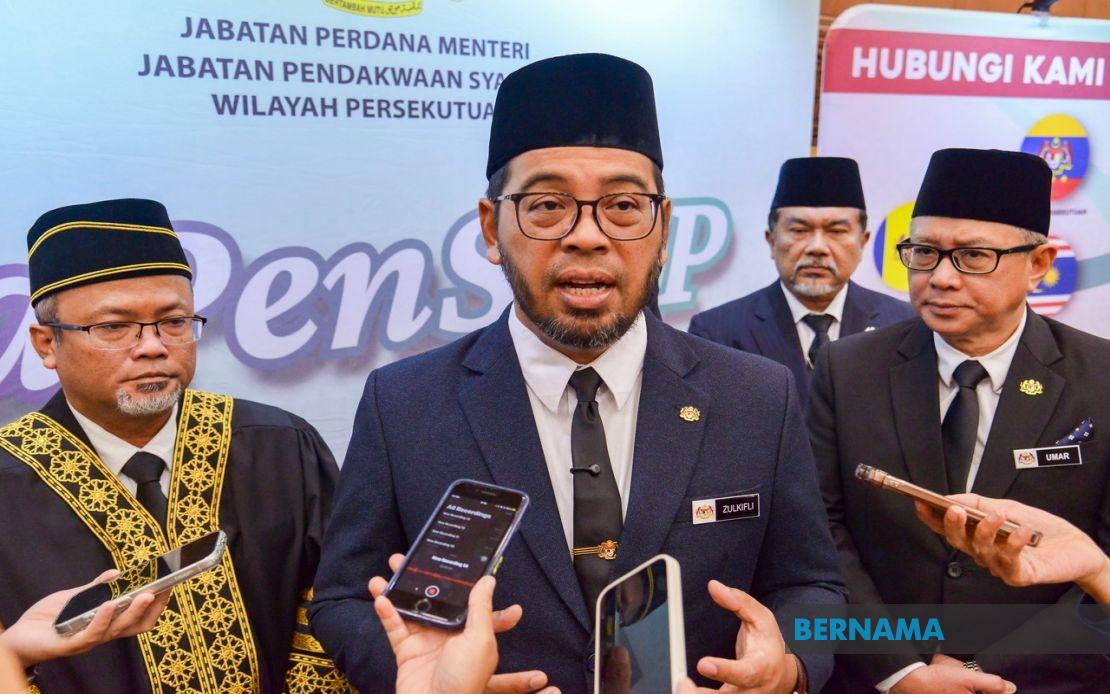
The Prime Minister's Department (Religious Affairs) has initiated a formal investigation into allegations that an official JAKIM reference number was improperly cited on marriage declaration letters distributed by the Malaysia Rohingya Ulama Council. The development emerged on July 15 when minister Dr Zulkifli Hasan disclosed that authorities had become aware of the documents circulating widely across social media platforms, but acknowledged that comprehensive details remained outstanding. This announcement came during his address at the second Malaysian Syariah Prosecutors Conference (PePSSM) 2026 in Putrajaya.
The disputed document carried the reference designation "JAKIM.PERH/LN.800-7(5)", which sparked immediate questions about whether the document carried legitimate institutional backing. The circulation of these marriage declaration letters raises significant concerns about potential document fraud and the unauthorised use of government reference numbers to confer false legitimacy on unofficial instruments. Such misrepresentation could undermine public confidence in genuine JAKIM documentation and create confusion among the Rohingya community regarding valid marital arrangements recognised by Malaysian authorities.
State-level religious authorities have already cast doubt on the document's validity. The Perak Islamic Religious Department (JAIPk) explicitly stated that it does not recognise the marriage declaration letter as a legitimate record. Beyond questions of authenticity, state religious departments have clarified that marriages involving Rohingya individuals cannot be registered through existing channels, as the matter touches on policy considerations currently under review by state governments. This regulatory gap highlights the complexity of managing legal recognition for asylum communities whose status remains in flux under Malaysian law.
The investigation underscores broader concerns about the Rohingya community's access to formal legal structures for personal status matters. Marriage recognition carries profound implications for inheritance rights, child custody, and other civil matters fundamental to family security. Without proper documentation verified through official channels, Rohingya families operating in Malaysia face significant vulnerability, particularly regarding spousal claims and succession matters. The distinction between informal community declarations and state-recognised marriages becomes critical when disputes arise or when individuals need legal proof of marital status.
Parallel to the marriage document inquiry, Zulkifli raised concerns about unaccredited religious lectures proliferating on social media platforms without proper oversight. He emphasised that while his department works to ensure speakers appearing on government-related broadcasts hold appropriate credentials, the broader regulatory responsibility rests with state governments, which hold constitutional authority over religious teaching accreditation and licensing of qualified instructors. This jurisdictional division reflects Malaysia's federal structure, where religious matters are primarily state competencies, yet the digital age creates enforcement challenges that traditional regulatory frameworks struggle to address.
The minister acknowledged the government was actively examining approaches to tackle unaccredited religious instruction online, though he cautioned that any enforcement mechanism must carefully navigate legal considerations. The challenge extends beyond mere accreditation verification—it involves balancing religious freedom with public protection against potentially misleading or unqualified teachings disseminated through platforms beyond traditional oversight mechanisms. Religious enforcement officers (PPA) increasingly report difficulties preventing such activities, suggesting current legislative tools may be inadequate for digital-age realities.
In his substantive remarks to prosecutors, Zulkifli articulated the government's commitment to strengthening Syariah law frameworks to address contemporary challenges, particularly those arising from cyber-related offences and digital platforms. He emphasised that effective prosecution requires enhanced inter-agency coordination among JAKIM, the Malaysian Communications and Multimedia Commission (MCMC), the Royal Malaysian Police (PDRM), and the Attorney General's Chambers. This multi-agency approach reflects recognition that religious law enforcement increasingly intersects with cybercrime investigation, requiring institutional collaboration across traditionally separate portfolios.
The minister further stressed that modern Syariah prosecutors must develop sophisticated capabilities in digital forensics, data analysis, and technology expertise to effectively investigate and prosecute increasingly complex offences. These skills become essential when addressing document forgery claims like those surrounding the marriage references, as verifying authenticity requires technical competency beyond traditional legal training. The emphasis on prosecutor capability development signals institutional acknowledgment that religious law enforcement has fundamentally transformed in the digital era.
For Malaysian readers, these developments carry several practical implications. The investigation into the Rohingya marriage documents illustrates how vulnerable communities may become targets for fraudulent documentation schemes, whether through deliberate misuse of government references or informal systems lacking legal recognition. The concurrent discussion of unaccredited religious teaching highlights evolving tensions between digital communication freedoms and institutional quality control. State and federal authorities must develop coherent strategies addressing these gaps without unduly restricting legitimate religious expression or community organising.
The broader Southeast Asian context adds weight to these Malaysian developments. Across the region, irregular migrant communities and asylum seekers navigate complex legal landscapes where personal status documentation remains chronically uncertain. Malaysia's experience with Rohingya populations offers lessons—both cautionary and instructive—for neighbouring countries grappling with similar populations. The emphasis on prosecutorial capability-building and inter-agency coordination suggests recognition that modern religious law enforcement requires institutional sophistication matching the complexity of contemporary challenges.
Moving forward, authorities must balance several competing imperatives. Protecting vulnerable communities from fraudulent documentation requires robust investigation and prosecution capacity. Simultaneously, establishing legitimate pathways for community organisation and religious life remains important for social stability. The investigation itself, while necessary for addressing immediate concerns, also necessitates clear communication to affected communities about legitimate registration processes and documentation requirements. Without such clarity, confusion surrounding the marriage documents' status could persist, potentially driving further informal arrangements beyond regulatory oversight.

